



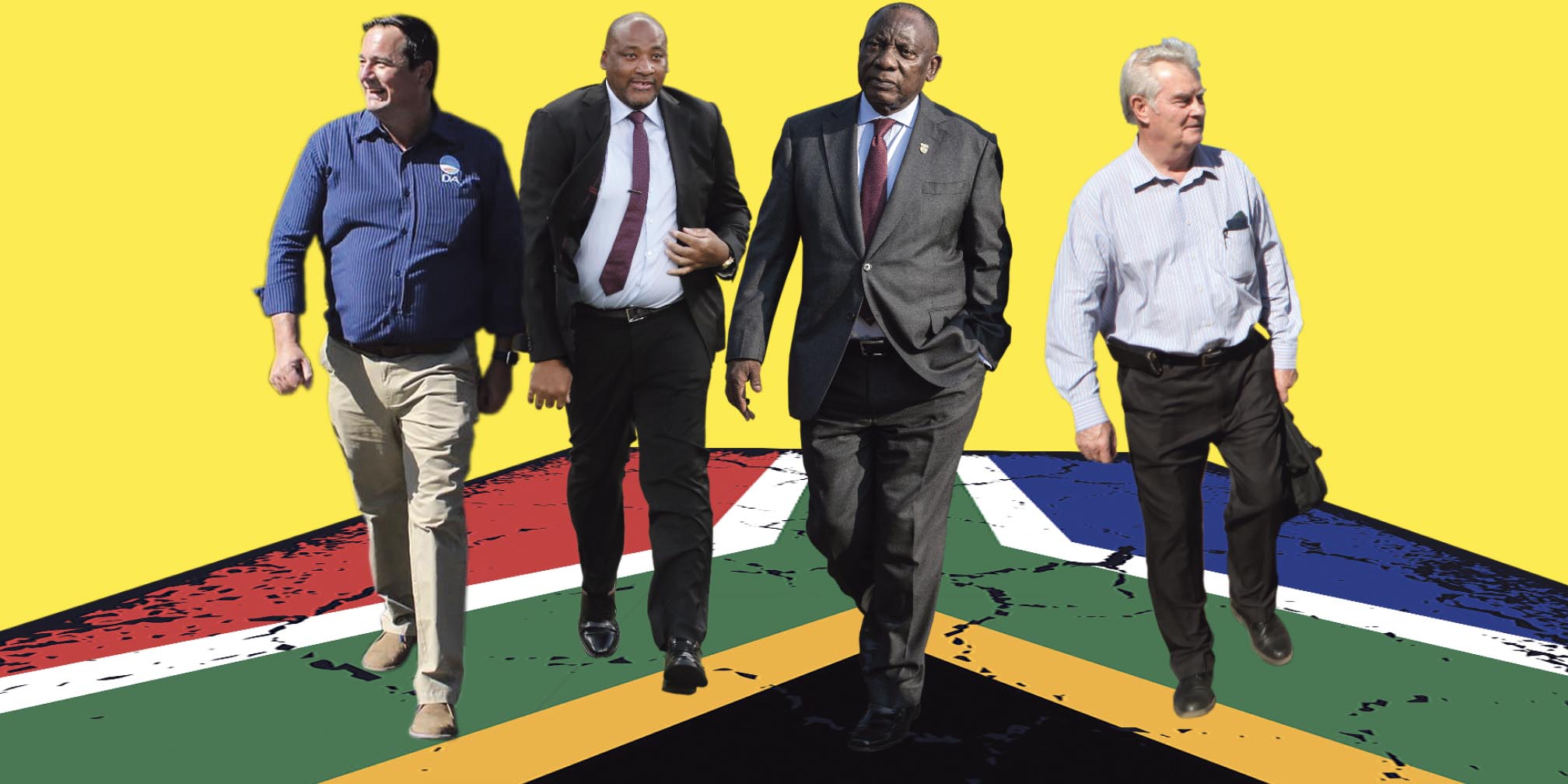
 Illustrative image. From left: Agriculture Minister John Steenhuisen; Patriotic Alliance leader Gayton McKenzie; President Cyril Ramaphosa; former Freedom Front Plus leader Pieter Groenewald. (Photos: Gallo Images / Getty Images)
 /file/dailymaverick/wp-content/uploads/2025/10/label-Op-Ed.jpg)
Nationalists who controlled political power in South Africa for 100 years from 1924 were eventually sent packing by voters in 2024. Voters realise that both Afrikaner and African nationalists, far from building a new, liberated and democratic SA, were perpetuating the colonial cheap labour economic policies of the British. They were also perpetuating unaccountable governance policies where Members of Parliament had no constituencies and were therefore flunkies of party leaders.
The challenge facing SA today is how to replace the neocolonial economic policies and quasi-democratic governance that were inherited from the British.
- The modern state of SA was created by the British.
- The mining-driven economy of SA was created by the British.
- The nationalist politics of SA of the past 100 years were a reaction to the British. Even the infamous policy of apartheid was first enunciated by the British in the five-volume South African Native Affairs Commission that sat from 1903 to 1905. With this commission the British wanted to find out how best to get African males to work regularly in their goldmines.
Two-hundred-and-ten years ago, on 9 March 1816, the British laid the foundation for Afrikaner nationalism when they executed five leaders of what came to be known as the Slagtersnek Rebellion. One of the leaders executed was the great uncle of President FW de Klerk.
One-hundred-and-twenty-four years ago on 31 May 1902 at the Peace of Vereeniging negotiations, the British laid the foundation for Black or African nationalism by agreeing that the future of the Cape Franchise would be decided by the Boer generals when they achieved responsible government.
/file/dailymaverick/wp-content/uploads/2025/07/6I1A0240.jpg "SA’s mining and minerals export economy, established by the British, is now moribund and cannot grow. (Photo: Felix Dlangamandla)")
My thesis is that the 150-year-old South African mining and minerals export economy established by the British is now moribund and therefore cannot grow – hence our high unemployment, poverty and inequality. Gold production, a central driver of the economy, started declining in the 1970s, as the following graph shows.

The rulers who tried to keep that moribund economy alive eventually got rejected by voters. That happened to the National Party (NP) in 1994, and to the African National Congress (ANC) in 2024. It might happen to the Democratic Alliance (DA) in 2029 if it continues as a member of the Government of National Unity with its current ANC policies. South African mining depends on a supply of cheap migrant labour and the use of extreme violence, as we saw at the Marikana massacre of platinum miners in 2012.
Our country’s main minerals are no longer demanded by the world economy. The phasing out of the internal combustion engine eliminates demand for platinum; synthetic diamonds have replaced demand for natural, mined diamonds; and coal is being phased out due to climate change challenges. Finally, our gold deposits have become too deep to mine economically.
The import substitution manufacturing industries built up during the heyday of mining – from its founding in the 1870s to the beginning of its decline in 1970 – are slowly dying due to lack of competitiveness. SA is thus becoming China’s economic appendage. We export minerals and food to China and import all types of manufactured products from China.
Way forward
How will SA be able to undertake the modernisation of its political and economic systems?
/file/dailymaverick/wp-content/uploads/2025/06/P6-Tori-GNU.jpg "The Government of National Unity with Chief Justice Raymond Zondo (centre). (Photo: Elmond Jiyane GCIS)")
Firstly, the country will have to restructure who controls political power. Political power today is controlled by a coalition of the black middle class, parts of organised labour and leaders of civil society. The objective of this coalition, as it does not own capital, is to consume state revenues rather than to promote investment in gross fixed capital formation. This coalition has now developed a vested interest in the perpetuation of the dying economic system it inherited in 1994. The ruling coalition benefits by using the tax system to fund hugely inflated salaries in the public sector.
Secondly, in order to industrialise beyond where it is today, SA therefore needs a new political coalition to control state power. This coalition must include the underclass who stand to benefit the most from the increased industrialisation of the economy. Industrialisation will overcome the economic exclusion of the underclass by creating employment opportunities for them.
/file/attachments/orphans/ED_5061241_832815.jpg "SA needs a new political coalition to control state power. (Photo: Gallo Images / Sharon Seretlo)")
/file/dailymaverick/wp-content/uploads/2025/07/fdclinic7.jpg "Modernising SA’s economy will involve updating the healthcare and education systems. (Photo: Felix Dlangamandla / Daily Maverick)")
This new coalition must also include owners of capital who stand to benefit from economic growth, but are presently disadvantaged by the current government’s policies that favour consumption and therefore promote low economic growth. The inclusion of owners of capital will also address their political marginalisation that happened after 1994.
The statement by Magda Wierzycka, CEO of Sygnia, (Sunday Times 22 February 2026) confirms the willingness of SA’s capitalists to invest in developing the country’s economy.
“We have the same intellectual capital in SA that is available in the EU or US. But unless someone takes deliberate action to support that intellectual capital with money, then all we are doing is we are exporting our best software engineers, and we’ll land up importing the systems that will actually drive our economy going forward.
“SA cannot be left behind. We cannot be in a state where we become even more dependent on the world for importing technology that we should be building ourselves.”
What to do to overcome SA’s shocking legacy of perennial unemployment and poverty
- Restructure the public service remuneration from the current 16% of GDP to 6% of GDP and introduce civil service entry examinations.
- Promote the urbanisation of the population of former Bantustans.
- Contribute to driving the industrialisation of southern and eastern Africa under the Africa Agenda 2063 and African Continental Free Trade Area (AcFTA) protocols.
- Revamp the SA National Defence Force by raising defence spending to 2% of GDP, and introduce national service.
- Strengthen democracy with the introduction of constituency elections for national and provincial Members of Parliament, and the direct election of the president and premiers.
- Update the healthcare and education systems to meet needs of a modern economy and drive entrepreneurship.
- Promote quality and affordable urban mass public housing.
- Promote the beneficiation of minerals in southern and eastern Africa and advance metal fabrication industries.
- Provide reliable and affordable electricity.
- Provide reliable and affordable transport for passengers and freight.
DM
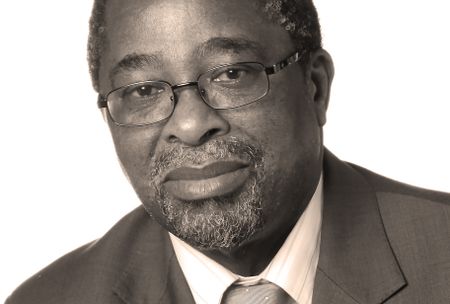
Moeletsi Mbeki is the Chairperson of the South African Institute of International Affairs, an independent think tank based at Wits University in Johannesburg.
Comments
Scroll down to load comments...