




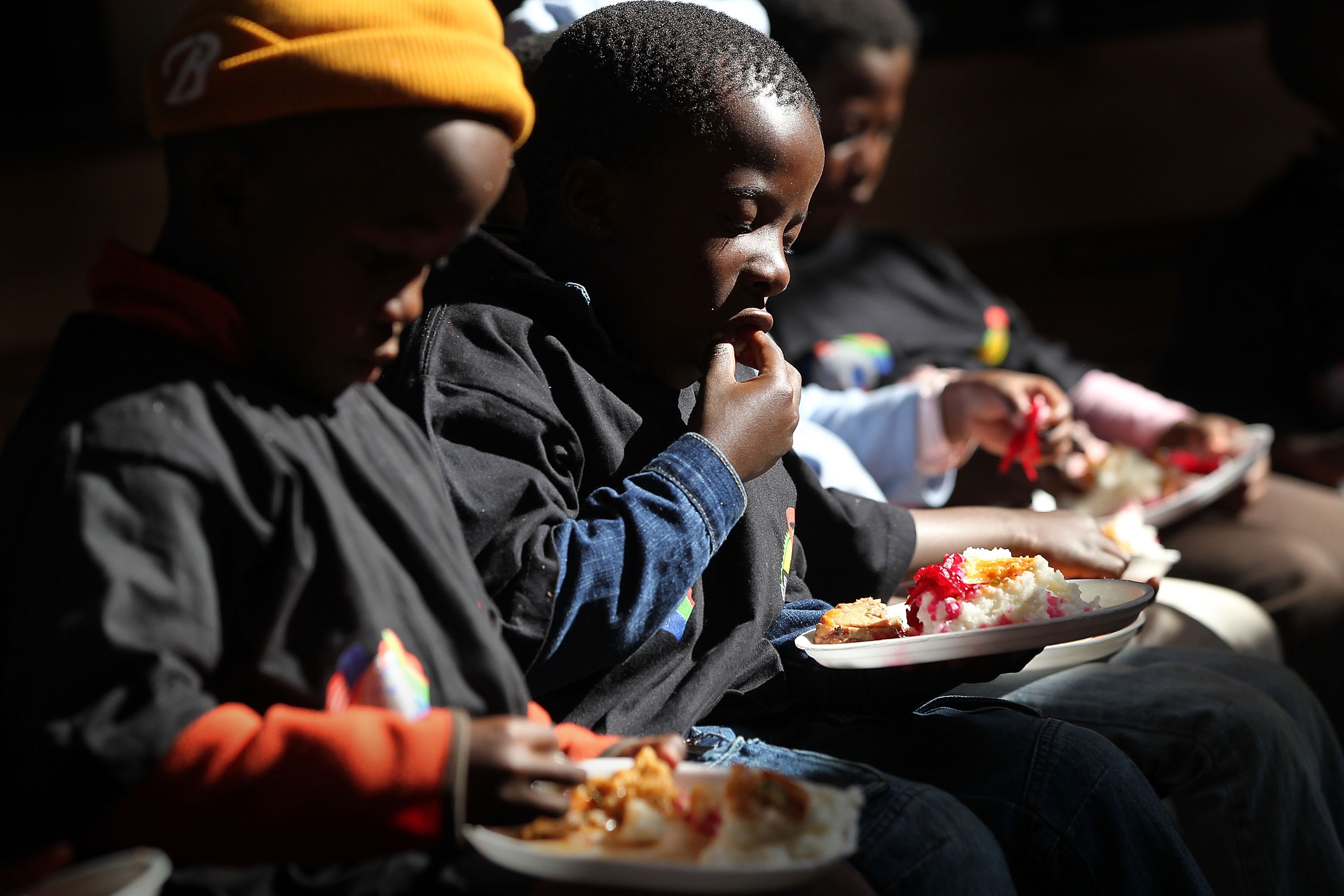
 R336-million was allocated for an early childhood development pilot nutrition programme between 2024 and 2025, but stakeholders report minimal action taken, risking the health of young children. (Photo: John Moore/Getty Images)
 The Department of Basic Education’s ring-fenced budget for a pilot nutrition programme for early childhood development (ECD) centres appears to have gone largely unused over a two-year period, despite an urgent need for food-based support in the sector.
The concerns around the implementation of the ECD nutrition pilot programme come at a time when the problem of hunger among young children is in the spotlight. At the South African Human Rights Commission’s national inquiry into South Africa’s food systems in March 2026, advocacy organisations made presentations about the urgent need for interventions aimed at addressing malnutrition and stunting in the early years.
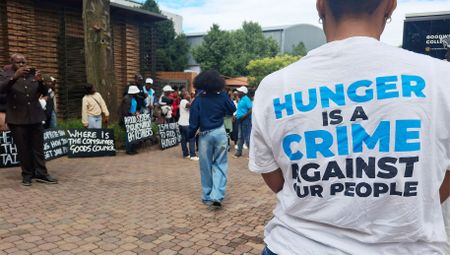
This follows the Cabinet’s approval of the National Strategy to Accelerate Action for Children at the end of 2025, a framework that aims to intensify efforts to advance the welfare and development of children and adolescents across South Africa. Among the national priorities under the strategy are the improvement of child nutrition and the boosting of early learning and brain power.
Funding for the pilot programme was first set aside in the 2024/25 budget, standing at R197-million. This was increased to R336-million in 2025/26, with the most recent allocation in the 2026/27 budget going up to R772-million, for use over the medium-term expenditure framework, according to Tshepo Mantjé, who is the early childhood development (ECD) coordinator with the Equality Collective and Real Reform for ECD.
“We have had this budget since 2024, and little to nothing has been done with that money since then,” he said.
“The time for talking about it is long gone, because young children are continuing to be stunted and malnourished, and, quite frankly, experiencing deaths from hunger and malnutrition due to the extreme poverty that is in this country… We have to mark the success of the DBE [Department of Basic Education] by what they do and not what they say. And money that is allocated to young children means nothing unless it reaches the young child.”
/file/attachments/orphans/Tamsin-ECD-nutrition3_205862.jpg "Tshepo Mantjé, an early childhood development (ECD) coordinator with the Equality Collective and Real Reform for ECD. (Photo: Felix Dlangamandla)")

Theodora Lutuli, owner and principal of Khanyisa Nursery and Inkwenkwezi Educare in Nyanga, Cape Town, said that while she had been aware of the high-level talks around an ECD nutrition programme, practitioners had yet to see any kind of practical implementation on the ground.
“It would make a vast difference, because remember that if a child is not fed properly… it will impact that child for their entire schooling [career]... Nutrition is critical, because you are making sure that you are not going to have challenges that could cause severe damage to this child, not only cognitively but developmentally,” she said.
/file/attachments/orphans/PHOTO2_543495_262310.jpg "Theodora Lutuli, owner and principal of Khanyisa Nursery and Inkwenkwezi Educare in Nyanga, Cape Town, on 22 January 2026. (Photo: Tamsin Metelerkamp)")
Two years of uncertainty
The existing ECD subsidy for registered centres was increased to R24 per child per day in 2025/26, with 40% of this amount earmarked for nutrition. This means practitioners have about R9.60 per child per day with which to provide two meals and a snack, said Mantjé.
“Anyone who is living in the South African economy will know that it is virtually impossible to feed anything meaningful for R9.60, but even more than the food, [this money] also goes into buying the pots and pans that prepares the food, so… the subsidy is grossly inadequate within the economic landscape that we are in South Africa, in terms of buying power,” he explained.
/file/dailymaverick/wp-content/uploads/MC-ChildNutrition_2.jpg "ECD practitioners have about R9.60 per child per day with which to provide two meals and a snack. (Photo by Gallo Images / Alet Pretorius)")
The reach of the subsidy is also limited. Data from 2022/23 showed that only 40% of centres in South Africa were registered, and of that 40%, only 33% were reported to be receiving the subsidy, said Mantjé.
“This is an opportunity for DBE to create a nutrition programme for ECD centres that can go beyond the subsidy and ensure adequate nutrition,” he said.
In August 2024, the Real Reform for ECD movement flagged an effort by the DBE to subsume the funds for the pilot nutrition programme under a ten-year, R10-billion-a-year National School Nutrition Programme (NSNP) “modernisation” tender.
“Real Reform for ECD and other civil society organisations raised concerns about this being a copy-paste of the NSNP model to the ECD sector. This would have been inappropriate, since the ECD sector landscape is fundamentally different from formal schooling… There's different sizes of kitchens, infrastructure and capacities, so more direct support would have been needed,” said Mantjé.
The plan to merge the ECD pilot programme with the NSNP tender ultimately fell by the wayside, he continued, and since then, there has been no publicly released plan of action for the implementation of the funding.
One of the possible barriers to progress has been a "siloism" of operations between departments within the DBE performing different functions related to early childhood development, said Mantjé.
“There is the early learning unit of the DBE, and another [internal] department focused on nutrition… We have had quite a lot of civil society engagement, collaboration and input within the early learning part of the DBE,” he said, adding that a limited amount of information seemed to be shared with that unit by the directorate focused on nutrition.
Real Reform for ECD had some engagements with the DBE’s nutrition unit in 2024, after the budget for the pilot programme was first set aside, to discuss research the organisation had produced around approaches to nutrition in ECD centres. However, opportunities for these consultations petered out in 2025, said Mantjé.
Concerns around the unused funds for the pilot programme are not new. In October 2025, the Union Against Hunger released a statement questioning the absence of an implementation plan, saying, “Children are hungry right now, while bureaucracy delays their right to eat. The money is there.”
In February 2026, when President Cyril Ramaphosa committed to ending stunting by 2030 in his State of the Nation Address, Zero2Five CEO, Julika Falconer, told Daily Maverick that the organisation had long worked with its partners to position ECD centres as “nutrition hubs” within their communities, and argued that early learning sites should be leveraged in the fight against stunting.
/file/attachments/orphans/Tamsin-ECD-nutrition1_535010.jpg "‘Little to nothing’ done with R330-million budget for ECD pilot nutrition programme since 2024. (Photo: John Moore/Getty Images)")
“The Department of Basic Education’s ECD nutrition programme – one of the most powerful tools available to improve the nutritional status of thousands of young children – has yet to be implemented after a two-year delay. If the commitment to ending child stunting is to be credible, this programme must finally reach the children who need it most,” she said.
Daily Maverick reached out to the Department of Basic Education with questions around the implementation of its pilot nutrition programme for ECD centres, but had not received a response at the time of publishing.
Picking a model
Ntuli’s ECD centres are conditionally registered, which means she has access to the early learning subsidy. She also receives some additional support from donor organisations that assist with food. However, she noted that not all centres had access to this kind of assistance.
“We operate in [ECD] forums. When I do have access [to donated food], what I do is I will call my forum members and I will say, ‘Come and get’. I have access to food, and then we share what is available. But it is not everybody who has access to that,” she said.
“Now, let's look at the percentage of children who are at facilities that are unfunded. Those children eat whatever is available. Is it nutritional? That’s questionable. If I only have this much [money], whatever I’m going to be buying will have to be cost-effective… because I’m looking at my rent, and I’m just wanting to stretch and make sure that I’m able to finish the month.”
/file/dailymaverick/wp-content/uploads/Oped-Frye-PovertyTW-option-1.jpg "The Department of Basic Education’s ECD nutrition programme – one of the most powerful tools available to improve the nutritional status of thousands of young children – has yet to be implemented after a two-year delay. (Photo: Gallo Images / Foto24 /Nelius Rademan)")
Mantjé noted that a successful model for an ECD pilot nutrition programme could draw lessons from the National Schools Nutrition Programme, but could not be a “one-size-fits-all” solution.
“What our research recommends is a flexible, context-specific approach, because early learning programmes differ in size, infrastructure, capacity, registration status and location,” he noted.
The Department of Basic Education’s Bana Pele mass registration of ECD centres divides them into silver- and gold-level programmes, which meet the standards set by the department and receive the subsidy, and bronze-level ones, which are listed by the department but do not yet meet the standards required for access to funding.
“The research proposes a dual-model [nutrition programme]... that sees a direct transfer to registered centres, particularly those at silver and gold level, because these centres are already within the registration system, are able to receive the money and would have infrastructure to roll out the food,” said Mantjé.
“Then, parallel to that will be provincial procurement or delivery models to unregistered programmes. This would require partnerships with civil society [and] community-based organisations that are already doing deliveries… within communities.”
Reaching bronze-level centres was critically important, said Mantjé, as these were the programmes that primarily operated in under-resourced communities, where children had a greater need for nutrition support.
“We have created a system where we keep centres in poor communities outside of the support that they would get through the subsidy, because of their inability to meet the standards of registration, meaning that the children get caught in a cycle where they are unable to access holistic, quality, inclusive Early Childhood Development services,” he said.
Access to an ECD nutrition programme at the bronze level would also give unregistered centres an additional incentive to enter the registration process, continued Mantjé.
Reflecting on the state’s commitment to ending stunting by 2030, Mantjé said that the ECD pilot nutrition programme should be seen as a tool to support the achievement of that promise.
“For the President to recognise his goal of ending stunting by 2030, he must personally see to it that the right to nutrition is supported at ECD centres in an adequate and sustainable way, while ensuring that poor and vulnerable children are not excluded from that programme,” he said. DM
/file/attachments/orphans/ChildrensReporterV2_187851.jpg)