




 Illustrative image: NSFAS logo. (Image: Supplied) | South African banknotes. (Photo: Waldo Swiegers / Bloomberg via Getty Images)
 The National Student Financial Aid Scheme (NSFAS) is facing fresh scrutiny following a two-year investigation by the Organisation Undoing Tax Abuse (Outa) that exposed a “funding pipeline” riddled with systemic weaknesses, stemming from the introduction of a student-centred accommodation model overseen by former CEO Andile Nongogo and ex-chairperson Ernest Khosa.
Nongogo was axed on 23 October 2023 after an Outa investigation found that he improperly appointed service providers to distribute allowances for food, hygiene products and transport to funded students. Khosa resigned in April 2024 after he was allegedly linked to irregular tenders that NSFAS issued to four service providers to manage payments to NSFAS beneficiaries.
/file/dailymaverick/wp-content/uploads/2023/10/andile.jpg "Former NSFAS CEO Andile Nongogo. (Photo: NSFAS / Facebook)")

Multimillion-rand contracts
In 2023, NSFAS entered into a five-year agreement with four online portal providers following a competitive bidding process. The winners, Xiquel Group, New Dawn Technologies, Training Young Minds, and Profecia IT, were tasked with managing the accommodation platform.
Outa’s investigation raised red flags regarding the procurement process. The organisation revealed that Training Young Minds had been disqualified during the initial evaluation, only to be reinstated and awarded a contract. Furthermore, by January 2023, NSFAS had already outsourced work to 39 additional service providers responsible for property inspection and accreditation.
Breakdown of finances
Outa estimated that over the course of these contracts, between R600-million and R1-billion was diverted to the four private entities, a financial burden that taxpayers must bear for services that Outa contends should be managed internally by NSFAS.
The scheme operated on a “system licence fee” model, whereby NSFAS automatically deducted 5% from payments to accommodation providers. This revenue was split 80/20 between NSFAS and the service providers, with the lion’s share going to the service providers. In just eight months in 2025, approximately R230-million was withheld from landlords to cover these fees.
Rudie Heyneke, Outa’s senior project manager, said the R230-million represented only the 2025 data, and the long-term projections were staggering.
“If you say that R180-million (80%) goes to the service providers, it means R45-million (20%) comes back to NSFAS. I’m sure that you can make a case that for one year, the solution partners will get in the region of R200-million. If you look at the five years, we are looking at R1-billion,” said Heyneke.
The fee deduction process was criticised by members of the Portfolio Committee on Higher Education.
NSFAS CEO Waseem Carrim said the scheme had a professional working relationship with Outa and supplied much of the information for the report through submissions.
/file/attachments/orphans/WhatsApp-Image-2026-01-06-at-1105_165070.jpg "NSFAS CEO Waseem Carrim. (Photo: Kopano Tlape / GCIS)")
Regarding Nongogo and Khosa’s student accommodation model, Carrim said: “The student accommodation project was implemented in 2023. We have acknowledged the challenges associated with student accommodation projects and set to work on addressing these challenges.
“NSFAS has offered its full cooperation and support to the Special Investigating Unit in this investigative process and in terms of its proclamation, and we will allow the law to take its course.”
/file/attachments/orphans/NsFASgraphicnew_781595.jpg "(Source: Daily Maverick)")
Paying for accreditation
The accreditation process also proved lucrative for agents and detrimental to the system. Under the service level agreement, landlords pay a registration fee for every bed that is accredited. This fee is split between the accreditation agent (80%), NSFAS (15%), and the portal providers (5%). The prices varied. For one to 20 beds, a fee of R200 was charged per bed; for 21 to 50 beds, R150 per bed; for 51 to 100 beds, R125 per bed; and for more than 100 beds, R100 per bed.
“Our investigation found that accommodation providers paid approximately R33-million to register their beds on the student accommodation portal,” said Heyneke.
However, for some landlords, the system has been a “disaster”. Samukelisiwe Khumalo, an accommodation provider for Majuba TVET College, claims she is still owed significant sums.
“Xiquel was the worst disaster because of their system; they don’t have a backup for their system. There were students who were staying in my property who registered, and I signed with them. But then they later revoked their application after staying on my property for two months. A lady was working there and just told me straight that I’m insane. I’m not going to get my money because they do not have the records of what I’m saying,” said Khumalo.
She also highlighted discrepancies in the payments she did receive, noting she was paid as little as R1,175 per student instead of the agreed R3,339.45.
When questioned about Khumalo’s claims, Carrim responded: “We have searched in our records and cannot find any record of this landlord.”
Failure to inspect accommodation
Another discovery involves the failure of the 39 accreditation agents to verify the properties they were paid to inspect. Outa found that many agents certified inflated bed numbers, allowing landlords to claim for “ghost students”.
“If agents are certifying properties without proper inspections or approving bed numbers that clearly do not reflect reality, then the reliability of the entire accommodation system must be questioned,” said Heyneke.
Of the 250,000 beds in the system, Outa has flagged 10,000 as “suspicious”. Heyneke cited the example of a property in Arboretum, Richards Bay, which was certified as a Grade A facility with 200 beds by the agent, Elandivect, with Xiquel as the solution partner managing the listing. However, satellite imagery revealed the property was a standard three-to-four-bedroom house with minimal outbuildings – clearly insufficient space for 200 residents.
/file/attachments/orphans/Screenshot2026-03-12103158_280100.jpg "The property in Richards Bay that was listed as Grade A accommodation with 200 beds. (Screenshot: Outa report)")
/file/attachments/orphans/Screenshot2026-03-12103220_376978.jpg "The pin marks the location of the property in Arboretum, Richards Bay, that was listed as a Grade A facility. (Screenshot: Outa report)")
Following NSFAS’ decision to ditch the four solution partners after a legal review, Carrim said there were no “irregularities in the way the accreditation agents were appointed”.
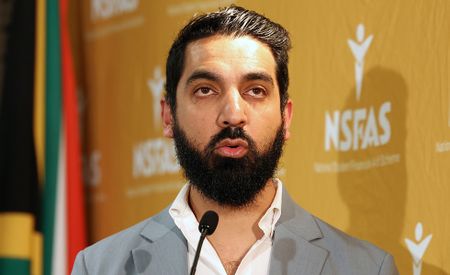
NSFAS has welcomed Outa’s investigation, and plans to review the report and consider its findings and recommendations in line with its ongoing initiatives to improve the management of student accommodation.
Outa has demanded an independent probe into the entire student accommodation infrastructure. The organisation is also pushing for criminal complaints and investigations against NSFAS officials, service providers and landlords found guilty of misconduct and corruption.
Daily Maverick asked Nongongo and Khosa for comment on Outa’s report. Nongonogo did not respond. Khosa said: “NSFAS has a new leadership. They know better what is happening in the organisation. I don’t want to be drawn into what’s happening at NSFAS. Your persistence is very suspicious.” DM