




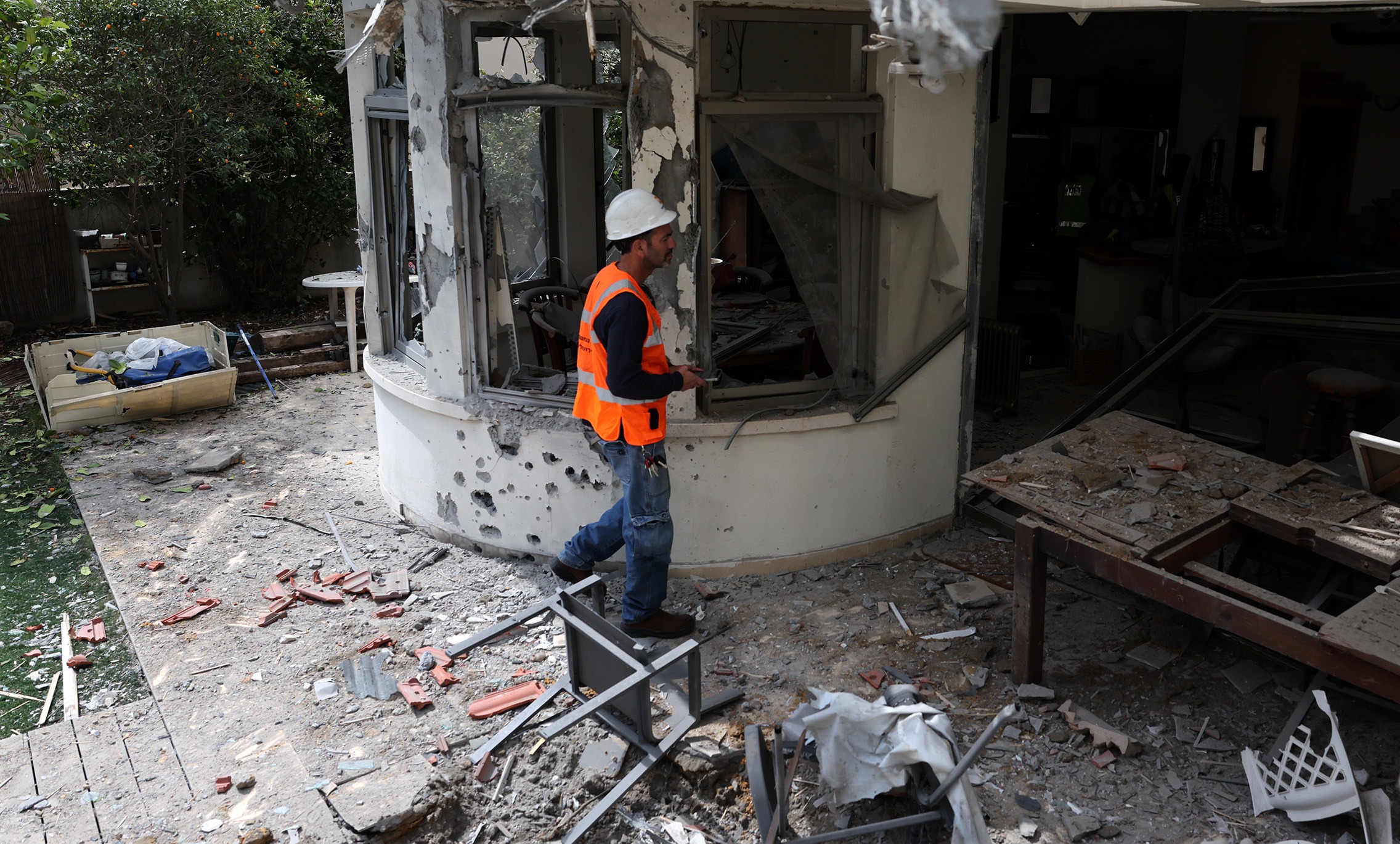
 An electricity company employee inspects a damaged building at the site of a reported Iranian missile strike in Shoham, central Israel, on 16 March. (Photo: Abir Sultan / EPA)
 Is Iran still able to attack Israel?
Answer from Peter Fabricius: Iran is still able to launch attacks on Israel and on Gulf states that harbour US bases. However, Iran’s capacity to do so is dwindling because of sustained attacks by the US and Israel on its missile and drone stockpiles and projectile-launchers.
“The combined force has severely degraded Iran’s missile and drone capabilities, which has limited Iran’s ability to launch retaliatory attacks in the region,” the Institute for the Study of War (ISW) and the Critical Threats Project (CTP) at the American Enterprise Institute reported on 16 March. They said the Israel Defense Forces (IDF) reported on March 16 that it had destroyed approximately 70% of Iran’s missile launchers since the conflict began on 28 February.
The ISW-CTP report noted that the IDF had recently said Iran’s ability to retaliate to attacks was also limited by the reluctance of missile crews to man their stations for fear of attack. As a result, the barrage against Israel had decreased, from nearly 100 projectiles over the first two days to a single-digit number in the past few days, Al Jazeera reported on 16 March, citing Israel’s Institute for National Security Studies.
The ISW-CTP report added, however, that Iran’s Lebanon-based proxy Hezbollah had kept up a steady barrage of missiles, drones, rockets and mortars against Israel. According to Hezbollah’s own claims, these attacks began with one each on 1 and 2 March, peaking at 25 a day on 7 March and decreasing to 15 on March 15.
While Iranian attacks have decreased in frequency, analysts warn that even a few projectiles are enough to maintain high oil prices and keep Israel and the Gulf states on edge. This instability is compounded by threats to shipping in the Strait of Hormuz— a critical bottleneck that handled approximately 20% of global oil tanker traffic before the conflict. Boosting oil prices and generally causing economic chaos are clearly Iran’s main strategies to counter the attacks by the US and Israel.
How will this war affect South Africa?
Answer from Victoria O’Regan: This conflict could affect South Africa in a number of ways. The most immediate impact will be on fuel prices. While the Department of Mineral and Petroleum Resources (DMPR) has said there is no immediate risk of fuel shortages in South Africa, the Central Energy Fund has estimated that diesel prices are set to increase by more than R7.80 per litre and petrol by R4.70 per litre in April.
The ongoing conflict has also disrupted global trade routes, which has affected South Africa’s agricultural exports. According to a report by Al Jazeera, the Middle East represents a $1.3-billion market for South African fruit exporters. The publication reported that South African exporters have estimated that about 90% of fruit shipments bound for the Middle East have been disrupted by the conflict.
/file/attachments/2989/13822892_796832.jpg "The Thai-flagged cargo ship Mayuree Naree on fire after being hit by Iranian missiles in the Strait of Hormuz on 11 March. (Photo: Royal Thai Navy / EPA)")
Is there a pattern of similar conflicts in the region that suggests the consolidation of greater Western hegemony, both regionally and globally?
Fabricius: There are no comparable conflicts in the region involving Western powers, though of course, the repercussions from the US and Israeli attack on Iran are spreading far into the Gulf States and beyond. There is speculation that the Gulf states that are being attacked by Iran could retaliate, widening the war and its global economic impacts. The effect on “Western hegemony” is unpredictable at this stage. It may even be diminished, depending on the outcome.
/file/attachments/orphans/13831272_214725.jpg "Iranians walk amid residential buildings damaged by bombardment in southern Tehran on 15 March.(Photo: Abedin Taherkenareh / EPA)")
How are US and Western rivals in other regions affected by the war in Iran — and by other recent geopolitical manoeuvres such as the destabilisation of Venezuela, Trump’s threats to seize Greenland, and the conversion of European states into US vassals?
Fabricius: The war in Iran is having a major impact across not only Europe but also across the entire globe, mainly through steeply boosting oil prices and disrupting travel in the Middle East. The war has aggravated relations between the US and other Western nations, including European states.
European states have turned down President Trump’s appeal to them to help the US patrol the Strait of Hormuz to allow oil tankers and other ships to traverse it. Europeans are saying, “This is not our war.”
European states also stood united to send a message to Trump at the World Economic Forum at Davos that they would not tolerate the invasion or annexation of Greenland, forcing Trump to back down. This does not suggest that European states have been converted to “US vassals”. Trump’s hostility has instead inspired greater European unity and independence from the US.
What role do the Epstein files, his alleged intelligence connections and supposed handlers play in current Israeli leverage over the Trump administration to carry out what the writer describes as a proxy war on behalf of Netanyahu and his Zionist faction?
Fabricius: If your suggestion is that Israel is somehow using embarrassing information about his involvement with Epstein to blackmail Trump into joining Israel’s attack on Iran, I don’t believe that is true. Trump may very well have other ulterior motives for attacking Iran other than destroying its nuclear threat, and distracting the US voting public from the Epstein files in an election year may be one of them, but one does not have to posit Israeli blackmail to explain the attack.
What is the death toll in Israel since the attack on Gaza began?
O’Regan: According to a Human Rights Watch report, 1,195 people were killed in Israel in the Hamas-led attack on 7 October 2023. Of those, 815 were civilians. In its attack on Israel, Hamas also took 251 people hostage.
According to the Gaza Health Ministry, at least 72,063 people have been killed in the Gaza Strip since the start of Israel’s military campaign in Gaza. Of those, 603 Palestinians have been killed since the US-brokered “ceasefire” came into force on 10 October 2025.
Who, or what country, could realistically act as a mediator in this war, given that Iran cannot trust the US, as the war began while negotiations appeared to be going well?
O’Regan: Up until days before the US-Israeli strikes on Iran, Oman had been acting as a crucial mediator between the US and Iran in an effort to negotiate over Iran’s nuclear programme and stave off another conflict. According to a report by The New York Times, the country had spent years cultivating a reputation as a reliable mediator in the region, frequently serving as a back-channel between Washington and Tehran.
Following the joint US-Israeli attack, the Omani minister of foreign affairs, Badr bin Hamad Al Busaidi, said in a post on X that diplomatic options were still “available” to de-escalate the situation in the Middle East, suggesting Oman was still open to mediating talks.
Earlier this month, President Cyril Ramaphosa said South Africa was willing to play a mediating role in the conflict if asked, reported Reuters. DM