
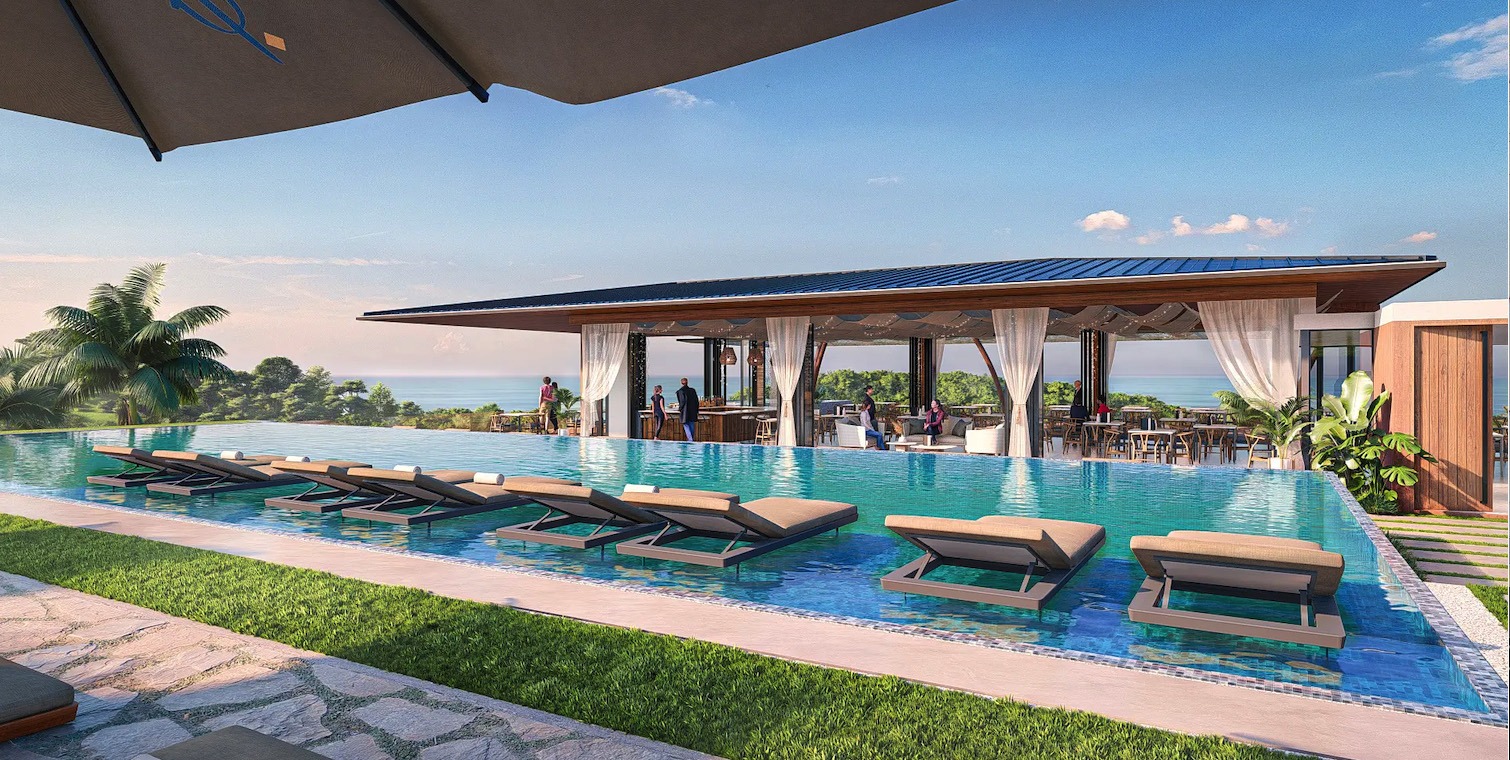
 An architect’s rendering of Club Med's Tinley Manor resort. (Photo: Craft of Architecture)
 A proposal to install shark-control nets and drumlines near a new luxury Club Med resort on South Africa’s KwaZulu-Natal coast has ignited a dispute between prominent marine scientists, the resort’s developers and the local authority over how to balance visitor safety with marine conservation.
The controversy centres on Tinley Manor, a coastal village north of Durban where the R2-billion Club Med resort is due to open later this year. With the development expected to bring hundreds of thousands of additional beach visits annually, local authorities have been considering measures to reduce the risk of shark encounters.
But an open letter signed by 11 leading marine researchers warns that installing lethal shark-control gear could harm endangered species while providing little measurable extra safety benefit.
Safety concerns
The new resort, developed by Collins Residential in partnership with Club Med, forms part of a major tourism investment along KwaZulu-Natal’s North Coast. According to the developers, the project is expected to generate more than 800 direct jobs and about 1,500 indirect jobs, while adding roughly 340,000 bed-nights to the country’s tourism sector each year.
Because the resort sits directly on a public beach, the issue of swimmer safety quickly became part of the planning process.
Club Med says the KwaDukuza Municipality approached national environmental authorities to determine appropriate safety measures in anticipation of increased beach usage – potentially up to 1,000 additional visitors a day.
/file/attachments/orphans/AadeceasedfemaletigersharkonScottburghBeachKZNwithvisibletraumatothejawconsistentwithinjuriesoftenassociatedwithhooksorsharkcontrolgearJasonVenterTheSharkWiseProject_493359.jpg "A dead female tiger shark on Scottburgh Beach, KZN, with visible trauma to the jaw, consistent with injuries often associated with hooks or shark control gear. (Photo: Jason Venter / The SharkWise Project)")
The coastline lies adjacent to the uThukela Marine Protected Area, a biologically rich zone known to host several shark species including bull sharks, tiger sharks and great white sharks. Authorities therefore began assessing the installation of “bather safety gear”, a term typically referring to shark nets and drumlines used along parts of the KwaZulu-Natal coast.
However, the proposal has drawn strong criticism from scientists and conservation groups.
Risk and effectiveness questioned
In an open letter, the researchers argue that the justification for installing lethal shark-control gear at Tinley Manor rests on weak scientific assumptions.
They point out that there has been no recorded shark attack at Tinley Manor since 1994, raising questions about whether additional measures are necessary at all. Even if more swimmers enter the water once the resort opens, they say there’s little evidence that concentrating more bathers at a single beach significantly increases the likelihood of a shark encounter, especially when their populations are probably plummeting.
More fundamentally, the scientists argue that shark nets and drumlines cannot reliably reduce risk at a specific location. These devices are not physical barriers. They operate as fishing gear designed to reduce the number of large sharks in an area by killing them.
Because the main species targeted – bull, tiger and white sharks – are highly migratory, moving hundreds or even thousands of kilometres annually, local installations cannot meaningfully control shark presence at a specific beach, the scientists argue.
“Installing a single net or drumline configuration does not control the local presence of migratory sharks,” the letter states. “The claimed benefit is therefore perceptual rather than operational.”
The nets and drumlines would also be moved from other areas, raising the question of which beachgoers are more important?
Environmental concerns
Another major criticism concerns the ecological impacts of shark-control programmes.
Data cited by the scientists suggest that KwaZulu-Natal’s shark nets and drumlines catch an average of 564 marine animals each year, of which roughly 416 die. Only a small fraction of those are the shark species the programme aims to target.
According to figures compiled from government data, about 13% of the catch consists of target species such as bull, tiger and white sharks, while nearly 87% are non-target animals, including rays, harmless sharks, turtles, marine mammals and birds. Many of these species are threatened or protected.
The scientists note that roughly 79% of animals removed by the programme fall into categories considered vulnerable, endangered or critically endangered by the International Union for Conservation of Nature (IUCN).
/file/attachments/orphans/ArchitectrenderingofClubMedsTinleyManorresortCraftofArchitecture2_854653.jpg "An architect’s rendering of Club Med’s Tinley Manor resort, which is under construction on KZN’s North Coast. (Photo: Craft of Architecture)")
One species frequently highlighted is the Indian Ocean humpback dolphin. Fewer than 500 individuals remain in South African waters, and past shark-net installations in the region have recorded dolphin deaths.
The scientists argue that introducing lethal gear close to the uThukela Marine Protected Area could therefore pose unnecessary ecological risks.
The Sharks Board angle
The KwaZulu-Natal Sharks Board (KZNSB), which manages the province’s shark-control programme, has defended the broader strategy.
In response to Daily Maverick questions, Professor Matt Dicken of Nelson Mandela University’s Ocean Sciences Campus – answering for the Sharks Board – said the system of nets and drumlines had historically been highly effective at reducing fatal shark incidents at beaches where they were deployed.
He said that the programme had helped prevent fatal attacks for decades and that the environmental impact of the gear was claimed to be relatively small compared with other fisheries.
He added that many proposed alternatives – including drones, shark spotters or electronic deterrent barriers – may not work reliably in the high-energy surf conditions typical of the KwaZulu-Natal coast.
Visibility in the water was often poor, he said, making it difficult to detect sharks visually. Bull and tiger sharks also spend much of their time below the surface, reducing the effectiveness of aerial or shoreline surveillance systems.
For these reasons, the Sharks Board maintains that traditional shark-control gear remains the only proven option currently available for the region.
Club Med’s position
Club Med itself has largely avoided taking a position on the specific safety technology proposed. In a statement responding to questions without answering them, the company emphasised that the beach remains public and falls under municipal jurisdiction. It says the safety measures are being assessed through a formal environmental review process led by government authorities.
The company also stressed its commitment to sustainability, noting that nearly 90% of its global resorts had Green Globe certification and that “the Tinley Manor project aims to meet international environmental standards as well as SA’s Green Star building certification. Our commitment is to prioritise both public safety and marine conservation,” the company said, adding that any final solution must balance the two.
Are alternatives possible?
In their open letter, the scientists said that balance could be achieved through non-lethal approaches. Suggested measures include combinations of:
- Drone surveillance.
- Shark-spotting programmes.
- Improved lifeguard monitoring.
- Restrictions on swimming during high-risk times such as dusk and dawn.
- New technologies designed to deter sharks without killing them.
One example often cited is the SharkSafe barrier, a system of magnetic and visual deterrents designed to keep large sharks away from swimming areas while allowing other marine life to pass freely.
While such technologies are still being tested in many parts of the world, conservationists argue they represent the future of shark-risk mitigation.
Towards coexistence
Ultimately, the Tinley Manor dispute reflects a broader global debate about how societies manage the rare but emotionally powerful risk of shark encounters.
Scientists involved in the open letter emphasise that they don’t oppose the resort itself or economic development along the coast. They simply argue that modern tourism should adopt safety measures that minimise harm to marine ecosystems.
“We are not against development in KwaZulu-Natal, nor against job creation,” the scientists wrote. “We are against unsustainable, extractive practices that are no longer relevant or acceptable in today’s ecological era.”
After the initial consultation process, authorities determined that a full Environmental Impact Assessment (EIA) would be required under the National Environmental Management Act to evaluate the potential impacts more thoroughly. The outcome of the environmental impact assessment is expected to play a decisive role in determining which path is taken. DM