




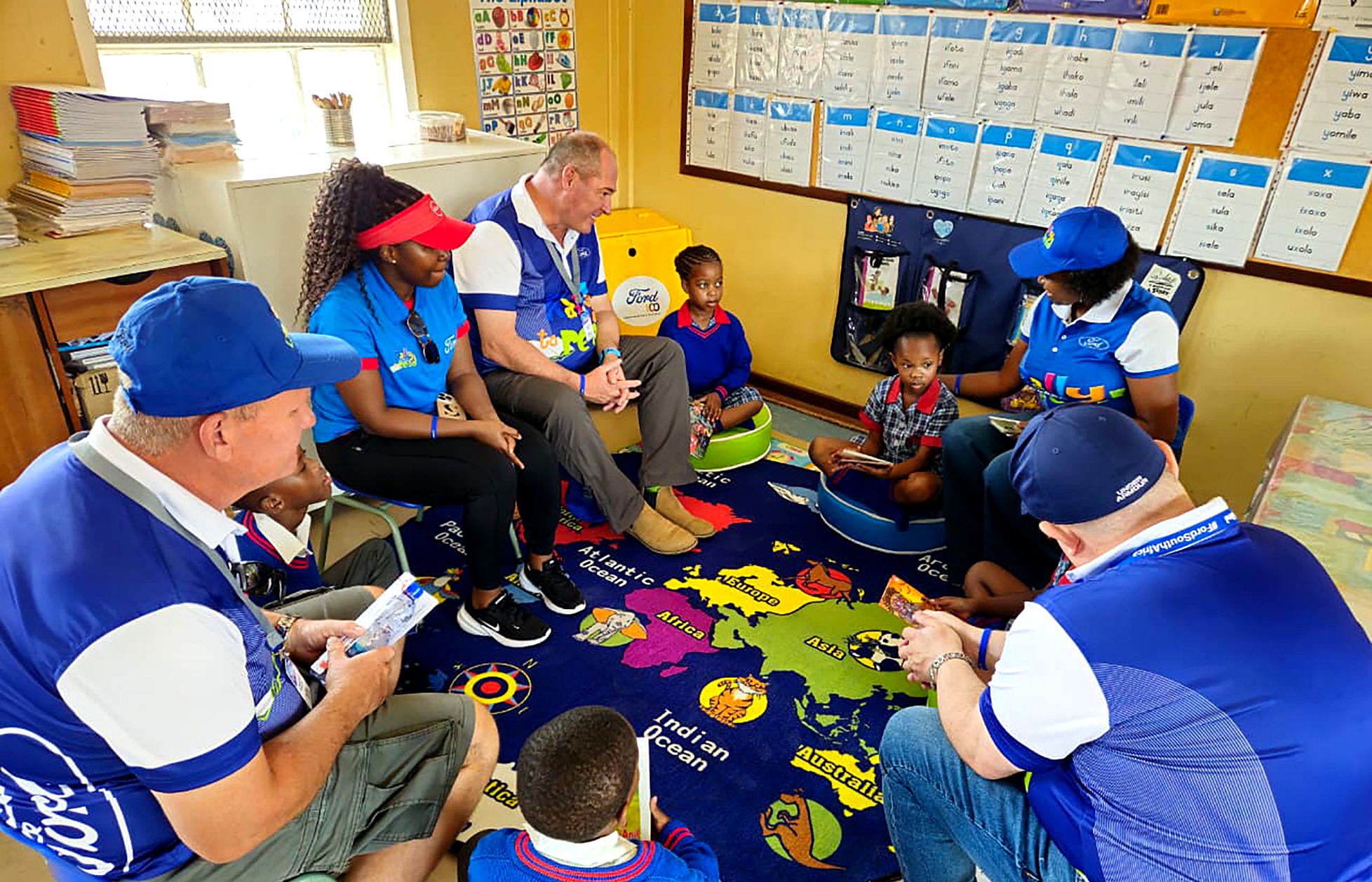
 Story time — Rally to Read and Ford Motor Company Africa staff and friends listen to Alex Jayiya Primary School learners demonstrate their reading skills in class. (Photo: Andisa Bonani)
 Patricia Nkumanda runs Alex Jayiya Primary School in KwaNobuhle, Gqeberha, with six teachers and 200 pupils. Enrolment has been dropping for years as young parents relocate to other areas, leading to lower staff numbers and a school where resources are stretched.
“I have to teach more than three grades,” she says. “I’m struggling because I don’t get time to do my administration work.”
With resources so stretched, some of the youngest learners were struggling to learn how to read. But last year, something changed when Rally to Read — a non-profit organisation created to address low literacy levels — arrived at the school. It helped implement a programme that Nkumanda says has helped Grade 1 learners. Children who could not read a single word began to identify phonics and interpret stories.
“Their confidence has developed,” Nkumanda says. “They are able to read.”
The situation at Alex Jayiya Primary School is not an isolated story. Across South Africa, only 30% of learners in grades 1 to 3 read at grade level in their home language. In some languages, up to 25% of Grade 3 learners cannot read a single word. Fifteen percent score zero on reading assessments — unable to decode anything after three years of formal schooling.
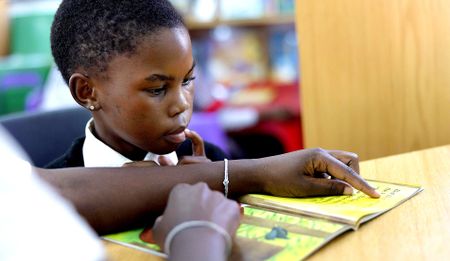
The statistics on South African children’s reading levels underscore the need for initiatives such as Rally to Read.
Ford Motor Company Africa has supported the Rally to Read programme for 26 years, contributing to its work in schools across the country.
The Rally to Read programme provides teachers with training and educational tools designed to improve lesson delivery and support learners in developing their literacy skills.
It operates on a three-year cycle with special focus on the foundation phase (grade R to grade 3) in the first year, the intermediate phase (grade 4 to 7) in year two and the holistic school development in the third year.
Rally to Read, in partnership with Ford Motor Company Africa, visited eight rural and semi-urban schools in Nelson Mandela Bay and the Sarah Baartman municipal areas of the Eastern Cape last weekend.
They brought classroom libraries with reading and learning books, laptops, projectors, charts, cushions and toys, among other items.
Neale Hill, president of Ford Motor Company Africa, said the company participates in the programme as part of its commitment to the communities where its employees live and where it operates.
/file/attachments/orphans/Neale_227805.jpeg "President of Ford Motor Company Africa Neale Hill joins Rally to Read to provide educational material for schools in Nelson Mandela Bay, Eastern Cape. (Photo: Andisa Bonani)")
“It’s especially important to me because we have such an incredible crisis when it comes to basic education in South Africa. When you look at the statistics in terms of the ability for children to read for meaning and understanding, not only in English but in their home languages too, [it] is really scary.”
Having reached 700,000 learners across SA, Hill said the Ford Motor Company Africa had to be part of such an impactful initiative.
Hill said if the country didn’t get it right at the basic education level and the intermediate phase, the affected children were destined to struggle for the rest of their academic lives.
“The view we hold is that literacy is a key enabler in terms of people being able to uplift themselves. This is about dignity, respect, and [giving] the people the ability to reach their full potential,” Hill said.
Asked why Ford chose to be part of Rally to Read when the city was faced with a range of issues such as youth unemployment, drug abuse and crime, Hill said literacy was an area where they felt they could really make a difference.
“This is part of a broader scheme of projects we are involved with. We see these as legacy projects, so it takes children from cradle to grave. Ultimately, we want to see people who went through the various programmes, including Rally to Read, become part of the Ford Motor Company family and work with us to contribute back to SA as well.”
Alex Jayiya Primary School in KwaNobuhle is one of many examples where learners struggled to read until Rally to Read intervened last year. The school has a total of 200 pupils between grades R and 7, and six teachers.
Principal Patricia Nkumanda said one of their biggest challenges, after literacy problems, was the enrollment numbers and the shortage of teachers.
/file/attachments/orphans/Patricia_491068.jpeg "Alex Jayiya Primary School principal Patricia Nkumanda in KwaNobuhle in the Eastern Cape. 14 March 2026 (Photo: Andisa Bonani)")
Nkumanda said the assistance from Rally to Read had eased the burden of spending extra time teaching one learner how to read.
“Rally to Read has helped, especially with the Grade 1 learners who now can identify phonics, can understand stories and interpret them based on pictures. The learners could not read before this programme, but their confidence has developed because they are able to read and are eager to ask questions in class.”
Dian Farm School principal Sindiswa Tyala says the school faces a range of challenges linked to its location and the socioeconomic conditions in nearby communities. The school has four teachers and 129 learners.
/file/attachments/orphans/Sindiswa_724633.jpeg "Gqeberha’s Dias Farm School principal Sindisa Tyala. (Photo: Andisa Bonani)")
“Since we’re a farm school, we would get a nine-year-old child who has never attended school in their life and would have to start from Grade R. This creates many challenges, including bullying because of the age gap,” Tyala said.
“We used to have very serious problems with reading, but since Rally to Read started working with us, our learners’ reading ability has improved. The books and training they provide to the teachers actually work, and we are grateful for their support.”
Tyala said key issues they faced were teaching two grades in one class and the shortage of teachers.
“It becomes a problem when one of us is on sick leave because the learners fall behind with their work, so it’s not easy. We don’t get to spend enough time with the learners so we can properly teach them, but the support we also get from the retired teachers who live on the farm also makes a difference.”
“I am proud to introduce myself as an alumnus of the Brand and Tillie Pretorius bursary fund. I attended Sidlemu Primary School, where my school got the opportunity to benefit from the Rally to Read programme and due to my academic potential, I was fortunate to be awarded the Brand and Tillie Pretorius bursary fund for my secondary education from 2016-2020,” she wrote.
A former Rally to Read student, Andile Ngobeni, said her experience with the programme had led her to the master’s degree she is now pursuing.
“I completed my matric in 2020 with seven distinctions and a 90% average. I hold a Bachelor of Science degree in mathematics, corporate finance and investments (2023) and a Bachelor of Science honours in mathematics (2024), all from Wits University. I am currently pursuing my master’s in mathematics and working as a graduate trainee in one of the big banks in SA.”
Ngobeni said her achievements were fuelled by her background and the principle of not disappointing those who invested in her.
“I could write a book about my journey and how the Rally to Read programme gave me inspiration to put effort into my education. I am truly grateful for Brand and his amazing wife, Tillie.”
Rally to Read trainer and mentor Thobile Mchunu said they began working with the eight schools last year, and were happy to learn about the improvement in the foundation phase.
/file/attachments/orphans/Thobile_972777.jpeg "Rally to Read trainer and mentor Thobile Mchunu. (Photo: Andisa Bonani)")
“We provide resources, develop the teachers, support the parents and introduce the teachers to digital tools they can use in the classroom,” she said.
“In the first year, we support the foundation phase teachers by co-teaching with them, demonstrating the lesson, reading with the learners and providing resources. In the second year, we support the intermediate phase, but we don’t leave the grades R to 3 group behind. We continue to support and monitor them.”
Mchunu said in the third year, they focused on the whole school development, covering the gaps identified through an assessment conducted by Rally to Read.
“We also ensure the sustainability of the programme so that when we leave, they continue with the work,” Mchunu said. DM