




 Illustrative image: SANDF members. (Photo: Phando Jikelo / Parliament of SA) | SANDF Logo. (Image: iStock) | (By Daniella Lee Ming Yesca)
 /file/dailymaverick/wp-content/uploads/2025/10/label-analysis-2.jpg)
Last week, President Cyril Ramaphosa lauded the South African National Defence Force (SANDF) for its role in supporting police anti-crime efforts, claiming the military is well-equipped and performing “a fantastic job”. However, this approach carries significant risks, and by blurring the lines between domestic law enforcement and military intervention, the state risks sabotaging its own authority.
It is easy to sympathise with those who live in one of the many communities where lives are defined by violent crime.
We’ve grown so desensitised to the chilling reality of families cowering in bathtubs and gangs claiming sovereign territory over our streets that we’ve lost our capacity for outrage. It is only when we step back from this “new normal” that the sheer horror of the situation comes into focus.
Obviously, this means many people will welcome the SANDF deployment.
However, it was astonishing to hear Ramaphosa tell Parliament: “This time around, we have developed our defence force capabilities so well that they build bridges, they save people who are in danger. They also help with supporting the police.”
Where is the evidence of this?
SANDF ‘free-falling into obsolescence’
As John Stupart has written, the SANDF is falling apart.
It is not a well-capacitated force by any means. It is, in his phrase, “free-falling into obsolescence”.
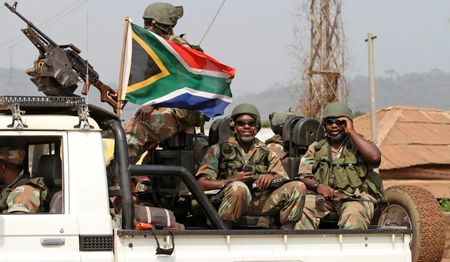
The fact that our soldiers were reduced to sitting ducks in Goma in the DRC underscored this. And despite Ramaphosa’s claim that it has been “capacitated”, in fact, as DefenceWeb explains, the budget for the SANDF has not increased.
We are now asking the SANDF to do more with less, despite Ramaphosa stating that this operation will cost about R823-million.
The openness and transparency of our society are enduring strengths.
/file/dailymaverick/wp-content/uploads/2024/10/ISS-DRC-peace-mission.jpg "SANDF members in DRC in October 2024. (Photo: SANDF)")
Under constant scrutiny
However, it also means that the soldiers deployed to assist in crime-fighting are likely to be constantly filmed. Between news crews hungry for the striking visuals of armoured patrols, and citizens armed with smartphones, every movement will be documented. We are witnessing what is likely to become the most scrutinised and recorded military operation in South African history — where every tactical decision is a heartbeat away from going viral.
The potential for an awful incident is huge.
It is worth remembering that during the Covid-19 pandemic, SANDF officers were involved in an incident in which Collins Khosa, a resident of Alexandra, was killed — simply for leaving a half-bottle of beer on a camping chair in his yard.
His actions were perfectly legal.
There is every reason to believe that something like this could occur again.
This time, it might be caught on camera and made public (neighbours who filmed the assault on Khosa were assaulted and their footage deleted).
This will be devastating for the legitimacy of a force that is supposed to protect citizens.
The chilling reality is that many criminals are probably more combat-hardened than the soldiers sent to subdue them.
The consequences of a mismatch are unthinkable. Imagine the psychological fallout of a well-resourced gang “winning” a firefight against the SANDF on live television.
It is also possible that single members of the SANDF are attacked and killed. This has happened repeatedly with South African Police Service (SAPS) officers, often because criminals want their gun. The incentive to get soldiers’ weapons might be even greater for those who prize such things.
Even more devastating than the violence itself would be its broadcast. While the digital trail might lead to arrests, the symbolic damage would be irreparable.
A viral video of a defeated soldier is a visual manifesto of a collapsing state. It wouldn’t just be a recording of a crime; it would be a broadcast of impotence. In those few seconds of footage, the myth of state protection would shatter, exposing a government that has lost the mandate — and the means — to shield its people. This is the “huge power” of the image: it transforms a local skirmish into a national eulogy for the rule of law.
One of the reasons that communities demand that the SANDF be involved in the fight against crime is that they believe that while the SAPS has failed to stop crime, the state can still succeed.
Were the SANDF to fail, there would be no reason to ever believe the state can succeed here.
And that, in turn, would discourage citizens from following the law, while encouraging criminals to break it.
At the same time, there is no reason to believe that even with the best will and best equipment in the world, the SANDF would be more effective than the police.
As the various commissions have displayed so clinically, one of the reasons the SAPS is so ineffective is that its leadership is hopelessly corrupt and factionalised.
Unfortunately, the same is probably also true of the SANDF.
Just in the last few months, 12 members of the SANDF Special Forces unit were accused of killing senior Hawks investigator Frans Mathipa. To make this even worse, the SANDF is now paying their legal fees.
As previously stated, why would the leadership of the SANDF be doing this? There is no legitimate reason for the SANDF to murder a police officer and if the soldiers were not following orders, why would their employer now pay for their defence?
To add insult to injury, the person in charge of that unit has been promoted since being charged.
Meanwhile, as Rapport has explained, two generals are now accused of looting a fund meant for soldiers, simply to fund their own credit cards.
At the apex of this crumbling structure stands the chief of the SANDF, General Rudzani Maphwanya. As the man at the helm, the accountability for this systemic decay begins and ends with him.
/file/dailymaverick/wp-content/uploads/2025/08/ED_504233.jpg "SANDF chief General Rudzani Maphwanya. (Photo: Frennie Shivambu / Gallo Images)")
Setting an example for soldiers
With this as their leadership, what can one expect from the rank-and-file members of the SANDF?
We are asking soldiers — men and women often struggling with the same grinding poverty as the communities they patrol — to uphold a rule of law that their own leaders treat with contempt. When a soldier is battling just to put food on the table while their generals loot their welfare funds, the thin veneer of military discipline dissolves.
Deprived of resources and a moral example, these soldiers are no longer a disciplined force of the state; they are a liability. They become far more likely to pivot from protectors to predators, turning to street-level theft or unchecked violence to serve their own interests at the expense of the citizens they were sent to “save”.
You can imagine the pain and suffering of citizens, desperate for help, who find that after a raid by these soldiers, some of their belongings are missing — and the only way to get them back is through violence.
The potential for a downward spiral is obvious.
One of the classic definitions of a state is that it is the sole entity within its borders granted the monopoly on the legitimate use of violence.
The use of the SANDF in crime-fighting operations has the awful potential to weaken this, and after that, there is no other state force that can use violence.
The demands for the deployment of the SANDF are entirely understandable, as is the response of a democratic leader to follow those demands.
Despite that, it is unlikely that any good will flow from this. DM