




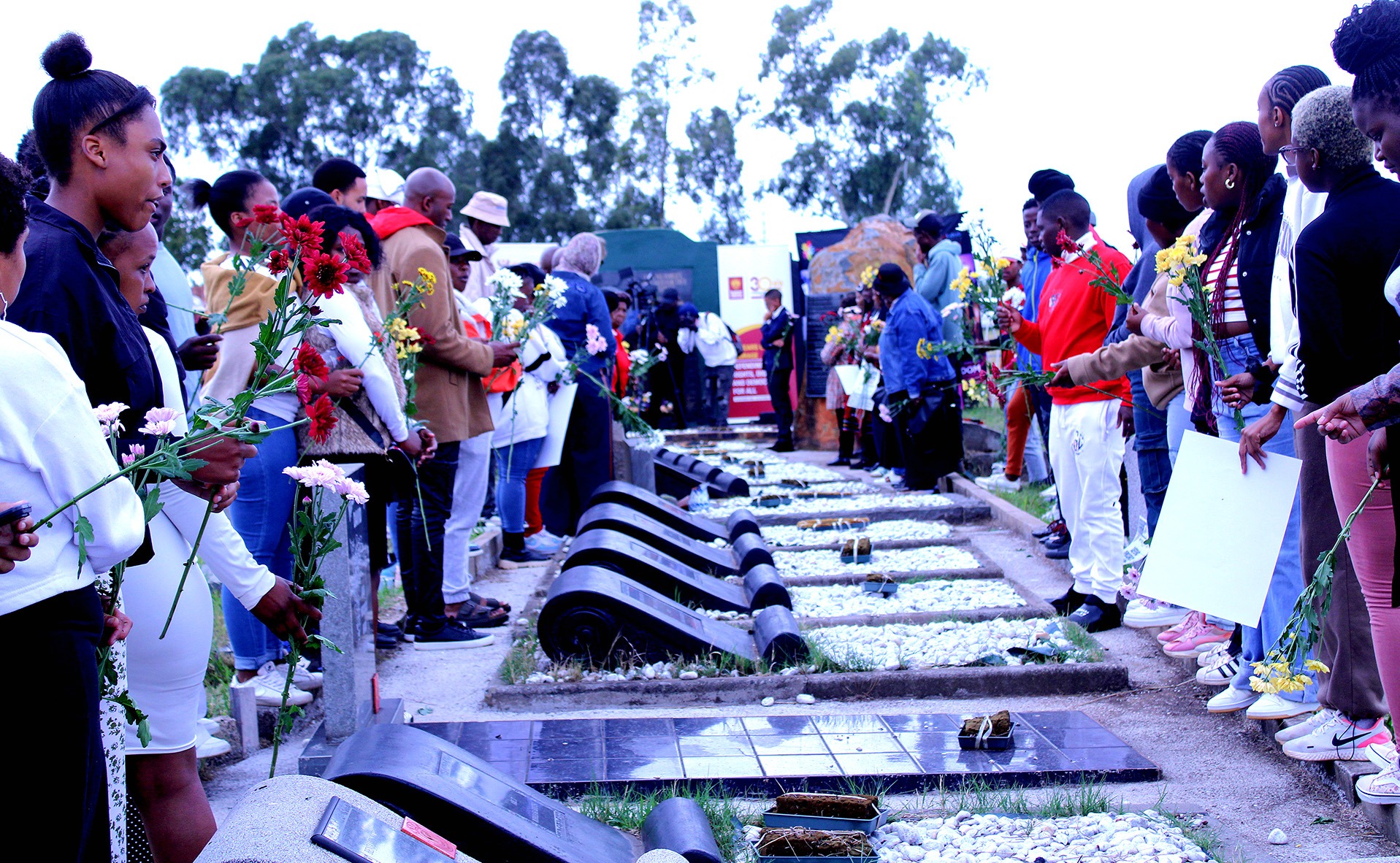
 The Ahmed Kathrada Foundation, joined by young people from surrounding areas and surviving family members, laid flowers at the graves of the 69 who lost their lives in the Sharpeville Massacre. (Photo: Lillian Roberts)
 On Sunday, 15 March, the Ahmed Kathrada Foundation held a commemoration titled “Remembering The Sharpeville Massacre 66 years on” at the Phelindaba Cemetery and the Sharpeville Memorial in Sharpeville, near Vereeniging, Gauteng.
On 21 March 1960, people protesting against the pass laws had gathered peacefully outside the Sharpeville police station, only to be fired on with live ammunition. Most of the victims were shot in the back as they ran from the police.
The official toll is 69 people killed and 180 injured.
“I hope it’s also a moment for you to think about the role that you can play in your different spaces, to honour their legacy and to always just remember that this is what hatred and racism does to people; to look at this and think about it as something caused by a system structured around racism,” Rethabile Ratsomo, programme manager at the Ahmed Kathrada Foundation, said in opening the commemoration.
Neeshan Balton, the foundation’s executive director, opened by saying that recent evidence has brought to light that more than 69 people were killed.
/file/attachments/orphans/CD02600C-B72C-485E-B4E1-6B280213D196_157906.jpeg "Neeshan Balton, executive director of the Ahmed Kathrada Foundation, spoke at the gravesite of the 69 people who lost their lives in the Sharpeville Massacre. (Photo: Lillian Roberts)")
“What Sharpeville did was that it made the world aware of the atrocities of racism, the end results of racism, and I so wish that we would have been joined here today by those who say that there is a white genocide in this country. There has never been, and you will never find the equivalent of this here, of white people being killed by black people,” Balton said.
“So, as we gather here today, next week will be International Day for the Elimination of Racism. Racism today is rampant across the world. It is as if it has a new lease of life. Racism has somehow found Red Bull and has got a new new energy, which is why we need an equal amount of energy to counter it, and that’s why we started Sharpeville, to remind ourselves of our history of opposing racism, but also what the consequences are of living in a racist system. So, as you gather here, please pay tribute right down the line to all of these people who laid down their lives on that fateful day and who opened up the pathways to freedom for all of us,” he concluded.
“They did not offer their lives. Their lives were taken. They did not die for freedom. They were killed. They were murdered. I think we need to understand that context…The youngest of the victims here was a 12-year-old,” said Tsoana Nhlapo, CEO of the Sharpeville Foundation.
Margaret Mbhele (70) laid down flowers for her mother, Norah Nobhekisizwe Mbhele, who was murdered at Sharpeville at the age of 23. Margaret was just five years old when her mother was killed, and her sister was two.
/file/attachments/orphans/8904BA85-2021-445B-831B-07E83A6CC17F_949617.jpeg "Margaret Mbhele’s mother, Norah Nobhekisizwe Mbhele, was 23 when she was murdered at Sharpeville. (Photo: Lillian Roberts)")
“When this day comes, I’m not well,” Mbhele said. Every year she and other surviving family members pay tribute to their loved ones. She is part of Khulumani Support Group, formed by the survivors and families of victims of the political conflict of South Africa’s past.
In the Sharpeville Human Rights Precinct, the 2025 documentary Free at Last: Unresolved Stories of Apartheid was screened, followed by a discussion. The first episode focuses on apartheid laws and the Sharpeville Massacre, with new evidence from researchers updating the number of those murdered to 95, through tracing official documentation, autopsies and mortuary numbers. It also focused on anti-apartheid activist Ahmed Timol, who was in police custody at John Vorster Square when he “fell” from the 10th floor.
Freedom was not free
Minister of Justice and Constitutional Development Mmamoloko Kubayi opened her keynote address by saying that Sharpeville is a reminder that freedom was not free.
Kubayi detailed the history of apartheid, the forced removals and the fracturing of families and communities, how education and jobs were segregated as well. She said that rebuilding in South Africa requires more than infrastructure.
People are frustrated with the Constitution, she said, as she spoke about the wide consultation to develop the Constitution with people in South Africa.
“We, the people of South Africa, we recognise the injustices of our past, and we therefore, through our elected representatives, adopt this Constitution as the supreme law of the land, so as to heal the divisions of the past and establish a society based on democratic values, social justice, fundamental human rights.
“We remain committed as government to ensure that the perpetrators of apartheid crimes, as per the report of the TRC, actually faced the music. Hence, when allegations emerged that there has been attempts to stop prosecution, the President established the commission [of inquiry] so that the truth can be known.”
Kubayi said they have opened 11 inquests through the National Prosecuting Authority, with six concluded.
She said the Sharpeville figures can be changed when the DNA has been identified as well as the location of the individuals tied directly to the massacre. Once that report had been submitted she would make a recommendation to the President.
“It’s a journey that can’t be closed overnight,” she said, encouraging people with new evidence to bring it to the state to help families achieve closure.
On discrimination
The minister spoke about the importance on non-discrimination towards legal immigrants, since we are “a global society”, and towards the queer community, because the “Constitution says I must not impose my choices, my religious beliefs, my cultural beliefs on the next person”. She also highlighted the importance of not discriminating against the disabled.
The rights enshrined in the Constitution, such as the right to shelter and water, were not a mistake because our forebears understood that there is no “political freedom without dignity”, she added.
“As we celebrate 30 years of our Constitution, fighting against racial discrimination, fighting against any form of discrimination, it requires all of us to recommit.” DM