




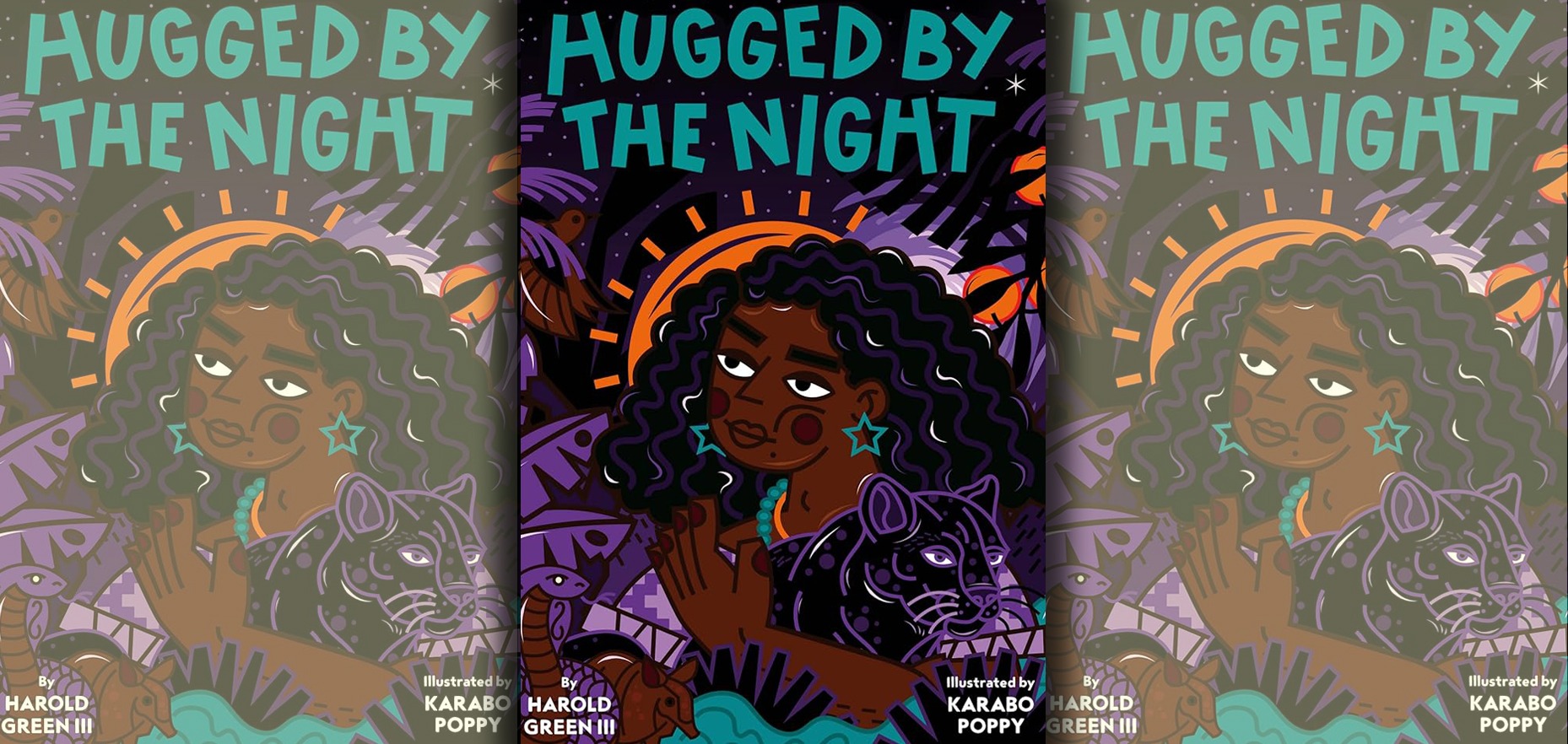
 Hugged by the Night is published by Chronicle Books. (Photo: Chronicle Books)
 It is not often that a children’s book arrives carrying this much weight. At first glance, Hugged by the Night is the kind of book a parent might pick up for bedtime: lyrical, richly illustrated, gently repetitive, built around a reassuring refrain.
Written by the poet Harold Green III and illustrated by South African artist and designer Karabo Poppy, it tells the story of three animals who look up at the night sky and wonder how they might become as confident, proud and fearless as she is. The sky hears them. She gathers them in her arms. What follows is part folktale, part blessing, part invitation to become more fully oneself. And yet it is also something more unusual than that.
This is not simply a soothing book for children learning not to fear the dark. It is a modern folktale about blackness, belonging and the ache of distance.
Green has described it as a story for descendants of the African diaspora, for those who may feel far from home in places where their blackness is made to feel strange, exposed or unwelcome. In that sense, the book is doing quiet but profound work. It is not just saying do not fear the night. It is saying do not fear who you are. That charge is part of what makes Poppy such a perfect choice for the project.
She is not a conventional children’s book illustrator, and the book does not pretend otherwise. Its lines are bold, not soft. Its palette is deep, luminous, textured. Its darkness is not pastel, the kind that has already been tidied up for a child. It begins by taking the reader fully into the night. There is fear there. There is immensity. There is the unknown. And then, somehow, there is comfort.
When I spoke to Poppy, she told me the project began when Chronicle Books approached her because, as she put it, if they had “an unconventional writer, they should probably get an unconventional illustrator as well”.
What they sent her was not a brief in the usual sense, but an audio note of Green reading the book aloud. His voice, she said, was “beautifully textured”, and that became the first point of inspiration. She wanted the book itself to feel layered from the start, right down to the physicality of it when you pick it up. That instinct for texture matters because this is a book about feeling your way into an alternative understanding of the dark.
Poppy told me about her own childhood fear of night and about the way her father redefined it for her. He took her outside at night and showed her that the sky was not a flat, terrifying black, but layered in purples, full of constellations, sound and hidden life. Night, he taught her, was not only a site of fear but also “a time of discovery”. That memory runs through the book.
What is especially noteworthy is the way Poppy uses darkness not only as atmosphere but as metaphor. The book is very consciously about claiming the night and claiming blackness at the same time. “Looking at black identity, looking at being proud of it,” she said, sits at the forefront of the work.
But she does not treat those themes heavily. Instead she turns them into image, rhythm and embrace. Night becomes a giant woman, all-encompassing, protective, strong. Poppy told me that when she designed this figure she was thinking of the women in her own family: tall, expansive women whose presence carried heritage and identity. “When I think about what night represents,” she said, “I looked at that being the women in my family.”
That tenderness is part of what gives the book its unusual emotional register. When I first opened it, my adult instinct was to be slightly afraid. The early pages do not shy away from darkness. They move towards it. But then something begins to shift. Small details, hidden visual echoes, flashes of colour begin to guide the reader elsewhere.
Poppy spoke about planting “Easter eggs”, tiny moments of invitation, places where the eye is gently pulled towards discovery rather than fear. She wanted readers to remain aware of what darkness can hold, but to encounter it differently.
This is where the book becomes especially powerful for black children in the diaspora, though it is by no means limited to them. The central reassurance is not sentimental. It is existential. Home travels with you. Blackness is with you wherever you are. You are not cut off from yourself by geography. You carry inheritance, memory and cultural thread within you.
Poppy explains this by saying that she wanted to create images that feel familiar even when that familiarity cannot quite be explained. That, she said, is “heritage coming through… that unspoken golden thread.”
That phrase stayed with me because it captures something many black readers will know in the body before they can name it in language. The sudden flood of feeling when a plane begins descending home. The pull of something ancestral and wordless. The sense that return is not only physical. This book understands that longing and answers it with a kind of visual refuge.
The illustrations also emerge from Poppy’s larger artistic politics. Known for her bold public work and design practice, she has long resisted the exoticised, flattened ways Africa is represented in mainstream visual culture. Growing up in Vereeniging, she rarely saw her ordinary world reflected back to her.
When Africa did appear, it often felt partial, distant or romanticised. She wanted instead to celebrate “the ordinary in Africa”, the everyday people and textures through which heritage is carried. That, she said, is what breaks exoticism: not denial, but specificity.
There is a broader argument here too, one that reaches beyond the book. In a country as wounded as South Africa, where trauma sits not only in history books but in the body, official language about healing can feel thin and exhausted. Art, by contrast, still has a chance. It can preserve memory, renegotiate meaning and give people back to themselves.
Poppy spoke with conviction about this responsibility. Art, she said, helps “soothe trauma, renegotiate how the world sees us and then inspire the next generation to do the same”. That sense of generational work runs through everything she creates.
There is something profoundly moving in that arc. A daughter shaped by her parents’ stories grows into an artist who reshapes what children might see of themselves. A father who once could not imagine needing a passport now travels the world with her. And a children’s book becomes, in the process, not just a bedtime object but a vessel for memory, dignity and repair.
That is what makes Hugged by the Night so unusual. It understands that comfort is not the absence of darkness, but the presence of something strong enough to hold us inside it. For children, it offers reassurance. For adults, it offers something rarer: a reminder that art can still gather us up and tell us who we are. DM
Hugged by the Night was published by Chronicle Books and is available at a retail price of about R395.