




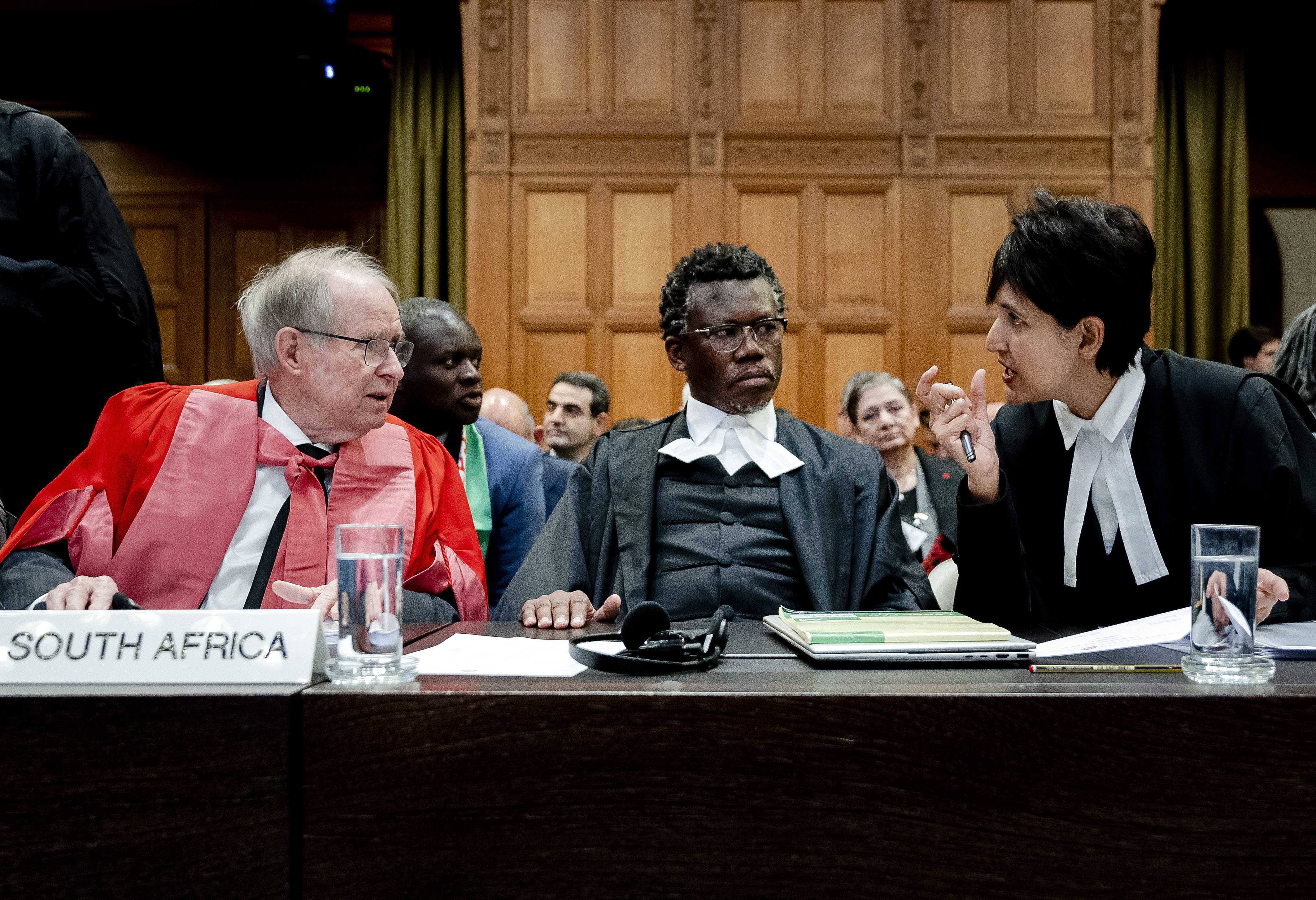
 From left: John Dugard, professor of international law, lawyer Tembeka Ngcukaitobi and lawyer Adila Hassim before the hearing of the genocide case against Israel brought by South Africa, at the International Court of Justice in The Hague, The Netherlands, on 12 January 2024. (Photo: Remko de Waal / EPA-EFE)
 What’s the background here?
To recap: South Africa brought a landmark genocide case against Israel at the International Court of Justice (ICJ) on 29 December 2023.
In its 84-page suit, it argued that since 7 October 2023, Israel had been committing genocide — and had failed to prevent genocide — against Palestinians in Gaza in violation of its obligations under the 1948 Genocide Convention.
In a preliminary decision on 26 January 2024, the ICJ concluded that it had prima facie jurisdiction to hear South Africa’s case. It also found it plausible that “at least some of the rights” of Palestinians in Gaza, protected under the Genocide Convention, were at risk, leading to the issuing of provisional measures requiring Israel to take proactive steps to prevent genocide, while the broader case is pending.
/file/dailymaverick/wp-content/uploads/2025/05/20250429-196-20.jpg "Zane Dangor, director-general of South Africa’s Department of International Relations and Cooperation, accused Israel of acting with ‘impunity’ during hearings at the ICJ in The Hague on Tuesday, 29 April 2025. (Photo: Frank van Beek / UN Photo / ICJ-CIJ. Courtesy of the ICJ)")
The ICJ issued further provisional measures, which are essentially temporary injunctions, on 28 March and 24 May 2024.
And the latest developments?
On Thursday, 12 March 2026, Israel filed its counter-memorial — a written statement of its arguments — in response to South Africa’s memorial before the ICJ.
The court had set an initial deadline of 28 July 2025 for Israel to file its counter-memorial. However, following requests by that country, the ICJ extended its time limit for submission to 12 January and later to 12 March.
We do not know the nub of Israel’s arguments, as written pleadings are not generally made public until the start of oral hearings, and even then, only if the parties have no objections.
However, in a post on X, the Israeli Foreign Ministry said that Israel had included objections to the jurisdiction of the ICJ in its counter-memorial.
“As demonstrated in the counter-memorial, the court lacks jurisdiction, and South Africa’s allegations should be dismissed in their entirety. Any contrary determination would undermine the fundamental right of states to defend their citizens against terrorists attacking from civilian population centres,” it said in its post.
Israel has submitted its Counter-Memorial to the ICJ, rejecting South Africa’s fabricated and politicized blood libel.
— Israel Foreign Ministry (@IsraelMFA) March 14, 2026
Israel is the only country that has been fighting for its existence since its founding almost 78 years ago.
Israel faces relentless threats of…
The Southern Africa Litigation Centre’s Dr Atilla Kisla explained to Daily Maverick that Israel was likely to respond to South Africa’s memorial, filed on 28 October 2024, on multiple levels.
This would probably include contesting the factual records, such as casualty figures, interpretations of military operations, or the context of statements, cited by South Africa and challenging its inference of genocidal intent.
The US has also intervened, right?
Yes. The US, along with Namibia, Fiji and Hungary, filed declarations to intervene in the case on 12 March. This brings the total number of countries wanting to participate in the proceedings to 22.
The case is open to other states that are parties to the Genocide Convention to intervene to join the case in support of one side or the other.
It’s clear from the US’s declaration, for example, that it is intervening on behalf of Israel.
However, the court also has the right to declare the intervention inadmissible. In the case of Ukraine v Russia, for example, 33 states filed declarations of intervention, of which 32 were deemed admissible by the court.
In that case, the ICJ declared the intervention of the US inadmissible, insofar as it concerned the preliminary objections stage of the proceedings, because of its reservation to Article IX (which deals with the court’s jurisdiction) when it ratified the Genocide Convention. The ICJ ruled that because the US made a reservation to Article IX of the Convention, which is thus not binding on it, it could not intervene in a case that relies on the interpretation of that same article.
(In South Africa’s case, the US has focused its 11-page declaration mainly on the interpretation of Article II, which deals with the definition of genocide, and the “standard of intent”.)
What will the ICJ do next?
The filing of the counter-memorial is the next step in the written proceedings.
As this is a contentious case, the court may allow South Africa to reply to Israel’s counter-memorial and for Israel to then respond in the form of a rejoinder.
In a statement on Israel’s filing, South Africa said it would “consider Israel’s response” and decide whether to request the ICJ’s permission to make further written submissions in reply, or to proceed directly to the oral hearings.
/file/dailymaverick/wp-content/uploads/2024/10/11937455.jpg "Tal Becker (left), the legal counsellor for Israel’s Foreign Ministry, and lawyer Malcolm Shaw at the International Court of Justice before the hearing of the genocide case against Israel, brought by South Africa, on 11 January 2024. (Photo: Remko de Waal / EPA-EFE)")
At some point, the court will also consider the applications from states to intervene in the case and set timelines for their written observations.
After the written proceedings, the ICJ will schedule an oral hearing, which will again be in The Hague.
Once the oral proceedings are eventually wrapped up, the court will need time to deliberate. The ICJ’s final judgment will decide whether Israel has violated the Genocide Convention through its military campaign in Gaza.
The ICJ’s judgments are final, binding on all parties to a case, and cannot be appealed.
When can we expect a ruling?
A ruling on the merits of the case is probably still several years away.
Previous genocide cases, such as Bosnia and Herzegovina v Serbia and Montenegro, and Croatia v Serbia, have taken years to conclude. In Bosnia and Herzegovina v Serbia and Montenegro, for example, the case was brought to the ICJ in 1993, but the final judgment was delivered only in 2007. DM