




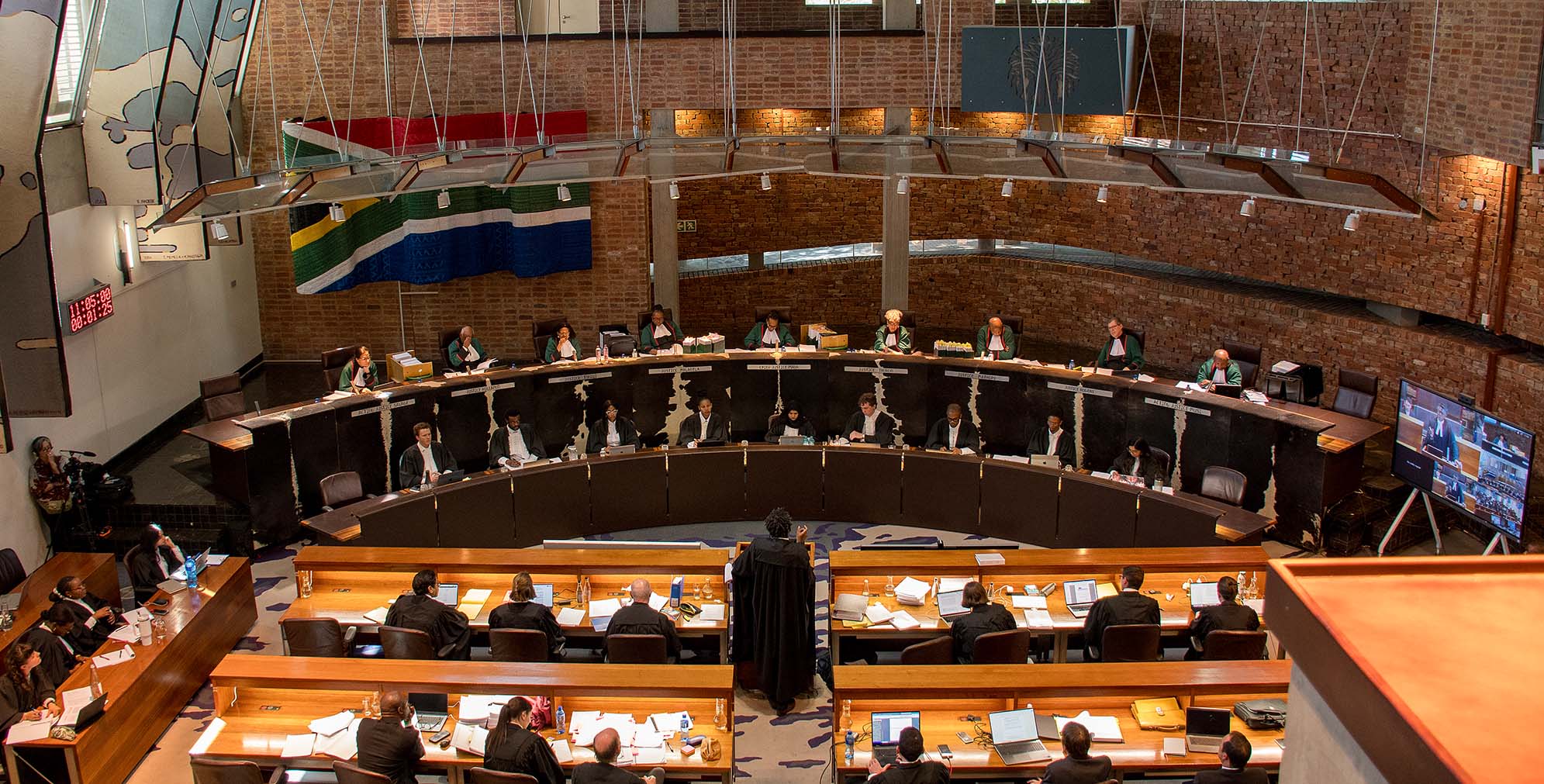
 The authors of a paper published in the 2025 Constitutional Court Review note that one of the underlying causes of the delay in issuing judgments is the expansion of the ConCourt’s mandate through amendment of the Constitution in 2013, making it the apex court on all legal matters. (Photo: Julia Evans)
 It’s been more than a year and three months since the Constitutional Court heard arguments in the EFF’s challenge to Parliament’s decision on Phala Phala, and the country’s highest court is yet to deliver judgment.
The case is just one in which litigants have waited several months for a decision, with a paper published in the 2025 Constitutional Court Review pointing out that in 2024 it took the court an average of 214 days (seven months) to issue a judgment. The longest hand-down time in 2024 was 414 days, say the authors Nurina Ally and Leo Boonzaier. But that timeframe appears to have been surpassed by the Phala Phala case, which has been awaiting judgment for more than 474 days (as at 16 March).
In 2010, the court took an average of 104 days to hand down judgments, increasing to 204 by 2021.
The paper, “The Constitutional Court’s Efficiency: An update from 2022 to 2024”, examined the trends in productivity at the apex court.
“Our findings show that the Court is continuing to experience serious efficiency problems, with its judgment,” the authors say.
Ally and Boonzaier note that the court has not addressed the efficiency problems they identified in 2022, when the pair looked at 11 years’ worth of judgments, from 2010 to 2021.
According to the Norms and Standards for Performance of Judicial Functions, judges in all superior courts should aim to produce a judgment within three months of hearing a case. In 2018, heads of courts from across the country resolved that a list of judgments outstanding for more than six months would be published on the judiciary’s website. However, these reports are now out of date, with the most recent available report being for the second term of 2025.
Expanded scope
Ally and Boonzaier note that one of the underlying causes of the problem is the expansion of the ConCourt’s mandate through amendment of the Constitution in 2013, making it the apex court on all legal matters. They point out that the court “received over three times as many new applications in 2021 than it did in 2010”.
And legal experts agree that this is one of the key reasons that the court has become slower in delivering judgments over time, especially since its support capacity has not grown with the workload.
“There are quite a lot of cases that come to the Constitutional Court that are complex and do require time to, firstly, just consider the issues, and then it takes even longer if there is dissent or disagreement on how to approach the issues. And so that is something that we will take as a given that the Constitutional Court, unlike other courts, will need a bit more time to consider the issues,” said Mbekezeli Benjamin, researcher at Judges Matter.
Despite the complexity of the cases, Benjamin points out that capacity concerns were raised more than a decade ago when the Seventeenth Amendment was being considered.
“Where I think the concern is, is that you have expanded the work of the court, but you have not expanded the number of judges. Also, the support structures and even the ways of working that the court is undertaking [have not changed]. And so that is something that needs to be seriously considered, and a method needs to be devised on how the court should handle its work,” he said.
Law Society of South Africa vice-president Machini Motloung, says the society is concerned about the delays in finalising judgments at the ConCourt.
“Timely delivery of judgments is quite critical for maintaining public confidence in the judiciary and for ensuring that justice is not only done, justice should be seen to be done. So, prolonged delays can undermine the effectiveness of the legal system and may erode the trust in the court’s ability to deliver justice efficiently,” he said.
Motloung added that delays in delivering judgments could have the effect of delaying other cases that might be awaiting a ConCourt ruling and could affect clients hoping for a speedy resolution to a dispute.
‘Systematic initiatives’
Daily Maverick asked the Office of the Chief Justice (OCJ), headed by Chief Justice Mandisa Maya, about these concerns. A statement by the OCJ, Maya and the other ConCourt judges said they are “cognisant of the responsibility this Court carries”.
“That said, sight should not be lost of the added responsibilities and workload that the Constitutional Court carries since its jurisdiction was expanded. It must also be pointed out that, despite this, there was no reciprocal improvement in the Court’s capacity and resources.”
The statement indicated that the OCJ – a unit within the Department of Justice – has been engaging with the executive to find a solution to the capacity issues. “It should be noted that the issue of institutional capacity forms part of a broader national conversation about sustainable funding of the judiciary.”
They added that there were several “systematic initiatives” under way to try to improve the court’s capacity, including digitisation and e-filing enhancements and improved research and clerking support. The OCJ said there were also discussions about “possible legislative amendments regarding the introduction of smaller panels to consider, amongst others, applications for leave to appeal”.
Ally and Boonzaier also argue that the court’s capacity needs examination, including the delays in making permanent appointments. At present the court relies heavily on acting judges, who are seconded from either the Supreme Court of Appeal or the high court.
Acting judges were often appointed three at a time and “one still encounters cases in which acting judges comprise half of the Court’s bench”.
“Acting judges participated in every judgment handed down between 2022 and 2024, bar one… The net effect is that across the entire decade from 2014 to 2024, it has decided only two of its cases without the assistance of acting judges,” the authors say.
While the Chief Justice is empowered to make acting appointments as she sees fit, Benjamin warns that a constant rotation of acting judges can slow down the court’s work, since new judges need to be trained and onboarded with each stint.
“On the day that they are appointed, we can already estimate when they will leave, because there’s a fixed term limit… The [Judicial Service Commission] waits until the Chief Justice informs them of the vacancy, and only then do they start the recruitment process. Ideally, they should do it before the judge retires. They should already have a rolling process,” he said.
Asked about the court’s vacancies, the OCJ said these “have minimal impact on the court’s operations”.
“This is because the acting justices that have been appointed from time to time have adequately filled the gaps created by the vacancies. They have carried their equal share of the workload in the Court.”
Updating the court
One thing that the OCJ and commentators agree on is that the ConCourt is long overdue for a legislative update. At present it hears all cases “en banc”, meaning the court always sits with a full panel, with a minimum of eight judges, as required by the Constitution.
“There might be a consideration of smaller panels just to do the initial assessment. For example, in the US Supreme Court justices are divided by region. So, one justice will take care of one region, another justice will take care of another region, and then the cases that emanate from that region first go to that one Justice of the Supreme Court, and then she or he refers it to the full court for final consideration.”
Such a change would require Parliament to consider a change in legislation.
Benjamin suggests that a simpler resolution could involve increasing the number of support staff available to ConCourt judges, and increasing their seniority to ensure that research is concluded quicker. At present, clerks of the ConCourt are relatively junior and serve for short periods.
“All the ConCourt justices have at least two clerks to assist them in their work. That is probably not enough, because if you compare similar courts that receive a similar volume of work, the US Supreme Court, the Canadian Supreme Court, even the UK Supreme Court, they have a bigger team of clerks to support each justice, and so that is one area that needs maybe to be bolstered,” he said.
The General Council of the Bar (GCB), a large advocate’s body, said it did not believe there was an issue with the lead times for ConCourt judgments.
“The Constitutional Court should be allowed the necessary freedom and autonomy to regulate and discharge its judicial functions without prescribing a fixed period within which judgments should be delivered by the Constitutional Court,” said the GCB’s deputy chairperson, advocate Donald Jacobs.
Despite this view, Jacobs said “capacity issues” could be addressed through several interventions, including filling judicial vacancies quicker and limiting direct access cases.
“The Constitutional Court should be more selective in deciding which cases to adjudicate and should instead give preference to cases which will provide a precedent for other cases,” he said. DM
Dianne Hawker-Kalubi is a legal journalist with two decades of reporting experience. She’s covered the appointment of judges for more than a decade. Dianne is the southern African correspondent for Deutsche Welle, covering political and human interest stories across the SADC region.