



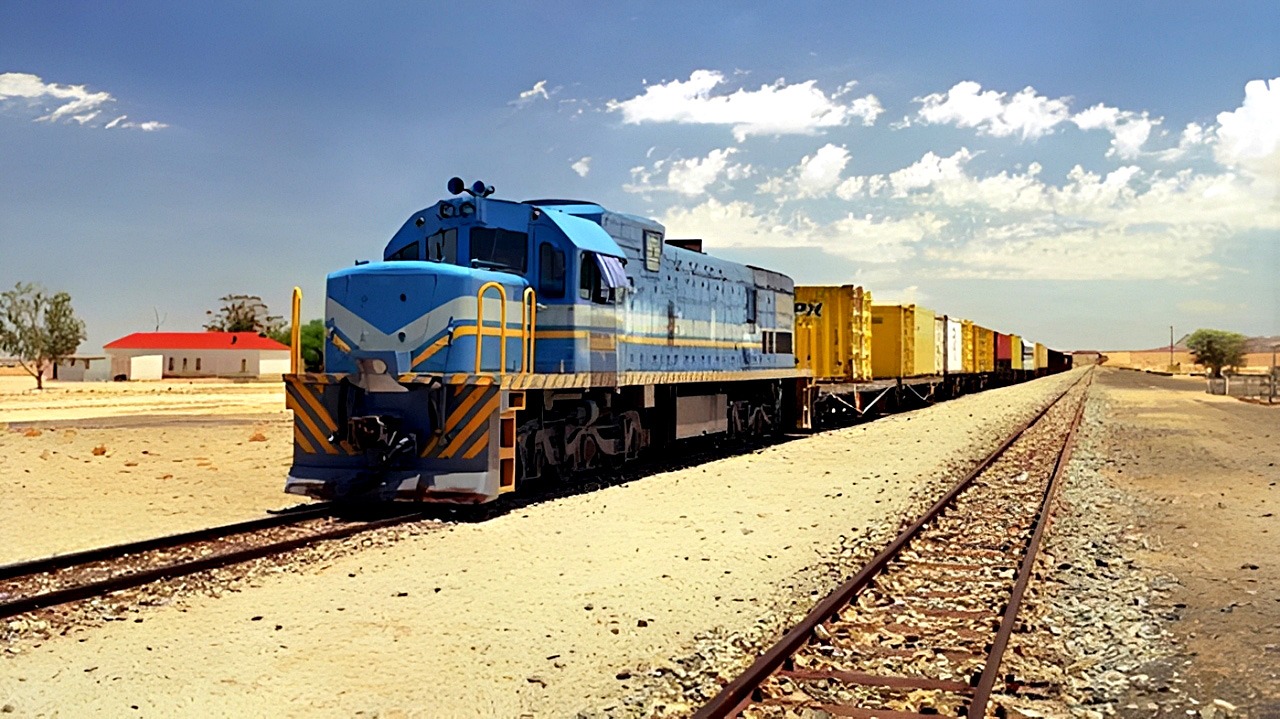
 The Trans-Kalahari Railway will run about 1,800km from Johannesburg to the Atlantic. (Photo: LinkedIn)
 On New Year’s Day, Donald Trump added Botswana and Namibia to the “naughty list” of passport holders who must pay a refundable bond of $15,000 for a visa to enter the US. This lumps them with some of the most corrupt countries on the planet: Uganda, Zimbabwe, Nigeria and Namibia’s northern neighbour, Angola.
It couldn’t have come at a worse time. In a joint effort, Botswana and Namibia are seeking investors for the proposed Trans-Kalahari Railway, built largely from scratch, starting in South Africa and running west through Botswana to Walvis Bay on the Atlantic, with a link to Namibia’s second port at Lüderitz.
If, as they hope, money comes from the US, there will be much travel to and forth, now more difficult with the visa bond. And it raises a red flag that could deter fund managers from the region’s biggest spend in years.
In 2010, Namibia and Botswana signed a memorandum of understanding on the Trans-Kalahari, but 16 years on there’s still no railway, just ministerial summits, another of which is set for June.
In Gaborone, former president Mokgweetsi Masisi has lamented the slow progress, saying “the project should not be starting, but rather in its final stages”, but during his five years at the helm, little was done. Masisi lost the 2024 election to Harvard-trained lawyer Duma Boko, who campaigned for the line and has been seeking donors abroad.
/file/attachments/orphans/125980362_488074.jpg "President of Botswana and presidential candidate for Botswana Democratic Party Mokgweetsi Masisi talks to media at the Mosielele Primary School polling station in Moshupa Village, west of Gaborone, on 30 October 2024. (Photo: EPA / Joel Honore Kouam)")
At first glance, the visa ban defies logic. On the annual corruption index published by Transparency International, Botswana and Namibia are ranked among Africa’s cleanest, high in the top 10. But a re-evaluation has been long coming, and Namibia especially has problems with graft. The ruling Swapo – in power since 1990 – has companies either linked to ministers or owned directly by the party, winning tenders for work funded by treasury.
In Botswana, President Duma Boko, in office just over a year, has pledged to diversify an economy in which most of the export revenue comes from diamonds. The rise of factory stones devastated the market, but while gems can be flown for sale abroad, coal and beef – the other two staples – are heavy to transport. There is a railway from Gaborone to Durban, but South Africa’s harbours have grown slow and congested, hence the plan for a line to the Atlantic.
/file/attachments/orphans/13375335_762805.jpg "President of Botswana Duma Gideon Boko speaks during the General Debate of the 80th session of the United Nations General Assembly at UN headquarters in New York on 25 September 2025. (Photo: EPA / Lev Radin)")
In 2023, after talks with Pretoria had gone nowhere, the then transport minister, Eric Molale, lashed out during a radio interview in Gaborone, saying “the waiting period at all South Africa’s ports to load and offload can be a minimum of two weeks”. The Trans-Kalahari, he believes, would draw cargo from exporters in Gauteng.
Phillip Balhao is a former mayor of Lüderitz who sees the railway turning Namibia into a regional giant.
“There is huge excitement here,” he said. “Everyone talks about the change it will bring. Just do the sums: Johannesburg’s economy alone is larger than all South Africa’s land-neighbours combined and this output would be going to the world through our country. It’s like winning the lottery.”
Balhao said the challenge lay in funding the line. “Namibia used to have a reputation as an easy place to do business and relatively free of corruption, but there’s a growing problem of favours being granted to people in government, and illicit cash moving in and out from Angola. Our press is vocal in identifying the culprits but that rarely leads to action.”
/file/attachments/orphans/images7_662788.jpg "Former Lüderitz mayor Phillip Balhao sees the railway turning Namibia into a regional giant. (Photo: Instagram)<br>")
He said investors worry about reputational risk. “I have spent years trying to grow Lüderitz and we’ve had success, mostly in the private sector. Personally I’d like to see a foreign company involved with the Trans-Kalahari and in expanding our harbours. Europe, Singapore, maybe the UAE. Full transparency and shareholders who can demand answers from the board, something that’s become difficult when the government here gets involved.”
If trains sound Victorian, they were. In 1879, the US linked the east and west coast via a number of tracks, all in private hands. Owners grew rich, steam engines roared across Australia, Canada and British India, and the world was captivated by tales of the Orient Express serving champagne and caviar all the way from Paris to Istanbul.
Africa was there too, lines spiralling from the gold fields of Joburg, north to the equator, east to Durban and Mozambique and the long-haul to Cape Town. But as car ownership grew and competition drove down airfares, rail became the Cinderella, until in 2017, China rebuilt the line from Nairobi to Mombasa at a cost of $3.6-billion. The game was on.
Landlocked Ethiopia linked its capital, Addis Ababa, with Djibouti on the coast, with a second route planned to Somaliland. West Africa’s first cross-border line in 70 years will connect Niger and Nigeria, and what’s been dubbed a “rail renaissance” is playing out across the continent.
At the end of his term in 2024, President Joe Biden arrived in Luanda to inspect repairs on the track from Katanga west to Lobito Bay in Angola. Built by the Portuguese in in the 1920s, it was damaged by neglect and civil war. Rare earth minerals and other ores from the Congo – vital to Washington – will be brought to the Atlantic and from there by sea to America.
Back to the new visa bonds and what might have triggered them. Gaborone has long had a pro-West stance but is now opening an embassy in Moscow. Did that upset The Donald? Maybe.
Botswana saw a five-year spat during the term of President Masisi, who accused his predecessor, Ian Khama, of embezzling billions. Khama was proved innocent, and last year the new government of Boko issued an apology – but mud sticks.
/file/attachments/orphans/13809165_374710.jpg "US President Donald Trump at a ‘Saving College Sports’ roundtable in the East Room of the White House in Washington, DC on 6 March 2026. (Photo: EPA / Aaron Schwartz / Pool)")
Then there’s the plan for a “Golden Passport”, a practice condemned in Trump’s decree on visas. For $75,000, it will be possible to become a Botswana citizen without the requirement of living 10 years in the country on a work permit. Add thousands of illegal migrants, mostly from Zimbabwe but also Angola and Malawi; Boko has pledged to formalise their status which could, in time, lead to citizenship. Another element in Trump’s decree on visas: control over who gets a passport.
South Africa’s record on crime, corruption and a broken immigration system is well known, but it hasn’t been punished by Washington… yet.
In Namibia the faults were obvious. For years oil money from Luanda has been trickling south of the border, with Angolans buying real estate in Windhoek and winning tenders that come with a number of resident permits that can, in time, mature to citizenship.
The Henley Index shows how many countries your passport is good for without a visa. From Singapore, Japan or neutral Switzerland it’s a breeze. Angola is at the other end, worse than Equatorial Guinea, even Haiti. By contrast, a Namibian passport is in the continent’s top five, along with Botswana and South Africa. Not for long, perhaps. In Windhoek, people talk openly about the “Angolan mafia”, not some Godfather with a gun but a growing presence of second homes, luxury cars and the ear of government. If the Trans-Kalahari is built, they are well placed for the boom that will follow.
A very public row in Windhoek is not helping. In August, a daily paper, The Namibian, reported that a $180-million contract linked to oil and gas deposits in the sea off Lüderitz had been advertised in a call for tenders. Then the authority in charge of harbours withdrew the ad amid reports that a Swapo-owned firm, Guinas Investments, had expressed interest. Another project at Walvis Bay has been offered to Sonangol, the Luanda oil company that made headlines when its former director, Isobel dos Santos – daughter of the late president – was accused of defrauding the firm before she fled to Europe.
At the centre of the furore is Andrew Kanime, a public servant of 30 years and chief executive of the Namibian Ports Authority, known as Namport. Kanime insists all tenders are “subject to an open and competitive bidding process”. He blamed the negative press about events at Lüderitz and Walvis Bay on “confusion and misalignment”, but cancelling the tender for Lüderitz has fostered suspicion of hidden interests at play, focused as usual on the “Angolan mafia”.
/file/attachments/orphans/inter_kanime_157976.jpg "Andrew Kanime, CEO of the Namibian Ports Authority.<br>(Photo: Africa Rises / Wiikpedia)")
(Photo: Africa Rises / Wiikpedia)
From transport to farming, telecoms and even satellite TV, the economy is peppered with companies linked to Swapo, the government or both. During his career Kanime has held positions in several of them, including the power corporation, state broadcaster and now the port authority.
Under Kanime’s watch Namport has come under increasing pressure; in September the docks at Walvis Bay were ranked among the world’s worst, placing 376th out of 405 in the 2024 Container Port Performance Index.
In its reports, the Economic Association of Namibia has drawn attention to the decline in business at the country’s habours, questioning a spend of $1.2-billion on new infrastructure and Namport’s ability to repay a loan of $200-million from the African Development Bank.
In November, despite repeated allegations in the press about the parastatal’s performance under Kanime, his contract was renewed for another five years. In his defence, he has not been charged with wrongdoing and readily answers questions from the media, but a due diligence report might be hard-pressed not to put a red flag next to his name.
But the spend and tenders at Namport are small change compared with the railway. The World Bank pegs Namibia’s GDP at just over $13-billion; the Trans-Kalahari, running about 1,800km from Johannesburg to the Atlantic, has a price tag of $10-billion, moving 90 million tonnes of Botswana coal alone, and a slice of South Africa’s $400-billion economy.
Worryingly, Transport Minister Veikko Nekundi, who will be directly responsible for the new railway, says that “issues of national security and sovereignty take precedence over any company’s operational matters”.
Balhao says the sole priority should be a transparent system at arm’s length from the government.
“The pressure on individuals is immense, from the ruling party and from cabinet. And outsiders, especially from oil-rich nations, are a worry.”
He said the Trans-Kalahari will bring thousands of jobs and billions in revenue. “The people of Namibia have a right to examine every cent that goes into this project, where it comes from and how it’s spent. And we need independent oversight, including a global board that can’t swayed or bullied by local interests.”
He said the controversy around Walvis Bay and Lüderitz and the ports authority had damaged Namibia’s good name. “I don’t know if that was behind a US decision on visas and I hope they relent and put us back on the clean list. But it’s our task to improve our image and we need to begin now.” DM
Geoff Hill is a Zimbabwean author and journalist.