




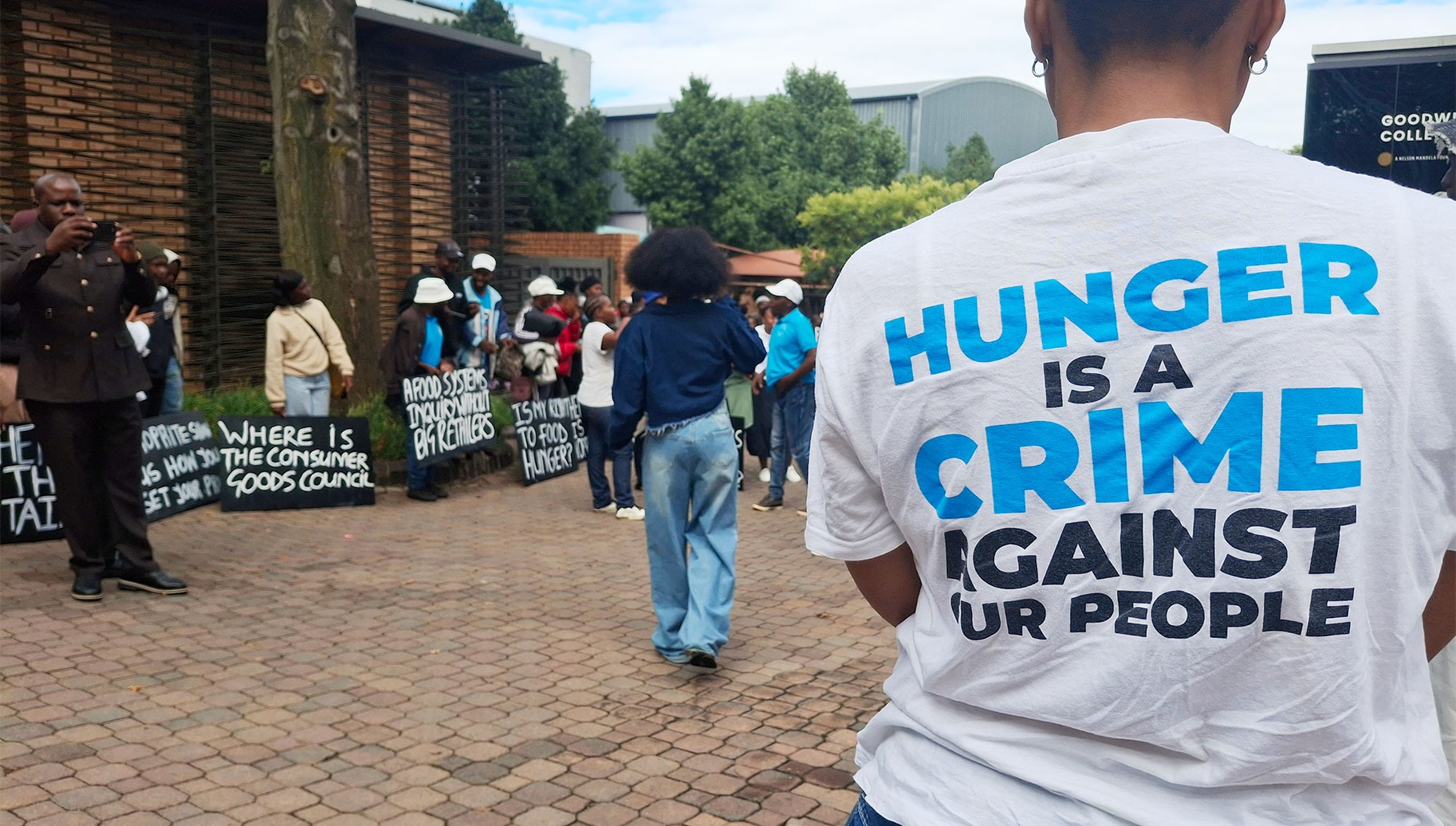
 The South African Human Rights Commission’s national inquiry into SA’s food systems heard oral submissions at the Nelson Mandela Foundation in Johannesburg from March 13-14, continuing on March 16-20. The inquiry will hear testimony from researchers, civil society organisations, community members and regulators about why millions of South Africans still go hungry. (Photo: Daniélle Schaafsma)
 “Why have we normalised malnutrition?” Palesa Claire Ndlovu, the member engagement officer for advocacy organisation Amandla.mobi, asked outside the Nelson Mandela Foundation, where members had gathered ahead of the organisation’s oral submission to the South African Human Rights Commission’s (SAHRC) food inquiry on Friday morning, 13 March.
“Mothers literally can’t afford nutritious food,” she said. “We’re not anticipating a future, we’re supposed to be building towards one.”
According to the 2024 General Household Survey, about 14 million South Africans went to bed hungry in 2024, which is roughly 22.2% of households in the country.
The SAHRC’s inquiry into South Africa’s food systems, which heard oral submissions on 13–14 March and will continue on 16–20 March, was convened to examine the structural dynamics and the concentration of power in the food value chain; failures of institutional coordination; policy coherence and legislative adequacy; as well as the role of land, indigenous knowledge and civic participation, public accountability and social movements in the country’s food systems.
For civil society organisations that have spent years pushing this issue onto the national agenda, the inquiry represents something rare: an official process that takes hunger seriously as a rights violation. The inquiry is a chance to put heat on a system that is repeatedly failing its people, said Mark Heywood, a co-founder of Union Against Hunger and a member of the organisation’s secretariat. It is a chance for the issue to be dealt with in a coordinated fashion and shows that ordinary people are struggling, he said.
/file/attachments/orphans/DS_6_852575.jpg "Community members from across Johannesburg join Amandla.mobi’s demonstration outside the Nelson Mandela Foundation on 13 March in Johannesburg, putting a human face to the statistics being presented inside at the South African Human Rights Commission’s national inquiry into the country’s food systems. (Photo: Daniélle Schaafsma)<br>")
The numbers
Statistics South Africa (Stats SA) set the scene on the first day of the inquiry. Food insecurity has risen steadily from 15.8% of households in 2019 to 19.7% in 2023, which is roughly 3.7 million households, according to Solly Molayi, acting deputy director-general of population and social statistics at Stats SA, who presented its submission to the SAHRC.
Stats SA’s research has shown that black African and coloured households, female-headed households and grant beneficiaries are consistently the most vulnerable, Molayi said. Counterintuitively, grant recipients are more food insecure than non-recipients, a finding that speaks directly to the inadequacy of grant amounts as living costs continue to rise.
On the second day of the inquiry, Professor Julian May, who represented the Department of Science, Technology and Innovation (DSTI) and the National Research Foundation’s (NRF) Centre of Excellence in Food Security, framed it plainly: South Africa is a net food exporter with a globally competitive agricultural sector, yet child stunting has remained stubbornly high for more than 30 years.
“Food security is not primarily a supply problem,” he said. “It is produced by structural drivers.” He proposed that persistent child stunting be treated not merely as a public health concern but as a constitutional crisis, given that the right to basic nutrition for children is an immediate, not progressive, obligation under Section 28 of the Constitution.
A system that works — just not for everyone
May’s final reflection was that “South Africa’s challenge is not about producing food. It’s about ensuring that the food system works for everyone.”
He posited that the brokenness of the system is not what needs to be queried, as the system actually performs well. The question that should be asked is “for whom the food system is working”, he said.
Amandla.mobi’s submission added a sharper edge to that observation. The organisation described years of failed engagement with major retailers over prices of staple food, including a 20,000-signature petition to a major retailer that was met with silence. Koketso Moeti, founding executive director of Amandla.mobi, drew attention to a striking conflict of interest: for many major retailers, their largest shareholders are organisations with representatives in positions of extreme power in South Africa. “Profiting from hunger is not a smart investment,” she told the panel.
/file/attachments/orphans/DS_3_666498.jpg "Community members from across Johannesburg join Amandla.mobi’s demonstration outside the Nelson Mandela Foundation on 13 March where the SAHRC was hearing submissions about the adequacy of South Africa’s food systems. (Photo: Daniélle Schaafsma)")
The Socio-Economic Rights Institute (Seri) and its partners also argued that the food system fails those at the bottom. They shared the stories of domestic workers who described being fed rotten leftovers, denied cooking facilities and having their own groceries thrown away by employers. Of farm workers who reported being prohibited from keeping livestock or growing food on the land they work and live on. And of reclaimers who described being systematically excluded from food donations because of political gatekeeping.
The Legal Resource Centre also highlighted how small-scale fishers, despite decades of advocacy and litigation, continue to be micro-regulated into exclusion while commercial fishing interests operate with relative freedom.
Corporate power and policy capture
Researchers from the University of the Western Cape documented how corporations producing ultra-processed food shape both consumer behaviour and public policy. Their data showed that 76% of packaged food in South African supermarkets is ultra-processed, with low-income consumers deriving on average 40% of their diet from such products.
Using the sugar tax as a case study, they said that nearly half of all submissions to that consultation process came from industry, and the levy was passed at half the recommended rate. Regulations for a front-of-package warning label, first proposed in 2014, remain unpromulgated.
Commissioner Doris Tshepe, who represented the South African Competition Commission, acknowledged price differences between the farm gate and retailers. The price of maize meal was on an upward trajectory for the first half of 2025, and although prices are decreasing, retail margins reached 637% in November 2025.
Professor Hettie Schönfeldt, one of the three evidence leaders of the inquiry, pressed Tshepe on whether fines were sufficient deterrents, even if the limit had been raised to 25%, citing the bread cartel fine, which amounted to a fraction of profits made. Tshepe acknowledged that criminal prosecution provisions introduced in 2019 as part of amendments that specifically deal with repeat offenders have still not been tested.
Hardin Ratshisusu, acting deputy commissioner and acting commissioner of the National Consumer Commission (NCC), was pressed on the calls from other submissions for greater transparency in food-pricing structures. While he acknowledged the NCC has powers to investigate cost structures, he cautioned that too much public transparency between companies could actually facilitate collusion.
Under further questioning, Ratshisusu also acknowledged that the NCC has not yet developed any formal criteria for assessing the fairness of food prices, partly, he suggested, because people buy out of necessity and consume the product before alerting the commission that something is wrong. When pressed, Ratshisusu acknowledged that nothing in the NCC’s mandate prevents it from investigating food pricing, but that it has simply not been a priority.
Who is responsible?
Across both days, SAHRC commissioner Sandra Makoasha, the chairperson of the inquiry, repeatedly pressed representatives on one question: who is responsible?
The answer, consistently, was everyone and no one. Food governance is fragmented across at least six national departments with no single accountable body, a gap that multiple presenters argued can only be closed through framework legislation.
Seri called for a national Food and Nutrition Security Act with clear duty-bearers and enforceable accountability mechanisms. May, who represented the DSTI-NRF, recommended the establishment of a National Food Security Council, chaired by the Deputy President, with coordinating councils at provincial and municipal levels.
The African Farmers Association of South Africa, in turn, pointed to the collapse of agricultural extension services and local economic development capacity in municipalities as a critical and under-appreciated driver of food insecurity. And Food Forward South Africa highlighted that if just 50% of South Africa’s 10 million tonnes of annual food waste were recovered, it could provide 20 billion meals a year at a fraction of the cost of purchasing equivalent food.
/file/attachments/orphans/DS_2_234943.jpg "South Africa’s big retailers were notable by their absence from the South African Human Rights Commission’s inquiry into food systems in South Africa. (Photo: Daniélle Schaafsma)")
The notable absence of major retailers from proceedings did not go unaddressed. Demonstrators from Amandla.mobi questioned it directly. “These people that are standing here, they’re the ones that support these retailers,” Ndlovu said. “Why will you not come here and tell us why you feel you’re already doing enough?”
Makoasha told Daily Maverick that the SAHRC had invited many big retailers to the inquiry, and some wrote back questioning their role in the investigation. According to Makoasha, the panel is deliberating the importance of including the organisations, and is considering whether they should be present during the second leg of the inquiry. DM