




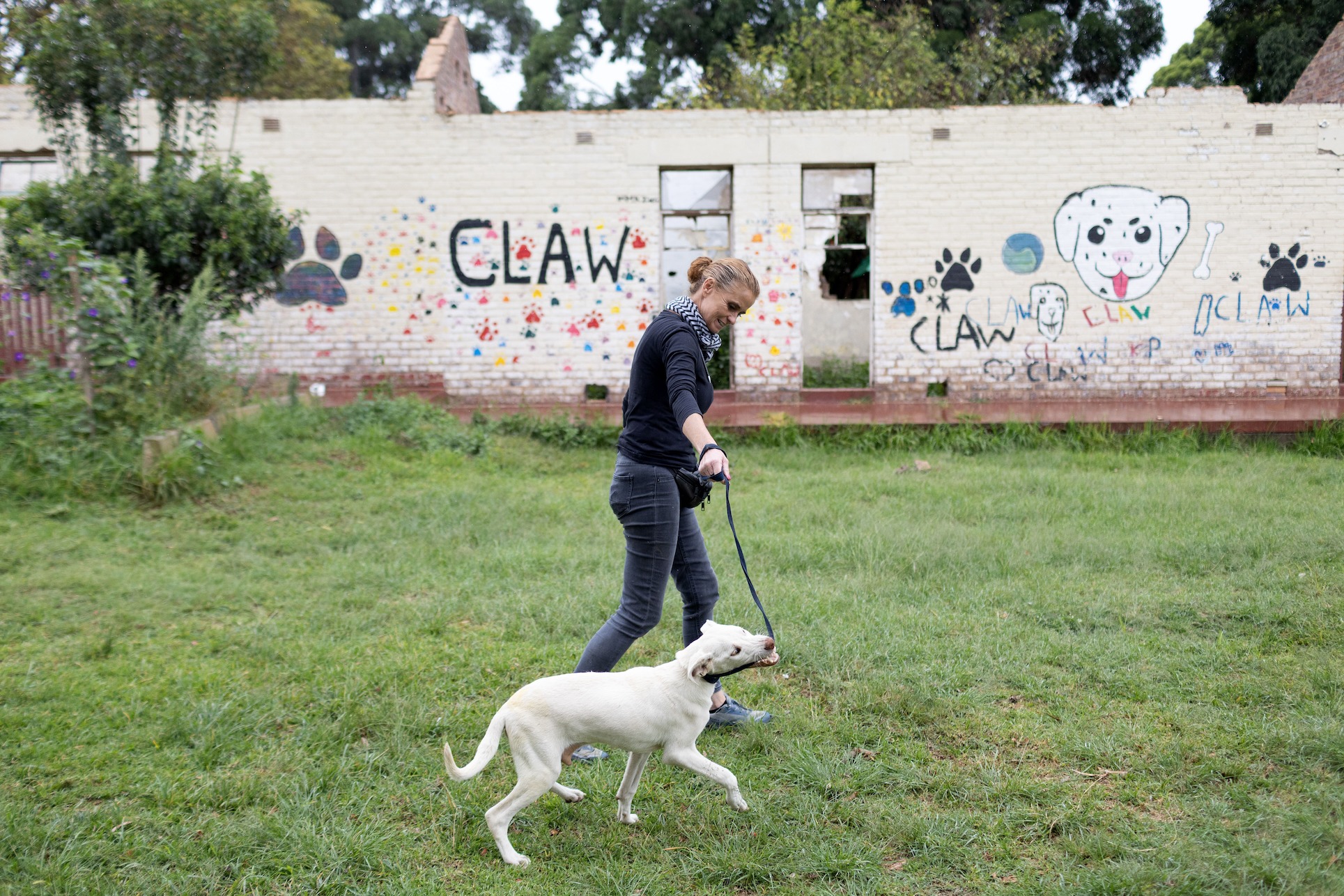
 Volunteer Michelle Weedman walks a dog being treated at the Community Led Animal Welfare centre in Durban Deep, Johannesburg. on 12 March 2026. (Photo: Our City News / Alaister Russell)
 For more than three decades, the team at Community Led Animal Welfare (CLAW) has quietly provided a lifeline to animals in some of Johannesburg’s most underserved communities.
From treating injured dogs to educating pet owners about basic care, the organisation has built its reputation on meeting people and their animals where help is needed most.
At the heart of that effort are staff and volunteers like Michelle Weedman, who works closely with residents and sees first-hand both the hardships and compassion that shape animal welfare work in the city.
Speaking to Our City News, Weedman explained that CLAW’s mission was born from a simple but urgent need.
“CLAW has been in existence for over 30 years, and it started as there was no veterinary care in the township areas at that time for animals that were greatly in need. It mainly services the township areas and provides basic veterinary care to these local communities that do not have access to veterinary services,” she said.
/file/attachments/orphans/Ndlovu-Joburg-CLAWinset1_278949.jpg "A poster on the wall at the Community Led Animal Welfare centre in Durban Deep on 12 March 2026. (Photo: Our City News / Alaister Russell)")
/file/attachments/orphans/Ndlovu-Joburg-CLAWinset3_965291.jpg "Nthabiseng Ralitapole and Michelle Weedman talk to a person who brought a kitten to the Community Led Animal Welfare centre in Durban Deep on 12 March 2026. (Photo: Our City News / Alaister Russell)")
/file/attachments/orphans/Ndlovu-Joburg-CLAWinset4_545689.jpg "Nthabiseng Ralitapole, who manages the cat room, interacts with a cat that is up for adoption at the Community Led Animal Welfare centre. (Photo: Our City News / Alaister Russell)")
She added that the work goes far beyond treating sick or injured animals. Education is a central part of what the organisation does.
“I think the biggest challenge that we see in the township areas, first and foremost, would be education. We work a lot with the walk-ins that we have and the communities that we work in, and we try to educate them around responsible pet ownership. It is a big job,” she said.
She believes that for many pet owners, even the basics of animal care can be difficult when households are already under financial strain.
“The first thing is what is required in terms of keeping that pet healthy and safe, starting with basic things like vaccinations, shelter and feeding, feeding pets, in particular, can be a sensitive issue in communities where many families are struggling themselves,” she explained.
/file/attachments/orphans/Ndlovu-Joburg-CLAWinset5_169015.jpg "A worker cleans out the cages for the dogs being treated at the Community Led Animal Welfare. (Photo: Our City News / Alaister Russell)")
/file/attachments/orphans/Ndlovu-Joburg-CLAWinset6_550042.jpg "Xolani Sibanyoni, who is responsible for the outdoor kennels, interacts with a dog up for adoption at the Community Led Animal Welfare centre in Durban Deep. (Photo: Our City News / Alaister Russell)")
/file/attachments/orphans/Ndlovu-Joburg-CLAWinset7_223609.jpg "Michelle Weedman, Zothani Khoza and Jared Johnson treat an injured dog at the Community Led Animal Welfare centre in Durban Deep. (Photo: Our City News / Alaister Russell)")
Weedman emphasised that preventative healthcare is another key area of focus, especially when it comes to parasites.
“It does not matter whether you are in the township or you live in Sandton, ticks and fleas are everywhere, and prevention is much better than the actual treatment itself,” Weedman said.
Despite the many challenges, Weedman said the organisation continues to witness powerful moments of compassion from the communities it serves.
“There are just so many special moments that we have with our communities… they are not all happy endings and they are not all warm moments and unfortunately many of them are very challenging,” she said.
While the organisation’s work has grown over the years, funding remains one of its biggest obstacles.
With more financial support, she believes the organisation could dramatically expand its reach.
“You have volunteers here and staff, and if you had double that, what one could actually achieve would be incredible,” she said.
The organisation also faces logistical challenges that many veterinary clinics never have to consider.
Currently, CLAW operates without several basic municipal services. The facility, located in what was once an old mine building, has been adapted to function as a veterinary clinic, but it lacks essential infrastructure.
“We have not had running water and municipal electricity for over 10 years,” she said.
Instead, water is trucked into the property daily and stored in tanks. Electricity is also limited.
/file/attachments/orphans/Ndlovu-Joburg-CLAWinset8_536082.jpg "Volunteer Jared Johnson and Michelle Weedman treat a puppy with facial injuries at the Community Led Animal Welfare centre. (Photo: Our City News / Alaister Russell)")
“We run off solar and that is used for our scale, our microscope and our fridge. If you turn on a light, you are very conscious that you are using solar energy and wondering how long it is actually going to last. We do not have municipal refuse collection, we have a skip (bin) that we have to pay for to be removed regularly,” Weedman said.
Despite the difficulties, Weedman believes collaboration between the City and welfare organisations could help improve the situation.
The organisation has also had to navigate safety challenges in the surrounding area due to illegal mining.
Referring to the presence of illegal miners, known as zama zamas, Weedman said: “In the past it was really challenging. At one point, the miners dug large holes into roads near the property, raising concerns about safety. We were worried about cars coming down the road at night because there were no street lights.”
/file/attachments/orphans/Ndlovu-Joburg-CLAWinset9_641273.jpg "Michelle Weedman treats a dog that has been poisoned at the Community Led Animal Welfare centre. (Photo: Our City News / Alaister Russell)")
While the situation has improved somewhat in recent years, occasional gunfire between rival groups can still be heard at night.
But Weedman emphasised that the organisation’s focus remains firmly on its mission.
“Our biggest thing is that they do not impact us. If we keep our distance, they keep theirs and despite the challenges from limited funding to infrastructure struggles, the work remains deeply rewarding,” she said. DM
This story was produced by Our City News, a nonprofit newsroom that serves the people of Johannesburg.