




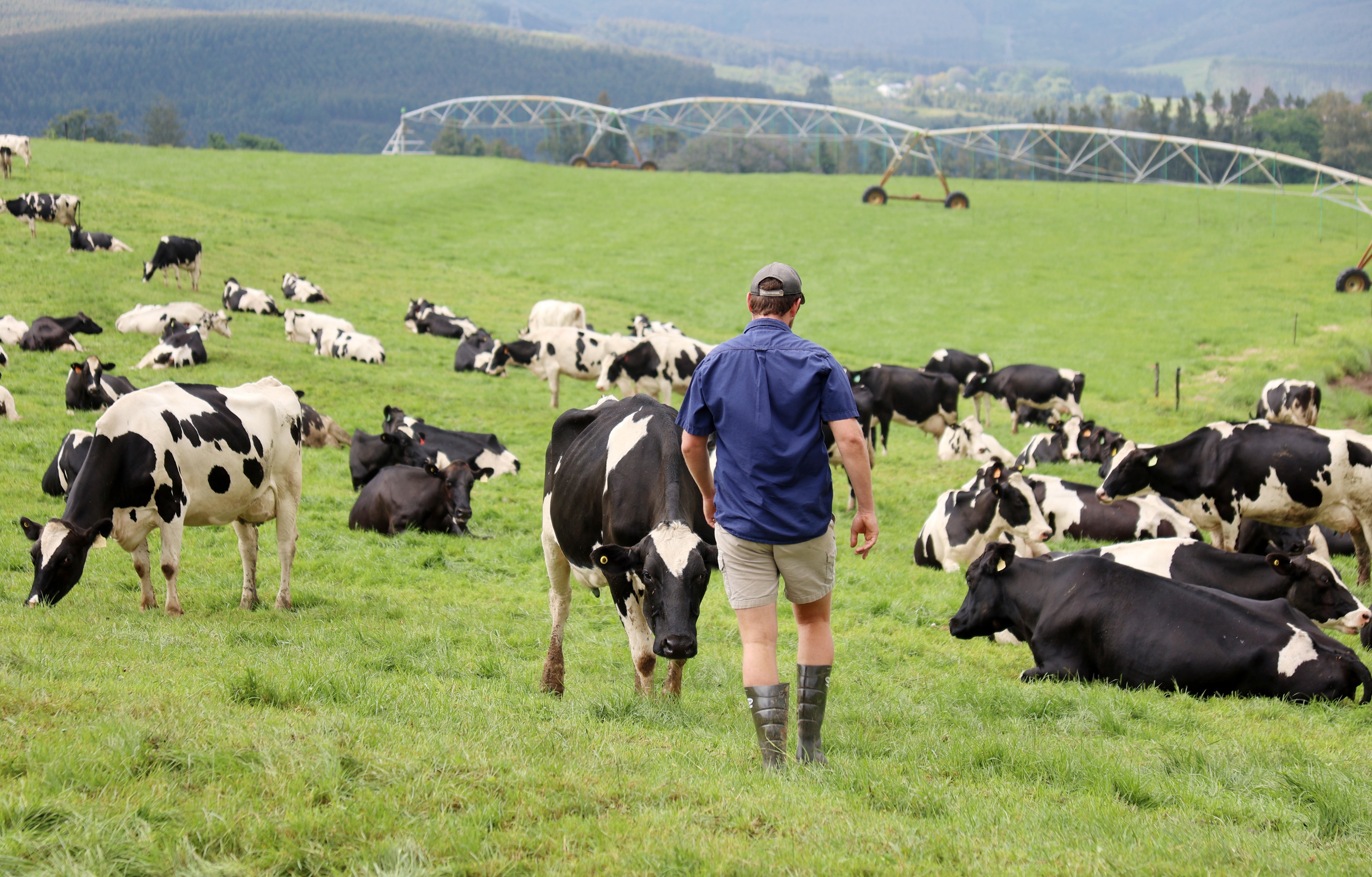
 While the percentage of South African dairy farms affected by FMD is still relatively low, there might be a greater impact later on, especially if the disease hits high-density dairy production areas in the Eastern Cape and Western Cape. (Photo: Thando Nene)
 As the start of the 2026 financial year looms in April, the outbreak of foot-and-mouth disease (FMD) in South Africa continues to be a major concern for local farmers, as the first phase of the government’s control strategy — vaccination – is rolled out across the country.
In some provinces, the severity of the crisis is reflected in the funding allocations of provincial budget outlines for 2026.
Lebogang Maile, Gauteng MEC for finance and economic development, announced in his budget speech on 10 March 2026 that the allocation for the provincial Department of Agriculture and Rural Development would include R63.9-million to contain FMD through vaccination and surveillance. This represents about 8.6% of the overall 2026/27 budget for the department, which is R742.6-million.
Bronwynn Engelbrecht, the DA’s Gauteng shadow MEC for agriculture and rural development, has argued that this budget allocation is insufficient to contain FMD in the province, where farmers are already facing movement restrictions, collapsing markets and rising feed costs.
“This funding does not indicate that the Gauteng government grasps that this is a disease capable of devastating livestock farming, disrupting food supply chains and destroying jobs across the agricultural economy,” said Engelbrecht.
“Farmers who work tirelessly to produce food for Gauteng deserve more than uncertainty and inadequate funding. They deserve a government with a clear strategy that acts swiftly, communicates clearly and understands that protecting agriculture means protecting jobs, food security and the economic stability of the province.”
/file/attachments/orphans/ED_562021_428425.jpg "Cattle at the Karan Beef feedlot in Heidelberg during a foot-and-mouth disease vaccination drive. (Photo: OJ Koloti / Gallo Images)")
Using the R63-million
Gauteng’s MEC for agriculture and rural development, Vuyiswa Ramokgopa, told Daily Maverick that the department had already redirected R16-million internally to strengthen the provincial response to FMD, on top of the existing baseline budget for animal health services.
These funds had been used to procure the BVI vaccine, manufactured by the Botswana Vaccine Institute, as well as the equipment and materials required to administer vaccines to cattle.
“The R63-million allocation represents additional funding aimed specifically at accelerating and intensifying Gauteng’s province-wide rapid response programme. This allocation will enable the department to expand operational capacity as we continue to respond to the evolving situation and support farmers in affected areas,” said Ramokgopa.
The funds will primarily support the operational requirements necessary to implement Gauteng’s vaccination programme, including the employment of additional animal health technicians and veterinarians, and the procurement of vehicles to support field teams operating across affected regions.
“The department’s current fleet is not sufficient to meet the demands of the expanded response,” explained Ramokgopa.
The response to FMD was a shared responsibility between national and provincial governments, she said.
The National Department of Agriculture was largely responsible for securing and distributing vaccine doses to provinces, while at the provincial level, the Gauteng Department of Agriculture and Rural Development was responsible for the deployment and administration of vaccines on the ground, as well as surveillance, monitoring and farmer support.
/file/attachments/orphans/FMD17_893456.jpg "Cattle grazing on a farm in Limpopo. (Photo: Leano Larona)")
“It must also be noted that provincial interventions are interdependent, as the management of the outbreak and the distribution of resources are influenced by the responses and needs of other provinces. Budget allocations and vaccine distribution are therefore considered within the broader national response,” said Ramokgopa.
In the Western Cape, R139.7-million of the R949.8-million provincial budget for “unforeseen and unavoidable events” will go towards combating FMD, according to Deidré Baartman, the MEC for finance in the Western Cape, in her budget speech for 2026/27. This money is earmarked for vaccines and scaling provincial veterinary capacity to protect the dairy and meat industries.
The KwaZulu-Natal provincial budget speech did not give an exact allocation for FMD management, though Francois Rodgers, KZN’s MEC for finance, noted that the disease was an “emerging crisis” that affected job creation and economic growth in the province’s agricultural sector.
He noted that KwaZulu-Natal had been identified as the epicentre of the national disaster.
The 2025/26 budget for the province included a R256.4-million allocation for “animal health”, though it is not clear how much of this budget would be targeted at FMD.
Concerns in the dairy industry
The Consumer Goods Council of South Africa (CGCSA) has reportedly issued an open letter to the ministers of agriculture, and trade, industry and competition, warning that government restrictions on milk and dairy exports due to FMD exceeded international standards and were causing significant harm to the industry.
News24 reported that the CGCSA letter stated that local regulations went beyond the guidelines set by the World Organisation for Animal Health (Woah), which permits the safe trade of dairy products that have undergone ultra-high temperature (UHT) treatment or double pasteurisation. These processes are considered effective in neutralising the FMD risk.
Updated FMD regulations around dairy products were issued in late February, marking two significant changes.
The first was that up until then, even farms that were vaccinated against FMD were considered infected, according to Mark Chimes, veterinary adviser for Milk South Africa.
“They changed that rule, which means now if you don’t have foot-and-mouth disease… but you are vaccinated preemptively, then ... you’re no longer placed under quarantine,” he explained.
Another change was the treatment requirements for milk and dairy products for the domestic market.
“For export purposes, you need to double pasteurise the milk, or it must be UHT-treated. Those methods, double pasteurisation and UHT, kill the virus ... but they applied the same rules for domestic use. Since we now have widespread foot-and-mouth disease anyway, they’ve relaxed a little bit and said you only have to pasteurise the milk once if it’s going for domestic use,” said Chimes.
However, there are still challenges around the export guidelines for milk and dairy products. Chimes noted that while the Woah guidelines push for double pasteurisation or UHT treatment, some importing countries are satisfied with lighter standards.
“An importing country, let’s say Zimbabwe, might have rules that are slacker and say, ‘We’re happy to take the milk as long as it’s … [gone through] single pasteurisation, provided it doesn’t come from a quarantined farm.’
“But unfortunately, with our veterinary services being fragmented across nine provinces, the interpretation of these guidelines differs sometimes. It’s very dependent on the province ... so one province might be happy to export or give an export permit for Zimbabwe, and the other province might not.”
Chimes noted that if an importing country were willing to accept single pasteurisation, dairy companies should be able to export to it under these standards, rather than those set by Woah.
In his role on the ministerial task team for FMD, established by the minister of agriculture, John Steenhuisen, Chimes said he had advocated for decisions about the regulation of milk and dairy exports to be set down in a directive and issued to provinces, “to make sure that all the state vets understand how these rules are to be applied and how they're to be interpreted”.
Chimes said that while the percentage of South African dairy farms affected by FMD was still relatively low, there might be a greater impact later on, especially if the disease hit high-density dairy production areas in the Eastern Cape and Western Cape.
“When farms are affected by foot-and-mouth disease, two things happen. Firstly, obviously, their production drops, and secondly, they end up with fewer animals, because a lot of animals are culled as a result of the disease,” said Chimes.
“Once the disease has passed, not only has the farm got fewer animals to produce milk ... [it’s also] got a long-term effect that once the farmer has to start replacing cows, he might not have any young animals to take their place.
“So, I foresee that we are going to see a drop in milk production in that sense, but at the same time, it’s affected our exports, so there’s a lot more dairy products coming onto the domestic market as a result of export restrictions.” DM
/file/attachments/orphans/ChildrensReporterV2_187851.jpg "Tamsin-DG-Murray-Trust")