




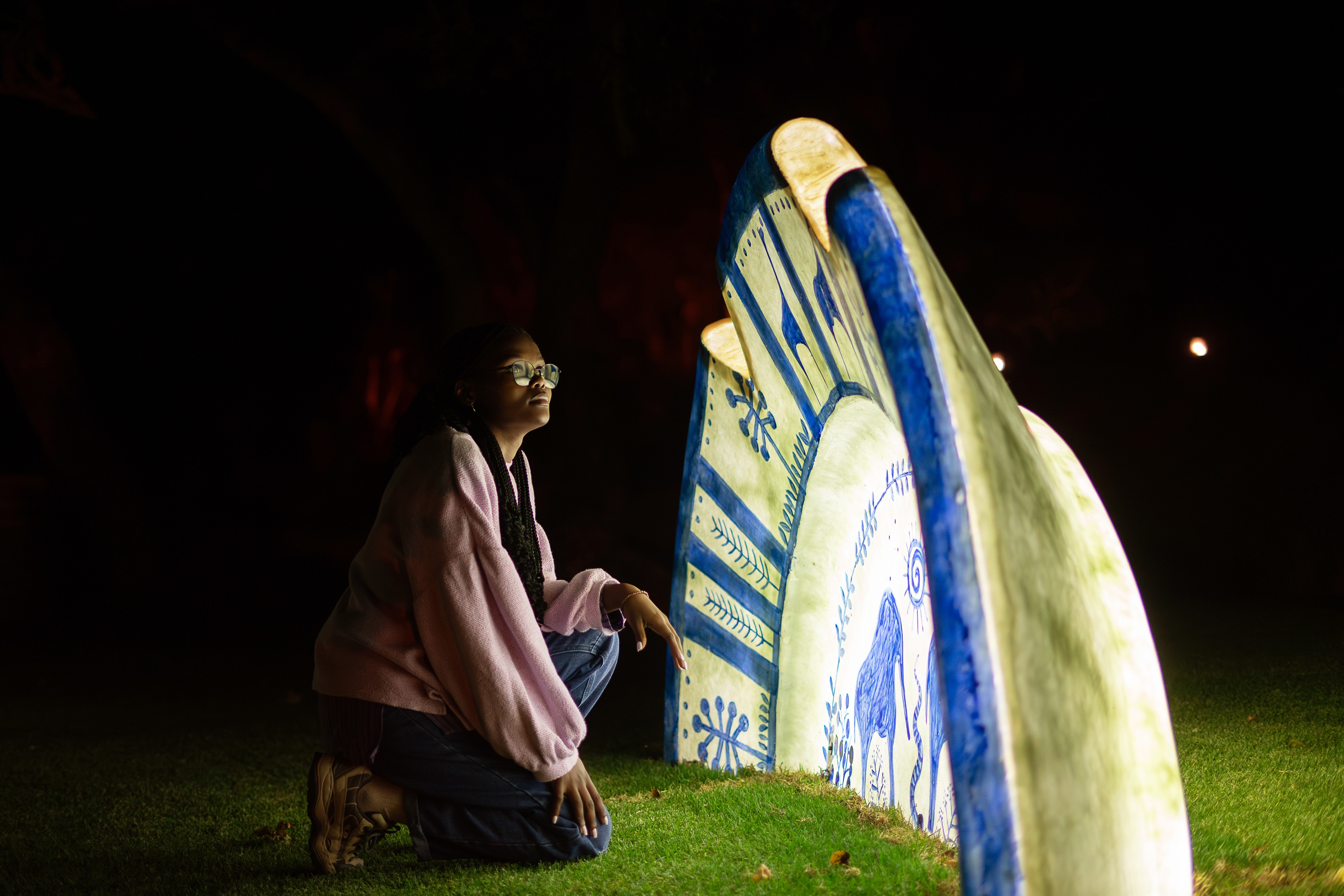
 Artifacts by Strijdom van der Merwe replaces colonial designs with those of the indigenous San and Khoe. (Photo: Spier Wine Farm)
 A smashed-in car stands in the centre of a garden lawn. Its mechanical guts are exposed, threatening to spill onto the grass, while steam rolls out from the seams of its doors. Through the windows, a soft red-orange glow pulses.
Guests at Spier Light Art are drawn to the scene, and like a magnet we’re pulled in to investigate the wreckage more closely. In front of the car’s remains are two luminescent frames: the borders of an Instagram post with the captions, “What is missing in this picture?” and “How will you be moved?”
The work, by Ronald Abdou and Zachary Stewart, is called Burning. It is, according to the curatorial notes, an exploration of “how social media enables people to become spectators of violence”, raising the question of “how digital platforms influence empathy and awareness”.
There is, then, a blatant irony in the fact that many of us stand around the car to take photos that will likely end up on our own social media pages. Yet, at the same time, there’s a twisted beauty in how our engagement with the piece makes its meaning tangible, becoming ourselves a part of the artwork’s purpose.
/file/attachments/orphans/BurningbyRonaldAbdouandZachStewartlooksathowsocialmediaenablespeopletobecomespectatorsofviolence_SpierWineFarm_278223.jpg "Burning by Ronald Abdou and Zach Stewart looks at how social media enables people to become spectators of violence. (Photo: Spier Wine Farm)")
/file/attachments/orphans/AMomentofRestforYouandThoseWhoCantbyStephenvandenHeeverandAmyLeibbrandtexploresrestbyobscuringandrevealingsecludedspacesandshadowpuppets_SpierWineFarm_266349.jpg "A Moment of Rest for You and Those Who Can’t by Stephen van den Heever and Amy Leibbrandt explores rest by obscuring and revealing secluded spaces and shadow puppets. (Photo: Spier Wine Farm)")
Burning is one of the 21 works on display at this year’s Spier Light Art, in its eighth edition. Curated by Jay Pather and Vaughn Sadie, the 2026 event positions itself in the context of South Africa’s arts and culture minister withdrawing Gabrielle Goliath’s Elegy from the Venice Biennale.
Spier Light Art’s curatorial statement asserts that their vision for this year’s edition is centred on the “urgency to capture the subjective experience in the midst of a political hegemony’s attempt to annihilate and wipe out our witnessing and acknowledgement”.
This practice of witnessing is found in art pieces like Artifacts by Stellenbosch-based artist Strijdom van der Merwe, where three shards of ceramic plates, illuminated from within, jut out from the ground.
Each fragmented piece is easily more than a metre wide, bearing chipped edges and decorated in the style of Dutch Delftware. Yet, instead of the expected florals and Western structures, Van der Merwe uses the traditional blue colour to depict indigenous designs from San and Khoe cultures as an honouring of untold history, while “symbolising a union between indigenous images and colonial imports”.
Among the viewers there is a sense of reverence, tending to keep a distance from the work as if anxious not to damage or disturb the excavation site.
/file/attachments/orphans/WhentheSkyFallsbyKennethShandureflectsonSouthAfricasdevastatingfloodsandtheresilienceofaffectedcommunities_SpierWineFarm_509089.jpg "When the Sky Falls by Kenneth Shandu reflects on South Africa’s devastating floods and the resilience of affected communities. (Photo: Spier Wine Farm)")
/file/attachments/orphans/LumenVitaebyKunyeColabrevealsconnectionbetweenpeopleandtheworldsnaturalrhythms_SpierWineFarm_603686.jpg "Lumen Vitae by Kunye Colab reveals connection between people and the world’s natural rhythms. (Photo: Spier Wine Farm)")
In other spaces on Spier Wine Farm, the artworks call their viewers into a more physical encounter. In Kunye Colab’s Lumen Vitae, for instance, two circles of colourful light shiver and morph in response to viewers’ voices, while the projection, like many of the other projections on display, draws people in to admire and capture their silhouettes dancing across the kaleidoscopic projections.
Spier Light Art’s collection of works has the potential for discourses to emerge across its interrogations of coloniality, our relationship with nature, as well as reflections on South Africa’s past, present and future. Alongside the event’s sculptural works are short films that play against a backdrop of the setting sun or the shadows of mountain ranges.
One of these films is Closer to Harm than Home by Theytjie, which reframes a commute in the Cape Flats as an act of survival. Through a vivid first-person perspective, the camera brings the viewer into the subject’s own eyes. We hear the ground crunching beneath each step and the intensifying breath of anxiety. Radio frequencies and static become the film’s score, immersing us in a shared tension and unease.
Urban life is bombarded by unnatural light, whether from the palm-sized glare of our devices or from the human-made infrastructure that turns night-time views into a sea of brightness, washing out even the stars.
Spier, on the other hand, casts this technology in a different light, where the medium becomes intertwined with its natural surroundings so that the nocturnal critters persist in their chirping and the stars remain unperturbed in the purple sky. DM
Spier Light Art is taking place until 6 April 2026. Entry is free but booking is required.