




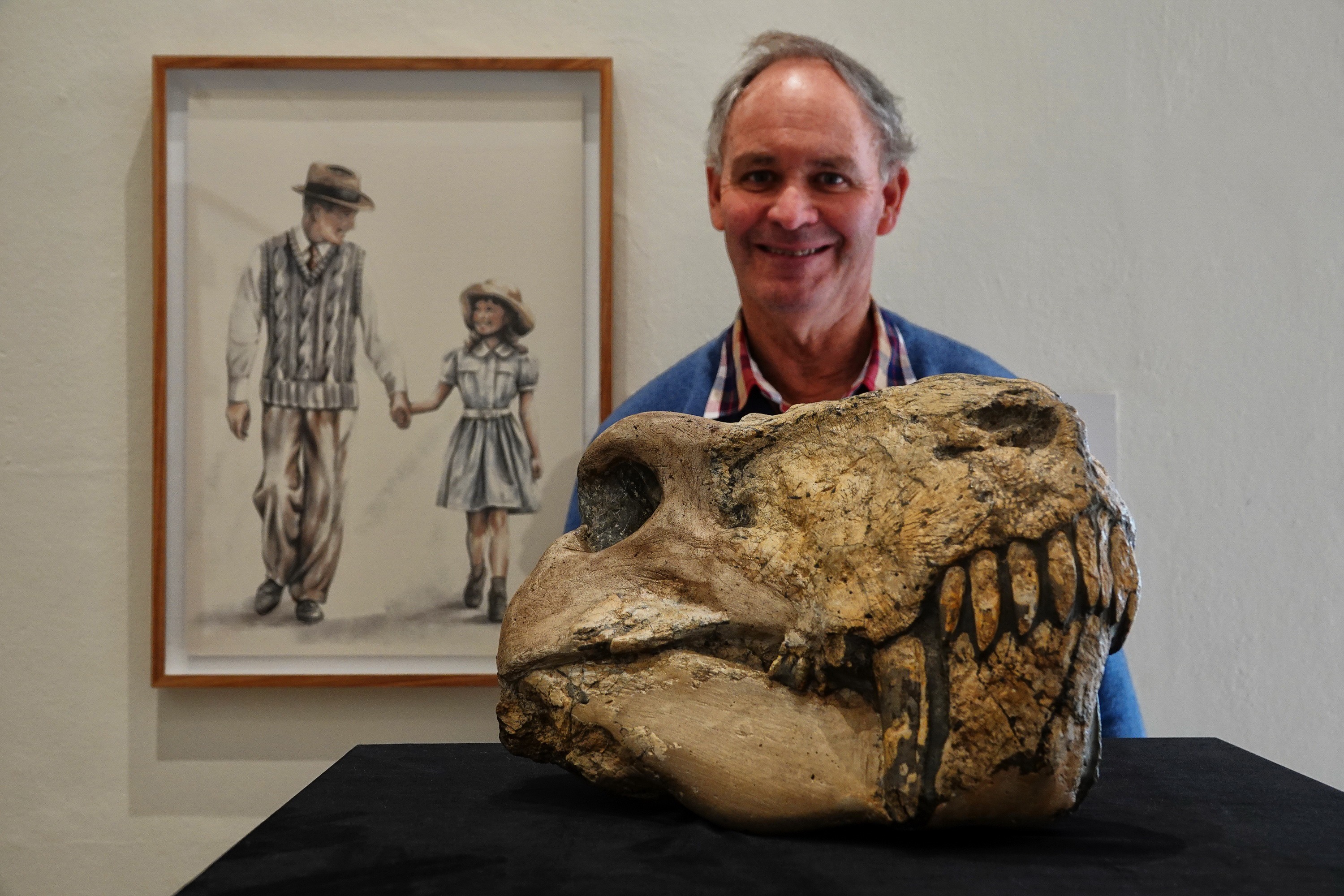
 Professor Bruce Rubidge with the ‘horse-head sized fossil’ that turned out to be a gorgonopsian predator 255 million years ago. In the background is an artist’s impression of his grandfather Sidney Rubidge and Peggy (Bruce’s aunt), off to look for fossils. (Photo: Chris Marais)
 It’s always the killer that catches your eye first. In the case of the Karoo Origins Fossil Centre in Graaff-Reinet, that would be the gorgonopsian Rubidgea, a tiger-sized predator with fierce eyes and a mouthful of dagger-sharp fangs.
In front of it, there is an Aulacephalodon, pig-sized and wild-eyed, forever frozen in the act of sprinting for its very life.
Gazing in startled horror at the drama, and hugging the safety of their burrows, are the Diictodons – dassie-sized creatures with strange beak-like mouths.
On the other side of the diorama is a creature the size of a small, portly cow, covered in scaly armour, munching impassively on tasty ferns and horsetails. This is a Pareiasaurus. A few curious weasel-sized Procynosuchus cynodonts explore a fallen log near its feet.
These are some of the characters that once roamed this part of the Karoo during the Permian period, about 255 million years ago.
To University of the Witwatersrand’s Distinguished Professor Bruce Rubidge, they are as familiar as the livestock and wild animals on Wellwood, the Merino stud farm north of Graaff-Reinet where he grew up. Bruce is part of the fifth generation of Rubidges on the farm, founded in 1838. As the eldest of five siblings, he was expected to take over the stud from his father Richard.
But a gorgonopsian changed his life.
/file/attachments/orphans/AgorgonopsianRubidgeawithadassie-sizedDiictodoninadioramawithadifference_ChrisMarais_831412.jpg "A gorgonopsian (Rubidgea) with a dassie-sized Diictodon – in a diorama with a difference. (Photo: Chris Marais)")
/file/attachments/orphans/AheftyPareiasauruswithfewcuriousweasel-sizedProcynosuchuscynodontsexploringafallenlognearitsfeet_ChrisMarais_319406.jpg "A hefty Pareiasaurus with few curious weasel-sized Procynosuchus cynodonts exploring a fallen log near its feet. (Photo: Chris Marais)")
A thing like a horse’s head
Rubidge’s story begins with his grandpa, Sidney, and his aunt, Peggy. In 1934, at the age of 10, Peggy came home from school and asked her father: “Dad, what are fossils and where can you find them?”
“Let’s go off for a picnic and see if we can find one,” he suggested. They headed for a koppie on a part of Wellwood called Rubidge’s Kloof, and Peggy soon found something interesting in the rock.
Bruce picks up the story: “Then Grandpa started chopping it out with a hammer and chisel. He didn’t know what he was doing, but a thing like a horse’s head started coming out of the rock. He contacted Frederick William Fitzsimons, director of the Port Elizabeth Museum. Fitzsimons wrote back and told Grandpa he must get hold of Dr Robert Broom.”
Broom was then South Africa’s top palaeontologist, based at the Transvaal Museum, now known as the Ditsong National Museum of Natural History, in Pretoria. Before Sidney could even send word about this strange beast encased in stone, Broom contacted him. News travels fast in the Karoo.
“Grandpa went to fetch him at Bethesda Road railway siding and brought him to Wellwood.”
Sidney Rubidge’s very first fossil turned out to be a great discovery. It may have had a horse-like head, but judging by its dagger teeth, this was clearly a carnivore. It was way older than the dinosaurs and turned out to be the apex predator of its time. Broom named it Dinogorgon rubidgei.
This striking skull now has pride of place at the Karoo Origins Fossil Centre in Graaff-Reinet, along with the story about Sidney and his daughter Peggy.
Broom would later write: “The mammal-like reptiles from South Africa may be safely regarded as the most important fossil animals ever discovered, and their importance lies chiefly in the fact that there is little or no doubt that among them we have the ancestors of mammals, and the remote ancestors of man.”
A knack for finding fossils
From then on, Sidney was completely hooked on stone bones.
“In fact,” says Bruce, “he wrote in an article that if he hadn’t been custodian of an old family farm he would have chosen palaeontology as a career. He was then 46 years old.”
While Robert Broom was a GP, practising medicine from his base in Pearston (1900 to 1903) he began collecting fossils in the Karoo.
He also encouraged several Karoo people to collect fossils for him to research. One of these, whom he met in 1914, was Croonie Kitching, a “padmaker” or overseer of the roads department, near Nieu-Bethesda.
Broom passed on the connection to Sidney Rubidge. Sidney then asked Croonie to look out for fossils, offering to pay for them.
“Croonie had eight children, so he sent his kids into the mountains to hunt for fossils. His eldest son, James, turned out to have quite a knack for finding them. He’d already found his first fossil by the age of six.”
Sidney later organised fossil-collecting trips for two weeks every year, taking a break from farming and hiring a van so that he could take Croonie and James with him.
/file/attachments/orphans/AconcretefossilfoundbyBrucewhenhewasonlythreeyearsoldHefoundhisfirstrealonewhenhewasfive_ChrisMarais_318991.jpg "A concrete ‘fossil’ found by Bruce when he was only three years old. He found his first real one when he was five. (Photo: Chris Marais)")
A concrete fossil
This, then, was the world Bruce was born into. The fossil fascination gripped him early.
“Dad was busy building this cattle grid, and I picked up a piece of concrete, which I decided was a fossil. I must have been three years old.”
Of course, the first person he wanted to show was his grandpa. Sidney was retired and living in a cottage on the farm, about 3km from the Wellwood homestead.
“I would often ride my tricycle down to visit my grandparents for tea – but first had to check with Dad if the Jersey bull was in the camp. If the bull wasn’t there, then I could visit grandma and grandpa.
“So I headed off at top speed to the cottage – called Trymore – with my discovery. I said ‘Grandpa, here’s a fossil’. He took it, and praised me for making a great find. The next time I saw it, he had chiselled little eyes, nostrils and teeth into it.
“That was fascinating to me. I found my first real fossil two years later, when I was five years old. It was the skull of another gorgonopsian on a Wellwood koppie. Back then, I thought everybody had a fossil collection, and when my dad broke the news to me that this was not the case, it was a bit of a shock!”
/file/attachments/orphans/Life-sizedreconstructionofProterosuchusanarchosaurfromtheearlyTriassicanddistantancestorofcrocodilesanddinosaurs_ChrisMarais_487214.jpg "Life-sized reconstruction of Proterosuchus, an archosaur from the early Triassic and distant ancestor of crocodiles and dinosaurs, which appeared in the wake of the end Permian extinction event. (Photo: Chris Marais)")
/file/attachments/orphans/AThrinaxodondistantrelativeofmammalscrawlsoutofaburrowwithitsbabies_ChrisMarais1_817803.jpg "A Thrinaxodon (distant relative of mammals) crawls out of a burrow with its babies. (Photo: Chris Marais)")
There was never much doubt about what Bruce would study after his school years in Makhanda (formerly Grahamstown): a BSc in zoology and geology at Stellenbosch University. It had a reputation for training palaeontologists, a tradition emanating from the Robert Broom era. He completed his honours in palaeontology and started working at Bloemfontein’s National Museum while doing his master’s degree. Then he was conscripted.
The army sent him to the military museum in Bloemfontein.
“Fortunately, my commandant was quite friendly with the director of the National Museum, where I had already begun working on a palaeontology exhibit. I was allowed to ride down to the museum on my bicycle every morning for an hour or two, then go back and do military stuff for the rest of the day. In the evenings I could go back to the museum, and that’s also when I worked on my master’s.”
Bruce describes himself as a fairly good fossil finder. You need to develop “fossil eyes”, to recognise the most promising sedimentary layers and to spot the tell-tale fleck of fossil bone. But he doffs the hat to others.
Dr Roger Smith of Cape Town is excellent, says Bruce.
The late John Nyaphuli, a fossil preparator from Bloemfontein who worked with Bruce, became one of the best.
“He was just an outstanding fossil collector. He discovered many new species.”
In 1980, still just 24 years old, Bruce Rubidge became head of the Palaeontology Department at the National Museum in Bloemfontein. This Free State city had always brought him good luck. It also brought him his future wife, Marina Liebetrau from Ladybrand, who was then studying library science.
Heading north
In 1989, the University of the Witwatersrand (Wits) asked him to apply for the position of director at the Bernard Price Institute for Palaeontological Research (BPI).
The BPI was later expanded into Wits’ Evolutionary Studies Institute under Bruce’s leadership, becoming one of the biggest palaeontological research departments in the world.
Meanwhile, Sidney’s world-class collection of Karoo fossils was safe on Wellwood – palaeontologists came from all over the world to see it.
Bruce’s brother, Robert, was farming and Robert’s wife, Marion, was running Trymore, Sidney’s old cottage, as a guesthouse. She would show visitors the fossil collection on request.
But Professor Rubidge had always wanted them to be in a place that was more accessible to the public and to other academics, and where the farming Rubidges would not be bothered by people seeking access.
/file/attachments/orphans/AnanimationofaPermian-erawaterholeisabsolutelymesmerisingcreatedbyColinPayneofFancyHorseStudios_ChrisMarais_638576.jpg "An animation of a Permian-era waterhole is absolutely mesmerising, created by Colin Payne of Fancy Horse Studios. (Photo: Chris Marais)")
/file/attachments/orphans/ColinPayneofFancyHorseStudioscreatedanimationandthehighlyrealisticmodelsofPermianeracreaturesfortheKarooOriginFossilCentre_ChrisMarais1_371649.jpg "Colin Payne of Fancy Horse Studios created animation and the highly realistic models of Permian-era creatures for the Karoo Origins Fossil Centre. (Photo: Chris Marais)")
/file/attachments/orphans/ProfessorBruceRubidgeandfossilpreparatorJustinArnolswithmodelsofthePermianerawildlifebehindthemattheKarooOriginsFossilCentre_ChrisMarais_302195.jpg "Professor Bruce Rubidge and fossil preparator Justin Arnols, with models of the Permian-era wildlife behind them at the Karoo Origins Fossil Centre. (Photo: Chris Marais)")
Fossils come home
“It was very important to me to link all this to Graaff-Reinet,” says Bruce. “We are living today on the same land these animals lived on 255 million years ago.”
In the Karoo Origins Fossil Centre, each of Sidney’s fossils is proudly displayed behind glass in well-lit cabinets. Many have their original labels, carefully hand-written by Bruce’s parents, Richard and Pam Rubidge.
Recreating a believable ancient world, one where these animals once walked, was a real priority for Bruce. Colin Payne (trained as a sculptor) of Fancy Horse Studios was central to the whole process. His years of experience creating installations and exhibits at Iziko Museum in Cape Town were invaluable. Colin also used his 3D animation skills to help bring the Permian waterhole display to vivid life in a realistic looping animated video.
The Karoo Origins Fossil Centre is an incredible asset, not only for tourism, but also for science. Karoo Origins is now an active palaeontological research centre, and has a collaborative agreement with Wits University, an attraction for local and international scientists.
Bruce, who retired from Wits at the end of 2025, remains passionate about the Karoo and his fossils. He and his wife, Marina, have moved to Graaff-Reinet permanently.
“Marina and I have set up Karoo Origins as a research, education and display centre, which will benefit the community through tourism. And at the same time it will foster and encourage research on the remarkably rich geological and fossil heritage of the Karoo.” DM
Find out more about visiting the centre on their website.
For more stories on life in the South African Heartland, get the Karoo Quartet set of books (Karoo Roads I-IV with black and white photographs) for only R960, including taxes and courier costs in South Africa. For more details, contact Julie at julie@karoospace.co.za
/file/attachments/2988/HeaderKLEINKAROO_510874.jpg)