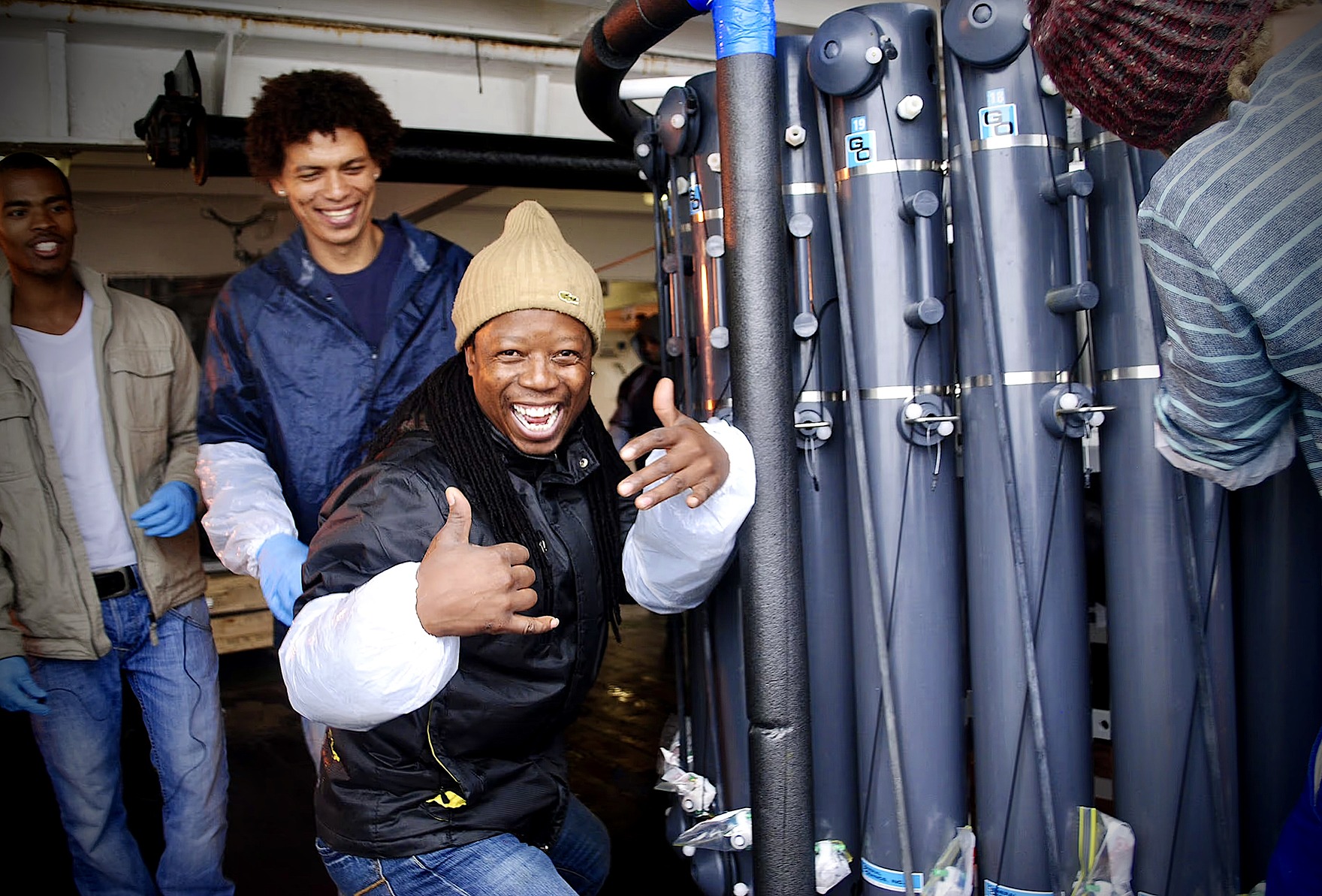
 Dr Thato Mtshali takes a quick break while taking measurements on the SA Agulhas II. (Photo: Socco.org.za)
 The University of Cape Town (UCT) and its South African research partners rank among the top of the world at the bottom of the Earth – according to the new global Antarctic Research Trends Report.
In the highly specialised, globally significant field of Antarctic and Southern Ocean science, this cohort of African researchers is not only leading on the continent, but punching above its weight globally.
Between 2022 and 2024, the university at the foot of Table Mountain and colleagues outperformed A-list counterparts such as Cambridge, Oxford, Princeton and Stanford universities.
The research trends report analysed nearly 30,000 peer-reviewed publications. Led by Umeå University’s Arctic Centre in Norway, it used a database of thousands of research institutions worldwide to highlight global Antarctic and Southern Ocean science and cooperation. It probed how much research was published, the quality of the studies, the extent of international collaboration and how often the work was cited.
The report did not specifically aim to compare South African researchers with Oxbridge and other top-tier academia, yet the data reveal a proudly South African success story. That success story places local polar stars on par with influential institutions in developed countries with greater resources.
Local scientists outperformed the other four universities, and many more international institutions, in sheer quantity of Antarctic publications.
In the two years to 2024, Cambridge came close – almost equal, but not quite.
The South African scientists also excelled in the number of articles they published in top journals. Princeton and Stanford, for instance, had a higher share of top-journal papers compared with their own overall paper output, but UCT and co produced more top-journal papers in total.
Between 2020 and 2023, they also produced the type of Antarctic research that was cited more often.
/file/attachments/orphans/Citationimpact_483145.jpg "The world's most cited countries in Antarctic research. (Source: © 2025 Antarctic Research Trends Report)")
Over years of research, South African scientists held the line
In the longer review period between 2016 and 2024, Cambridge netted 29th position among the world’s 116 highest Antarctic achievers for research quantity.
UCT and partners earned 35th position compared with Oxford (67th), Stanford (79th) and Princeton (82nd). That means the local scientists produced relatively fewer publications than some countries and institutions that ranked higher, but still held their place in high-quality journals among the world’s best.
Professor Marcello Vichi, head of UCT’s oceanography department, says the effort is collaborative: South Africa’s Antarctic research is growing at the same pace as the other countries despite having fewer researchers. Local oceanography has grown five times in 15 years. “The bulk of us is producing excellent research.”
The British Antarctic Survey produced the world’s highest research quantity since 2016, followed by the Russian Academy of Sciences (2nd) and Germany’s Alfred Wegener Institute (3rd). Pretoria University earned 58th position. Between 2022 and 2024, Johannesburg University earned 79th position. Other South African universities such as Stellenbosch and Rhodes also specialise in various Antarctic studies, such as engineering and geomorphology.
“What makes our work distinctive is our focus on fine-scale processes that shape the Southern Ocean,” explains Dr Sandy Thomalla, head and chief scientist at the Southern Ocean Carbon-Climate Observatory (Socco) in Cape Town.
“Signals from storms and eddies were once treated as noise. We now know they’re fundamental to how the ocean absorbs and releases carbon and heat,” Thomalla says. “Understanding these fine-scale dynamics is essential to predict how the Southern Ocean will respond to climate change.”
Explaining that Socco’s tiny office of seven staff publishes in top journals like Nature and Science, Thomalla says their findings have yielded game-changing insights into how the Southern Ocean regulates the climate through CO₂. These findings have informed forecasts and policy. “You don’t need huge numbers to produce high-impact science,” she notes.
Socco makes big waves by not only planning up to 10 years ahead, but aligning its research with national and global priorities. It also works closely with UCT.
“UCT deserves significant credit,” says the university’s alum. “Its oceanography department has trained many oceanographers now working across the national research community.”
Thomalla also acknowledges the Percy FitzPatrick Institute of African Ornithology for its seabird legacy and UCT’s new MARiS marine and Antarctic research hub.
/file/attachments/orphans/AshleighJohnsonDFFE_697030.jpg "The Department of Forestry, Fisheries and the Environment's Ashley Johnson gives a lecture aboard the SA Agulhas II during an Indian Ocean demonstration cruise for government officials, 25 May 2025. (Photo: Tiara Walters)")
Saffers’ secret snow sauce
Thomalla stresses that South Africa would not make “this level of global impact” in quantity and quality of Antarctic research without the state recognising why it matters – and investing in it.
For starters, much of this research takes place at facilities unique for any African state.
South Africa’s SA Agulhas II – used by a UK expedition to find Sir Ernest Shackleton’s Endurance ship in 2022 – is the only working state polar research vessel on the continent. Bases in East Antarctica, Gough Island and Marion Island support the country’s research as Africa’s only veto-holding state at Antarctic Treaty meetings.
And an entire haul of actors keep Africa’s only polar expedition on course.
The Department of Science, Technology and Innovation (DSTI) funds infrastructure such as the SA Agulhas II. The Department of Forestry, Fisheries and the Environment (DFFE) operates the ship. The DSTI also funds the South African Polar Research Infrastructure (Sapri).
Sapri – in turn – is run by the South African Environmental Observation Network. And science at the chief polar agency, the South African National Antarctic Programme (Sanap), is funded by the National Research Foundation (NRF).
As a whole, then, South Africa was the 12th most cited country in Antarctic research since 2016, ahead of other BRICS states, including China.
‘Changing of the guard’: China rises to the top
Researchers quoting each other is not the only benchmark of scientific achievement, as China’s recent rise to Antarctic science dominance shows.
In 2022 and 2024, China overtook the US “as the leading publisher of Antarctic and Southern Ocean research in terms of quantity and quality”, the report says. The data reveal that China-based scientists have collaborated less internationally than many other nations, suggesting a greater commitment to do leading research among themselves.
“This finding contrasts with the steady decline in publications in the database from the other leading nations, notably the US, Germany, Australia and the UK,” the report adds. “Although Russia had a high number of total publications, its publication numbers in the top-quartile journals were comparatively minimal. These results may indicate a changing of the guard in Antarctic and Southern Ocean research.”
Professor Matt King of the University of Tasmania, the report’s leading university globally for Antarctic and Southern Ocean publications, told Daily Maverick that “funding has been tapering off in the US and rising in China over the last decade or more … so we should not be surprised that there is a changing of the guard – Antarctic research is an investment.”
Since “substantial” scientific activity is a core basis for letting a country sit at the treaty’s decision-maker (“consultative”) table, Canada’s successes emerged as an ironic warning of the tense state of Antarctic diplomacy.
Claiming that Canada’s science fails to satisfy the requirements of decision-maker status, China and Russia have vetoed its bid for a seat at the table since 2022.
“Canada’s volume and quality of its scientific output during the study period are comparable or higher than those of many other nations with consultative status,” according to the report.
Decision-maker state Ukraine has blocked Belarus’s decision-maker bid in retaliation for its role in Russia’s illegal war on Ukrainian soil. Belarus did not crack any rankings in the report.
King, also a co-author of the report, urges that “we must work out how to collaborate better, while also recognising that any differences in geopolitical ambitions may affect how that is done”.
Why well-funded Antarctic research is everyone’s business
King, a prominent advocate for increasing Antarctic research funding, notes: “South Africans should be proud of the work the nation does in Antarctica, with their researchers collaborating well with those from other countries and doing high-quality work off meagre resources.
“The changes happening in Antarctica will impact South African weather and climate, rainfall, coastlines, water security and drought. So money spent there is about the nation being forewarned and, hopefully, forearmed.”
Vichi, UCT oceanography head, echoes the report’s concerns that Antarctic research is on the decline in some of the world’s foremost treaty states. This gives Africa’s only polar state an opportunity to buck that worrying trend.
“We are now leaders in measurements of complex sea-ice environments during one of the seasons [winter] that is sampled the least by anyone,” Vichi says. “This explains the high citation index.”
South Africa is doing “science that opens up new understanding in a system that has undergone dramatic changes since 2016, and we were there to document this”. DM
- The Antarctic Research Trends Report 2025 was led by the Arctic Centre at Umeå University, with contributions from the University of Tasmania and the Nordic Institute for Studies in Innovation, Research and Education, and support from UArctic and the Scientific Committee on Antarctic Research.