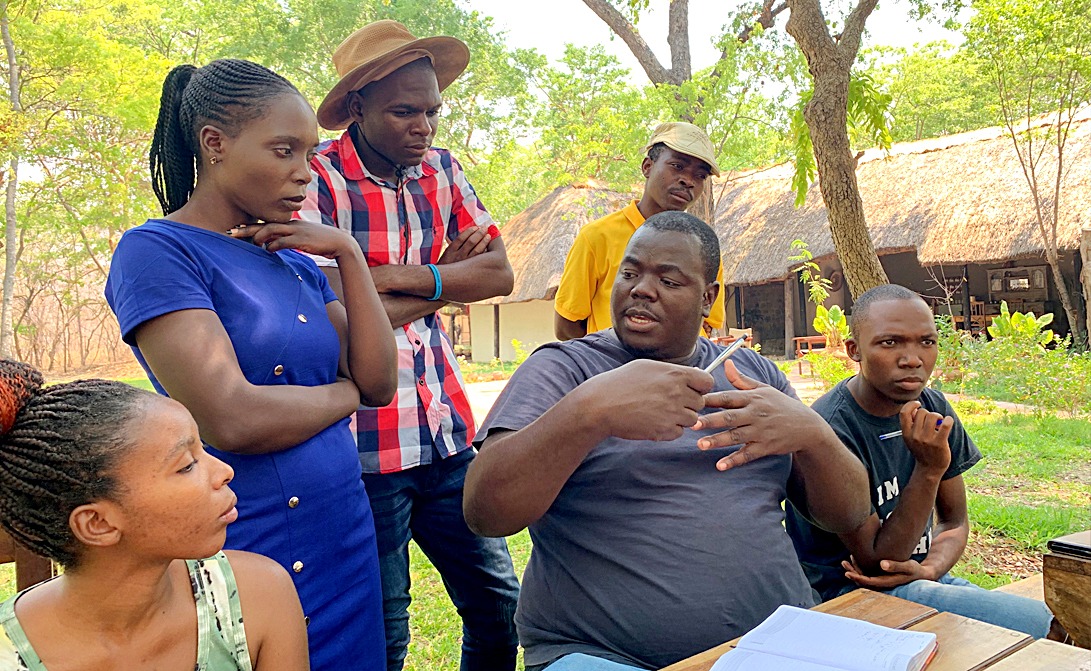
 The research team at work in Hwange, Zimbabwe. (Photo: Darragh Hare)
 Night had settled over Tanzania’s Burunge Wildlife Management Area when a lion broke into a boma. It seized a calf and began dragging it towards a gap in the fence. The owner, a young woman, clutched the calf’s head, straining with all her strength as the lion pulled back. By the time neighbours arrived the lion had retreated. The calf survived with minor injuries. The fear lingered.
Dr Darragh Hare first heard the story during a research visit. What struck him was not only the danger but the response. The woman was not demanding that the lion be killed. She wanted people advocating for more lions to understand the cost of living with them – the losses, the fear, the calculations families make every night.
Across much of Africa, such encounters are part of daily life. Yet debates about wildlife management – trophy hunting, ivory trade, anti-poaching enforcement – often unfold in distant capitals.
Hare directs the Morally Contested Conservation (MCC) project, a research collaboration examining how people in east and southern Africa, as well as in Western countries, think about controversial conservation issues. Since 2021, the team has worked in transfrontier conservation areas in Kenya, Tanzania and the Kavango-Zambezi region.
/file/attachments/orphans/DRDARR_1_893246.jpg "Dr Darragh Hare presented at the 2025 Oppenheimer Research Conference, representing a team of researchers from the UK, US, Kenya, Tanzania, Zimbabwe and Malawi. (Photo: Oppenheimer Generations)")
The project has from a simple premise: conservation policy has long relied on ecological and economic evidence, but has paid less attention to how communities judge what is right or wrong.
Before academia, Hare spent a decade in public policy. He recalls how data about species numbers or tourism revenue often carried more weight than community sentiment. “My ancestors got rid of every problematic animal a few hundred years ago,” he says of Scotland, where he grew up. “We wiped out the wolves, the bears, the lynx. So why don’t people here just do the same?”
/file/attachments/orphans/MorallyContestedConservationteamattheNyaodzafishingcampKaribaLakeZimbabwePhotoAllenAlly-ma_378351.jpg "The Morally Contested Conservation team at the Nyaodza fishing camp, Kariba Lake, Zimbabwe. (Photo: Allen Ally-ma)")
Hare also mentions trophy hunting. Should people be allowed to hunt elephants? In some places, elephants are so numerous that they cause ecological damage and are subject to culling.
In Tanzania and parts of Zimbabwe, the team found trophy hunting to be controversial – but not primarily for the reasons often debated in Europe or North America. There, public discussion centres on whether killing animals for sport is inherently unethical. In many rural African communities, the debate focused on: who benefits? Who receives the meat? Who decides where hunting occurs? International campaigns and trade decisions can reshape these policies. Yet the people most exposed to wildlife often have limited influence over those debates.
Militarised conservation
More contentious still was conservation law enforcement. In several rural areas, nearly everyone researchers spoke to mentioned a relative, neighbour or friend who had encountered armed rangers.
In regions with heavily armed poachers targeting rhinos or elephants, some residents accepted the need for armed patrols inside protected areas. But support shifted sharply when enforcement spilled into everyday subsistence activities.
“If it happens inside the park, in self-defence or to stop poaching, it is seen as acceptable,” Hare says. “But if it happens when someone’s just collecting honey or nuts or firewood, then it is not.”
All of these activities may be illegal. Communities nevertheless weigh them differently. Poaching and attacking rangers are seen as serious crimes. Grazing livestock or harvesting forest products in protected areas may be unlawful, but many people regard them as customary rights.
Proximity counts
Betty Rono, a Kenyan-based PhD student working on the project, has focused on communities in the Mau Forest complex. Mau is east Africa’s largest montane forest and a critical water source. It is also a site of overlapping claims: a biodiversity stronghold, a timber reserve, contested settlement land and home to thousands of people.
“When voices from rural sub-Saharan Africa are heard alongside those from London or Nairobi, the divide blurs,” Hare says. Urban Africans, their data suggests, sometimes align more closely with Western conservation perspectives than with rural neighbours. The disagreement, their research suggests, is less about Africa versus the West than about people who live with wildlife versus those who engage with it at a distance.
/file/attachments/orphans/MembersoftheMCCresearchteaminMagadisouthernKenyaPhotoSteinerSompeta_514170.jpg "Dr Darragh Hare with his research team in Magadi, southern Kenya. (Photo: Steiner Sompeta)")
Language has been central to the team’s approach. Rono says questionnaires were translated into local languages, and researchers later returned to communities to review findings with participants. The aim was not only accuracy but respect.
That return visit proved critical in Lake Kariba, Zimbabwe. Survey data initially suggested a strong moral rejection of elephant poaching. Researchers wondered whether this reflected cultural attachment to elephants.
When they returned to discuss the results, residents clarified. Their objection was less about elephants than about the armed men who came to kill them. Poachers brought danger into villages – men with powerful rifles who made life unpredictable and frightening.
“If we hadn’t gone back,” Hare says, “we might have written a paper claiming cultural attachment to elephants.” Instead, residents explained that their objection was grounded in the threats poachers posed, not in reverence for the animals themselves.
For the MCC team, such findings complicate familiar narratives. Conservation debates are often framed as North versus South. Their research suggests a different fault line: between those who live with wildlife and those who observe it at a distance.
This does not produce simple policy prescriptions. In some areas, communities support strong enforcement inside parks. In others, they resent it. Views on hunting vary by context. What remains consistent is the demand to be heard.
As Hare reflects, what still puzzles him most is not the conflict, but the tolerance – the ability of people who lose livestock, crops and sometimes even lives to wildlife, and still choose coexistence.
The young woman in Burungi did not deny the importance of lions. But she asked to be seen as more than a statistic in a biodiversity report. DM
Kemunto Ogutu is a Roving Reporters correspondent based in Kenya. This story was produced with support from the Yazi Centre for Science and Society and the Resilience Fund run by the Global Initiative Against Transnational Organised Crime.