



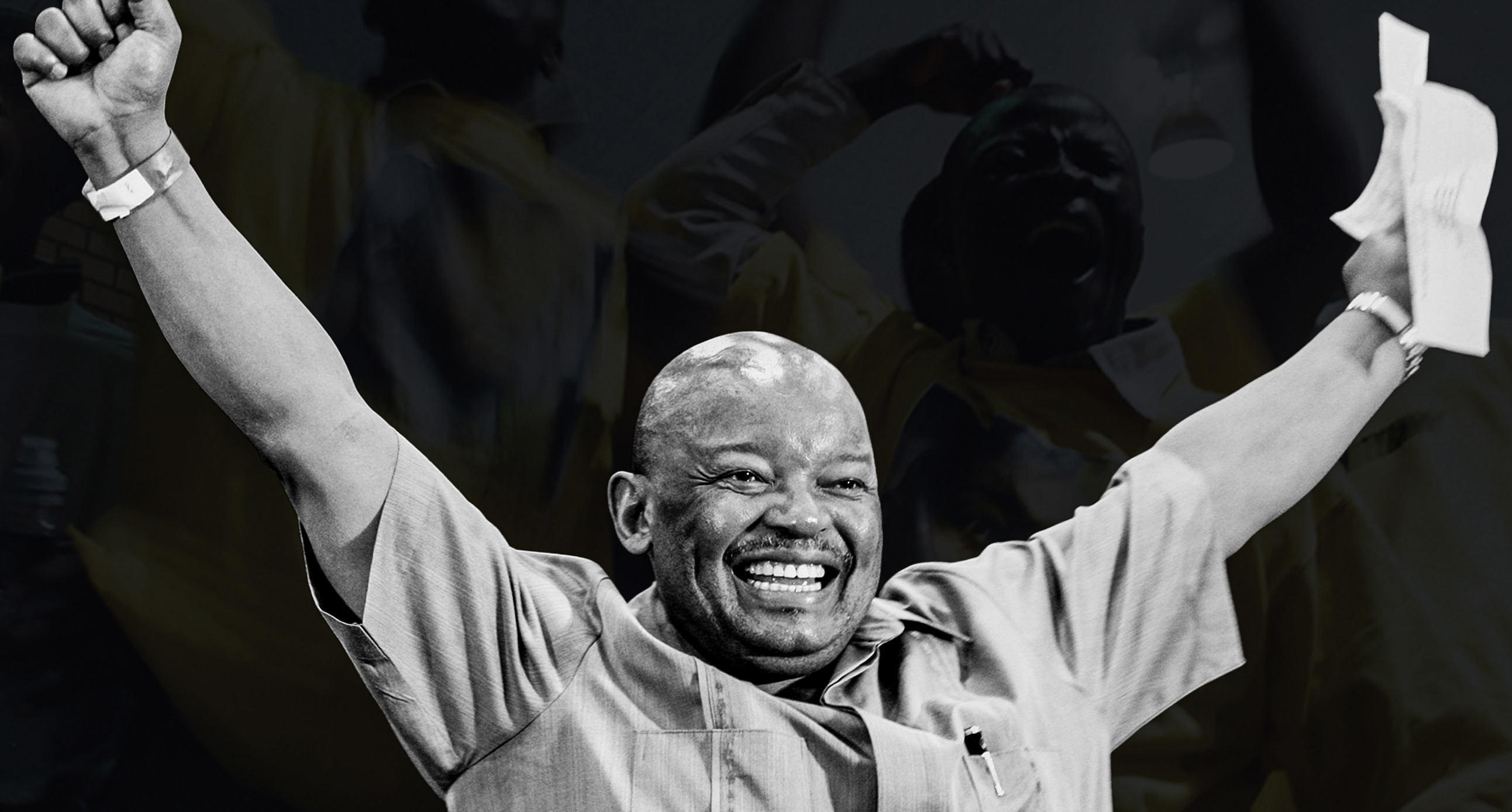
 Mosiuoa Lekota celebrates on stage during the first session of the Congress of the People (Cope) inaugural congress in Bloemfontein on 15 December 2008. (Photo: EPA / Kim Ludbrook)
 Even in his last days, Mosiua “Terror” Lekota was still talking, not only about politics, but deeply troubled by societal issues, including a tragic accident that claimed the lives of 13 children in Vanderbijlpark last month.
This is according to his sister, Puleng Mosiua-Buthelezi, who spoke to Daily Maverick after his memorial service at the Regina Mundi Catholic Church in Soweto on Wednesday, 11 March.
Lekota died on Wednesday, 4 March 2026, after a long illness. He served as a struggle activist, inaugural chairperson of the National Council of Provinces, premier of the Free State, minister of defence and co-founder of the Congress of the People (Cope). He died on 4 March at the age of 77.
/file/attachments/orphans/ED_599722_683394.jpg "Family, friends and colleagues at the memorial service for Mosiuoa Lekota at Regina Mundi Catholic Church in Soweto on 11 March 2026. (Photo: Gallo Images / Sharon Seretlo)")
/file/attachments/orphans/ED_599727_373737.jpg "Dr Naledi Pandor at the memorial service for Mosiuoa Lekota at Regina Mundi Catholic Church in Soweto. (Photo: Gallo Images / Sharon Seretlo)")
/file/attachments/orphans/ED_599705_917515.jpg "Deputy Minister of Defence and Military Veterans Bantu Holomisa at the memorial service. (Photo: Gallo Images / Sharon Seretlo)")
Regina Mundi, also known as “the people’s church”, provided refuge for anti-apartheid activists and students fleeing police during the 1976 Soweto uprisings.
On Wednesday, in a different political climate, Cope supporters gathered to remember him alongside other activists and political formations, including the ANC, Azapo, ACDP, ATM, UDM and Al-Jamah.
/file/attachments/orphans/ED_378797_925549.jpg "Mosiua ‘Terror’ Lekota addresses supporters at the then DF Malan Airport in Cape Town. (Photo: Gallo Images/Drum)")
Throughout the nearly four-hour proceedings, Lekota was described as a fearless freedom fighter, a principled man – and a very jolly fellow.
His longtime friend and liberation war veteran, Pandelani Nefolovhodwe, recalled some of their best memories, from Lekota teaching him chess while they were in jail together, to the time Lekota suffered a heart attack.
/file/attachments/orphans/000039965_526947.jpg "Anti-apartheid activists, including Winnie Mandela (centre left) and Archbishop Desmond Tutu (centre right), on a march calling for the release of Nelson Mandela. Mosiuoa Lekota is to the left of Mandela, and Trevor Manuel can be seen partly obscured behind her. Date and location unknown. (Photo: Media24 Archives / Gallo Images)")
“When we were in Parliament, he had a heart attack, and he was rushed to hospital by those who were near him. He went to hospital and was resuscitated, and he recovered after a week or so. I then went to him as a friend and said congratulations on your recovery. He said to me, ‘I was returned from the gates of heaven. I was told you need to go back to where you came from because you have not finished the race,’ ” said Nefolovhodwe.
“Even during our chess games, when we were almost at the end and he realised he was cornered and about to lose the game, he would insist I hurry up so he can try defeat me. Regardless of the outcome, he always wanted to finish what he started,” Nefolovhodwe said.
This was echoed by Mosiua-Buthelezi, who said Lekota wanted to remain an activist until his last day on earth.
“He said to me, ‘If I die still being a politician or activist, just know I would have died a happy man and at peace,’” she said.
/file/attachments/orphans/PXPW0165_471552.jpg "Mosiua Lekota addresses a United Democratic Front meeting in Johannesburg in the 1980s. (Photo: Paul Weinberg / South)")
Mosiua-Buthelezi said her fondest childhood memory of her brother was that he was always a caring and sharing person, no matter how little he had.
“When I was in university and our father was not around, he paid for my fees using his bursary money and odd jobs… when he was arrested, I had to drop out.”
He served as a Member of Parliament until after the May 2024 elections, leaving behind a political legacy that spanned the struggle against apartheid and South Africa’s democratic era.
Cope broke away from the ANC in 2008, which was the first major split in the party since the birth of democratic South Africa in 1994. In October of 2008, Lekota said he was handing the party “his divorce papers” in response to its decision to recall then president Thabo Mbeki before the end of his term.
/file/attachments/orphans/0000200383_510229.jpg "Mosiuoa Lekota celebrates with supporters outside the Johannesburg Magistrates’ Court on 18 October 2013 after a battle fought since 2010 came to an end when the court appointed him as the rightful leader of Cope. (Photo: Gallo Images / Foto24 / Nelius Rademan)")
In the 2009 elections, Cope campaigned as almost an ANC without Zuma, winning more than a million votes (7%) and preventing the ANC under Zuma from reaching a two-thirds majority in his first term.
Remembering Lekota, the ANC’s first deputy secretary-general Nomvula Mokonyane said he was a man of integrity. Although they were no longer in the same political party, he was still one of their own.
“Ntate Mosiua, a veteran of our struggle, believed in democracy. He believed deeply in accountability, he believed that leaders must speak honestly even when it is difficult, and he believed that freedom carries with it the responsibility to always place the interests of the people first.”
Friend Sello Mojatula said he met Lekota in 20o2, initially as colleagues. “At first, I thought he was a difficult man.” He later found that Lekota was a man of principle and was respected even by those who disagreed with him politically.
“He was my father, my brother and everything to me,” Mojatula said.
His fondest memory includes a time when he was hospitalised. Lekota visited him in hospital and told him, “It is not your time, yet. There is no way you will die before me,” he told mourners.
/file/attachments/orphans/PXPW0171_813962.jpg "Then United Democratic Front publicity secretary Mosiua Lekota and Transvaal regional Secretary Moss Chikane address a rally in Soshanguve in 1984. (Photo: Paul Weinberg / South.)")
Lekota’s political activism began in the early 1970s when he was a university student at the University of the North. During this period, he joined the South African Students’ Organisation (Saso) and became an advocate of the Black Consciousness Movement (BCM).
He was prosecuted by the apartheid regime and imprisoned on Robben Island in 1974, where he spent eight years alongside struggle leaders including Nelson Mandela.
After his release in 1982, he returned to politics, joining and leading the United Democratic Front (UDF).
In 1994, he was appointed premier of the Free State, a position he was removed from two years later for the mishandling of corruption accusations he had levelled against some provincial comrades. It was Mandela who appointed him premier, but Thabo Mbeki ordered his recall.
In 1999, he was appointed minister of defence under then president Mbeki, a position which he occupied until 2008.
President Ramaphosa has declared that Lekota will be accorded a Special Official Funeral Category 2. He will be laid to rest in Bloemfontein on Saturday, 14 March. DM