




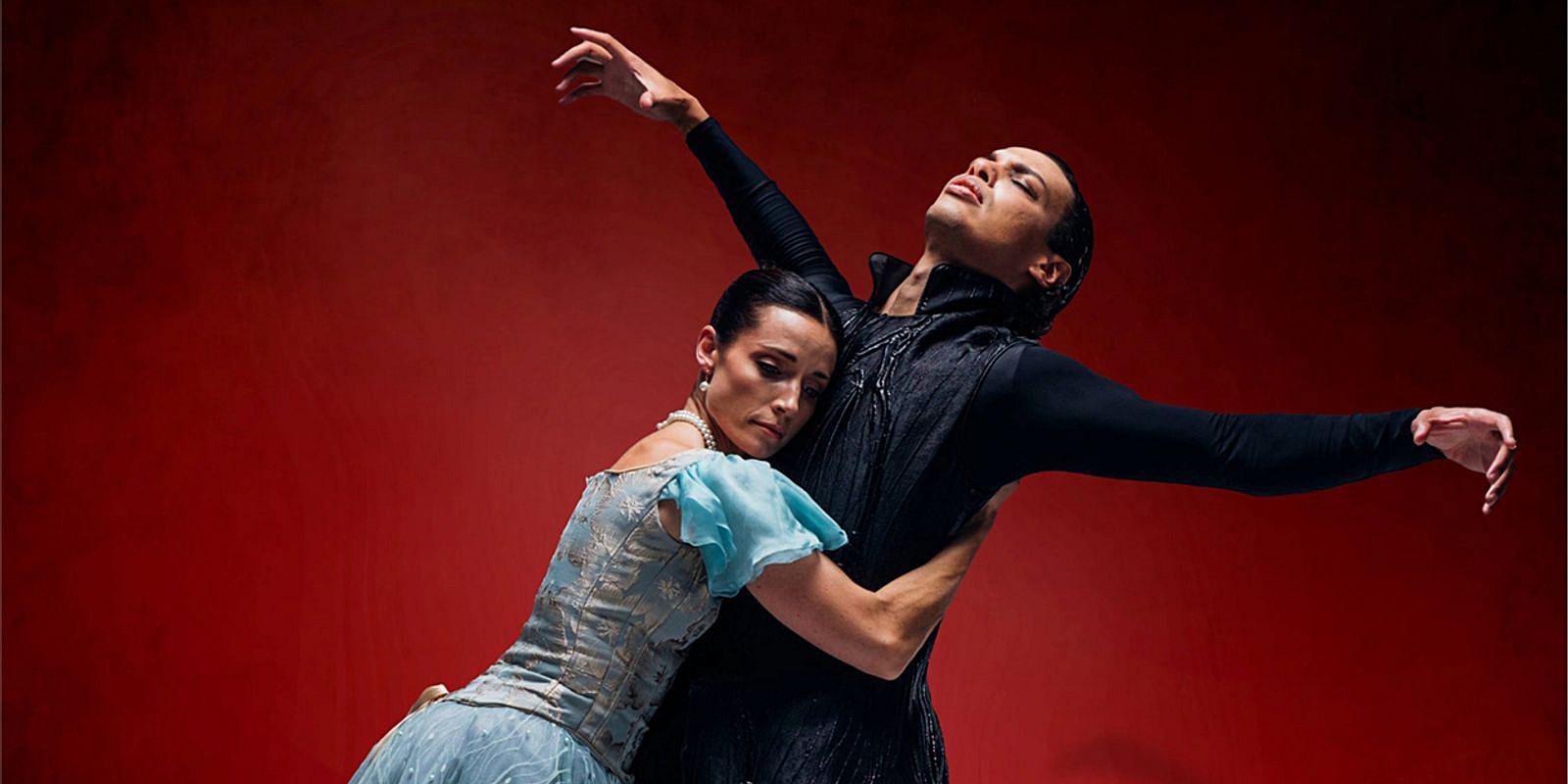
 Kirstél Paterson and Leusson Muniz in Dracula. (Photo: Lindsey Appolis)
 Halloween is months away, but dark forces are upon us. Nothing to fear, though. Though these vampires have fangs, their bites aren’t in quite the same league as their pliés and pas de deux.
In something of a coup for Cape Town, celebrated choreographer David Nixon has been in town rehearsing his 1999 ballet, Dracula, for a two-week run this month. Four dancers will be sharing the role of the undead Transylvanian count, namely Brazilian-born Cape Town City Ballet principal Leusson Muniz, company newcomer Zachary Healey and guest artists Jerome Barnes and Lihle Mfene.
If Dracula seems a far cry from The Nutcracker, well, that’s the point. Nixon, whose career spans more than four decades, has a reputation for creating and staging work that’s both challenging and crowd-pleasing – and that does not necessarily comport with convention. Perhaps the point is to keep ballet alive and fresh by adding to the repertoire brave new works that audiences can’t resist.
Danced to music by four divergent composers (there’s Estonian contemporary classical minimalist Arvo Pärt; multiple Grammy Award-winning American composer Michael Daugherty; Russian composer Alfred Schnittke’s Faust Cantata; and sections of Sergei Rachmaninoff’s Symphonic Dances), the ballet has from the beginning been considered a favourite among dancers and audiences
/file/attachments/orphans/LeussonMunizinrehearsal_BrendaVeldtman_769225.jpg "Leusson Muniz in rehearsal. (Photo: Brenda Veldtman)")
/file/attachments/orphans/DavidNixonattendstothedancersinrehearsalforDracula_BrendaVeldtman_347629.jpg "David Nixon attends to the dancers in rehearsal for Dracula. (Photo: Brenda Veldtman)")
For Nixon, who initially created the work with BalletMet in Columbus, Ohio, while he was artistic director there, the ballet “represents a huge shift in the way I tried telling a story, and in the way I choreographed”. It’s often hailed as his signature work, having enjoyed a number of revivals over the past quarter of a century. Last October, Nixon directed the show in Oklahoma City, where reviewers called it “haunting”, saying that “patrons are on the edges of their seats and the tips of their own toes as the drama unfolds”.
Nixon is not afraid to create moments of visual awe. So, along with the rich dancing, there are some gasp-out-loud visual moments, too. “In Oklahoma City, audiences were very vocal, particularly when Dracula disappears, or when he’s climbing, head-first, down the castle wall.”
And, yes, there’ll be plenty of visual astonishment in the new iteration, playing at Artscape from 13 March. Nixon is taking full advantage of a double-stage space that can accommodate huge sets, including Dracula’s castle. He’s leaning into everything the venue has to offer, including the downstage lifts and the orchestra pit.
The way the show came about is unusual in that it was initially prompted by what Nixon took to be a gimmicky ploy to lure audiences at Halloween. BalletMet’s marketing committee, having clocked America’s growing fondness for the macabre holiday, asked him to create a work they could sell around it.
Making a Halloween ballet was not ideally something he’d wanted to do, but the challenge saw him reconnecting with a childhood affection for the vampire story, which, upon reading Bram Stoker’s novel he determined had “much more to it than just people with fangs drinking blood and sleeping in coffins”.
“There’s much more to this story,” he says. “Set in Victorian times, it represents men’s fears about women wanting to transform, their fear of women becoming much more sensual. Dracula’s brides are examples of a Victorian idea of absolute wickedness – what women shouldn’t be.”
Beyond this underlying theme of sexual awakening, Nixon was also interested in the deeper nature of the monstrous creature at the centre of the story. “I asked myself what, in a vampire, actually remains of the human element. Can they still fear? Can they still actually love?”
A far cry from the sugary wholesomeness of The Nutcracker, this is a grown-up ballet-noir that explores adult appetites in the context of fierce and surging emotions. Needless to say, apart from the fact that it’s danced, don’t expect a straightforward retelling of Stoker’s Gothic tale.
Nixon’s adaptation takes an unexpected approach, daring to shed a more humanising light on its monster than Stoker does in his novel, the dancer in the role tasked with revealing some of the contradictions and human yearnings that exist below the monster’s exterior.
Certainly, what’s unavoidable is the ballet’s choreographed eroticism. The inexplicable, furious lust that draws Dracula and Mina to each other is something the dance explores rather unapologetically. It might well be described as as a balletic bodice-ripper, and one UK critic said of a production in 2019 that “Nixon gives us the vampire as hard-bodied sex symbol” and “squeezes every last nuance of erotic metaphor from Stoker’s novel”.
/file/attachments/orphans/LeussonMunizandIsabellaBlairinrehearsalforDracula_BrendaVeldtman_278707.jpg "Leusson Muniz and Isabella Blair in rehearsal for Dracula. (Photo: Brenda Veldtman)")
Nixon says the ballet explores an attraction between Dracula and Mina that is “on a completely different level, a level which they can’t resist – it’s deep, a no-choice situation”.
It’s this irresistible attraction that prevents him from taking her the way he takes Lucy, for example, whom he devours, completely, in the ballet. Nixon does not hold back choreographically, the dancing at times evoking assorted libidinous passions, including the conflation of seduction, dark sex, exsanguination and ultimately death during the second of two memorable duets between Dracula and Lucy.
Setting aside its narrative sophistication, for Nixon it was an interest in using dance to express aspects of the unsayable that had ultimately persuaded him to create the ballet. “I saw a physicality in this story that we could capture in dance, perhaps even more than is possible in film. The vampire is still a beast, still a monster, and is superhuman, and there’s the element of grace and virility, all associated qualities that we can demonstrate physically in dance. That’s why I felt, in the end, I could tackle it as a dance.”
Whether it’s bat-like flight, Lucy’s blood transfusions, Renfield and Dr Seward dancing frenetically in the asylum, or Dracula’s insatiable appetites, Nixon has developed a dance vocabulary to express the unexpected.
The ballet is demanding of its dancers. “For the main characters, it’s very physical, requires a lot of stamina,” Nixon says. “At the end of Act One, especially, Dracula has consecutive solos and duets; in a sense it’s to show something of his superhuman ability, but it’s also like a kind of marathon for the dancer.”
Nixon knows what’s required to get the dancers where they need to be in order to sustain the energy throughout a gruelling ballet. While dissuading them from some of the habitual niceties of a more genteel classical ballet practice, rehearsals have been about encouraging them to lean into the physical poetry of a darkly sensuous Gothic tale.
He is also entrenching a more contemporary approach. “I’m looking for a fluidity, which is hard for dancers, because often they’re trying to do a lot of posing, and not necessarily using their body in a more contemporary, fluid way,” he explains.
He is, he admits, “very particular” about the dancers’ “quality of execution”. “For me, technique in ballet is about how we do things. It’s not about the steps. It’s not about how many, or how fast, or whatever. It’s something that comes from the way in which we work.
“As a choreographer I’m trying to develop the dancers, grow them as artists – not just as people who can execute steps, but who can use the language of dance to connect with an audience energetically.”
/file/attachments/orphans/LeussonMunizandKirstelPatersoninrehearsal_BrendaVeldtman_484303.jpg "Leusson Muniz and Kirstél Paterson in rehearsal. (Photo: Brenda Veldtman)")
/file/attachments/orphans/LihleMfeneandSashaBarnesinrehearsalforDracula_BrendaVeldtman_660950.jpg "Lihle Mfene and Sasha Barnes in rehearsal for Dracula. (Photo: Brenda Veldtman)")
He says an audience needs that energy in order “to be brought into piece and to wake up, essentially, in a performance”. It’s the aliveness in the artwork, the force that raises the work above something that’s merely physical or that simply looks pretty.
“I don’t think of myself as an abstract choreographer,” Nixon says. “I’m a storyteller. To tell a real story, you have to be able to develop characters and motifs, and you require chemistry on stage between the dancers. A storyteller must make that happen. This is what’s really interesting for me.”
Rather than dancers who are merely technically proficient, Nixon says he wants great performers. “I think that far too often critics are looking at the steps and the concept rather than the performers – in dance, that’s who you’re really going to see, you’re there to watch dancers move, see how they inhabit the characters.”
He believes that every successful ballet he’s done “has come out of the fact that I am looking at the characters always, and looking at their emotions and their psychology”.
Nixon’s real pleasure, though, apart from seeing his ballet about an undead creature come to life yet again, has been witnessing the growth of the Cape Town cast through the rehearsal period.
“This group of men is one of the strongest I’ve ever had,” Nixon says. “And it seems that the part of Mina was made for [CTCB principal] Kirstél Paterson. I don’t quite understand how, but it just plays to every single string she has – she’s a powerhouse in it, and she’s moving beautifully.”
Nixon says he knew, back in 1999, that he was onto something when he created the ballet, because of the effect it had on the dancers who were with him in the studio. They were bewitched by it, he says, “mesmerised” in ways ballet dancers often aren’t during rehearsals.
Twenty-six years on, its impact on Cape Town’s dancers has been no less significant. Nixon says rehearsals have taken them to profound and previously unexplored places, the story, characterisations and choreography resonating deeply. He says, for example, that Muniz, who will dance Dracula on opening night, “has found something in this ballet that’s enabling him to pull out all the stops”.
“At the end of the day, what makes Cape Town City Ballet special are these dancers, their openness, their willingness,” Nixon says. “They’re just extraordinary in that way. They just want to dance and they want to dance their very best and they give you more than 100% all the time. And they don’t have the resources of dancers elsewhere in the world. They’re not paid the same, their facilities aren’t the best – and yet what they want is to dance and they come and every single day they give me 100% or more of what they have. That is why I come back to Cape Town.” DM
David Nixon’s Dracula runs at Artscape from 13 to 29 March.