




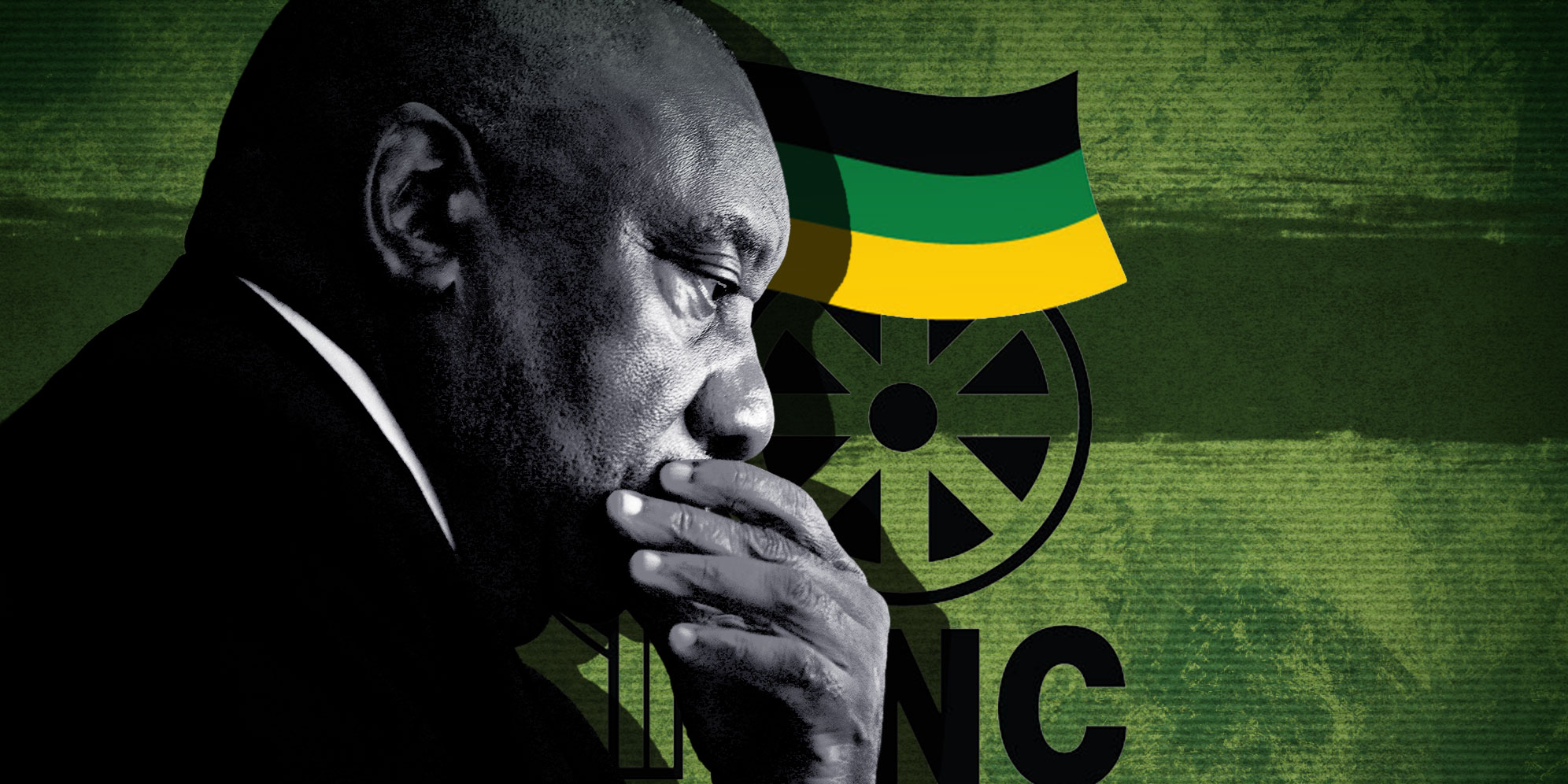
 Illustrative image: President Cyril Ramaphosa. (Photo: Gallo Images / ER Lombard) | ANC logo. (Image: Wikicommons) | (By Daniella Lee Ming Yesca)
 The importance of these elections cannot be underestimated.
While the elections of 2024 will be remembered for the creation of a national coalition and the ANC’s falling below 50%, these polls may have the potential to show that the party is no longer a potent political force.
If that happens, more voters will be encouraged to vote for other parties in the 2029 general elections. While it may seem a distant possibility that another party could win more votes than the ANC in 2029, this year’s local elections might show that this is becoming more likely.
There are some reasons to believe that the ANC might actually consolidate across the country. The general “reform story” is, slowly, starting to bear fruit.
It is easy to forget now, but Stage Six load shedding must have been an important factor in the ANC’s decline in 2024.
It is now a distant memory.
At the same time, crucially, some small green shoots are emerging in the economy. The economy did grow slightly last year, and if momentum builds towards the end of the year, this could be a factor.

Also, if the plans announced by President Cyril Ramaphosa in his State of the Nation Address look like they will actually be implemented, perhaps, just perhaps, people who have voted for the ANC in the past will be given a reason to do so again.
Unfortunately for the ANC, virtually no voters will see the physical progress of trains moving across the Northern Cape or the changes at the ports. But they will feel the impact if the economy is moving by then.
That’s a massive “if”. And frankly, probably unlikely.
Things are just moving too slowly, while the US and Israeli attacks on Iran, and that country’s response, are pushing oil prices to levels that will seriously damage our economy.
There are other problems.
While Eskom has dramatically improved, it is now starting a process of publicly consulting people and stakeholders in municipalities about disconnecting those councils.
The reason is obvious: Eskom has tried many, many times to try to get councils to pay up, and they have simply failed to do so.
On Wednesday, the list of affected councils was finally published by Moneyweb. It includes the metro of Ekurhuleni, which has previously refused to implement load shedding.
Like most other councils on this list, it is also dominated by the ANC.
The aim of Eskom here may well be simply to find a way to put public pressure on these councils. While these hearings will probably end with various people saying they cannot live without electricity and thus they will not be switched off, Eskom will have succeeded in embarrassing the leadership of these councils – and thus the ANC.
Regional regression
At the same time, there still appears to be no recognition among the leadership of ANC regions of how these elections could literally render them politically impotent.
In Ekurhuleni this week, it emerged that the ANC’s provincial secretary and member of the mayoral committee for finance, Jongizizwe Dlabathi, was retracting his resignation.
He had resigned after apparent differences with Mayor Nkosindiphile Xhakaza, but it appears that the ANC’s national executive committee intervened, rejecting his resignation.
This means that a national leadership body has now intervened, not in a province, but in a region of the ANC.
At the same time, Xhakaza has decided to sue News 24 and its journalist Sikonathi Mantshantsha for its reporting on his alleged involvement in the murder of the auditor Mpho Mafole.
So, instead of focusing on improving service delivery, he has decided to create a highly public spectacle in which he is already being accused of trying to weaken media freedom.
At the same time, the news about service delivery failures in Joburg simply continues.
Daily Maverick’s Anna Cox reported on Wednesday that the city had failed to spend what would be considered a reasonable proportion of its capital budget for this stage of the financial year.
Considering the unbelievable state of the city’s infrastructure, this beggars belief.
It is the very definition of governance competence to manage the money given to you. And yet the city appears unable to do this.
Campaigning on empty
As previously mentioned, there appears to be no end to the focus on internal issues by regional ANC leaders in Gauteng’s metros. For the moment, there appears to be little evidence that matters are different in councils in other parts of the country.
There appears to be a lack of “ANC Governance Success” stories for the party to sell to the electorate.
As the party’s own structures appear to be weaker than in previous elections, and because Cosatu’s support will be less than energetic, the party has few tools on which to rely.
It also lacks a group of leaders whom it can tell voters will be the future of the party.
Yes, President Cyril Ramaphosa has had a period of successes, and his popularity may be increasing again (despite the fact that the Phala Phala scandal will not go away). But he will be out of office as the ANC leader by the end of next year, meaning that now, voters might not be persuaded by his presence.
Also, none of the party’s other leaders, whether in the provinces or in other structures, appears to be winning favour with voters.
Politics doesn’t always move in a straight line. But our democratic history shows that previous local elections have pointed the way for the national and provincial elections that followed.
In 2021 (the pandemic election), the ANC fell below 50% of the popular vote for the first time. Just 45.59% of voters supported it.
Three years later, in 2024, it won 40.18%.
This rate of decline could easily accelerate, meaning that the ANC could fall much further in just three years.
Change might well be coming in these local elections, and the ANC seems to be frozen, unable to meet the challenge. DM