




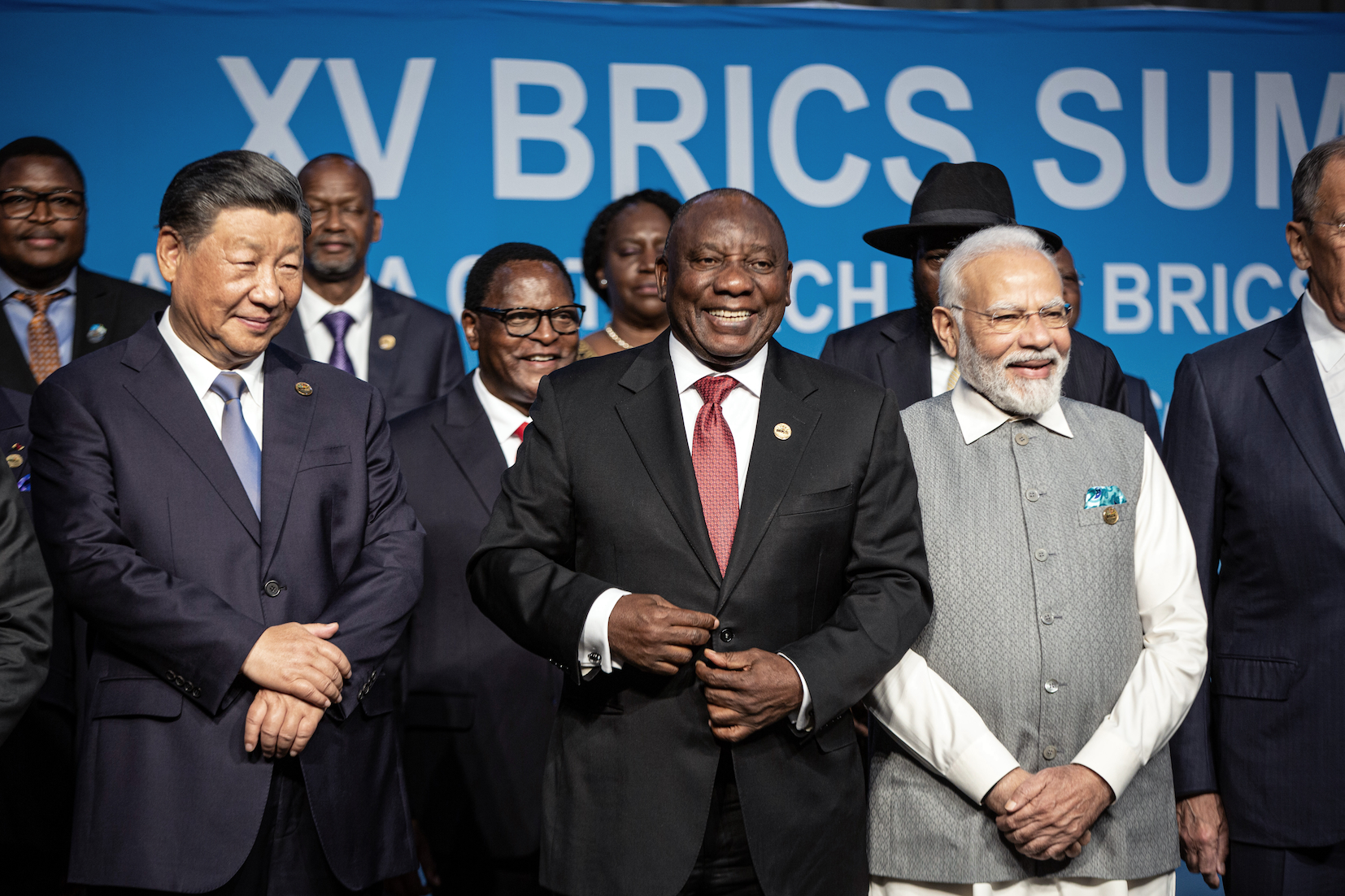
 President Cyril Ramaphosa and fellow BRICS leaders, Chinese President Xi Jinping and Indian Prime Minister Narendra Modi, at the BRICS Summit in Sandton on 24 August 2023. (Photo: Per-Anders Pettersson / Getty Images)
 The war in Iran has driven deep wedges between members of the BRICS bloc, preventing the group from taking a joint position on the conflict and raising questions about the coherence of the 10-nation body, which claims to speak for the Global South. The sharpest differences have emerged between new full members Iran and the United Arab Emirates (UAE), which are on opposing sides of the front line in the war that was launched by the US and Israel on 28 February.
In retaliation for a devastating assault on its leadership — including the killing of its supreme leader, Ayatollah Ali Khamenei — and destruction of much of its military infrastructure, Iran has retaliated by firing missiles and drones into the territories of several Gulf states, including the UAE. Iran has insisted it is targeting only US military facilities in those countries, but some civilian infrastructure, including hotels and airports, has reportedly also been hit, in the UAE in particular.
It is understood that BRICS has been unable to issue a joint statement on the war, and it seems unlikely to be able to, because of these sharp differences between Iran and the UAE. In June 2025, shortly after the US and Israel launched joint strikes on Iran’s nuclear facilities (the 12-day war), BRICS issued a joint statement calling the strikes “a violation of international law and the Charter of the United Nations” and calling on all parties to stop the violence and resolve their differences through peaceful means.
Yet 12 days into this year’s attacks, BRICS as a collective has been silent on the war, although all its member states have individually expressed views on it. Some, like Russia, China and Brazil, have sharply criticised the US and Israeli attacks. Others, like India, Egypt, Ethiopia and Indonesia, have been more critical of Iran’s retaliatory strikes on Gulf states or have been equivocal.
South Africa’s statement of 28 February tends towards the equivocal category as it condemned “international law violations” without naming any countries. However, it added that “anticipatory self-defence is not permitted under international law and self-defence cannot be based on assumption or anticipation”, which appeared to be a reference to the US’s and Israel’s justifications for their attack.
The Indian impasse
India’s position is critical and pivotal in this impasse. It is one of the five core members, with Brazil, Russia, China and South Africa, before BRICS expanded in 2023 and 2024 to include Iran, Egypt, Ethiopia, Indonesia and the UAE. India is holding the BRICS chair this year, which gives it more influence over decisions. It appears to be content to allow the divisions among members to prevent a collective BRICS position from being expressed because of its own ambivalence.
/file/attachments/orphans/13804979_171358.jpg "Indian Prime Minister Narendra Modi. (Photo: Rajat Gupta / EPA)")
“India’s position at the moment is being shaped by a very delicate balancing act,” said an analyst, who preferred to remain anonymous. “In this particular crisis, New Delhi appears to have aligned more closely with the emerging US-Israel-UAE axis, which inevitably complicates the domestic and diplomatic optics back home. The government, therefore, seems keen to avoid any BRICS statement that could put it at odds with partners it is currently working with closely.
“At the same time, India cannot openly abandon its traditional posture of strategic autonomy or its longstanding ties with Iran. It was forced to condole Khamenei’s death after five days.
“That tension is precisely why you are seeing a certain studied silence and a reluctance to push for a collective BRICS position. In effect, the safest course for New Delhi right now is simply to keep the temperature down and avoid being forced into a declaratory stance one way or the other.”
The analyst added that India was the odd man out among the core BRICS members, and the manner in which the other members handled India on the Iran issue would determine the future coherence of the bloc.
Former Indian foreign secretary Shivshankar Menon told Karan Thapar on The Wire that India’s failure to condemn the attacks by the US and Israel and the assassination of Khamenei was “inexplicable” and “sad”. He also lamented India taking five days to sign the condolence book for Khamenei.
Menon said the other founding members of BRICS, which will meet for its annual summit in India later this year, would disapprove of India’s position on the Iran war. “They will find it hard to explain why we are silent on this issue.”
Limits of expansion
John Kirton, the director of the BRICS Research Group at the University of Toronto, said: “The expansion of BRICS has frozen its ability to respond to the critical global emergencies of our time, as its silence on the latest war with Iran shows. While Russia and China are weakly supporting Iran, India is tilting toward the US and Israel, its democratic soulmates.”
He added that getting consensus in a joint statement from 10 leaders “is a major coordination burden when so many are busy with more urgent things. And [Chinese President Xi] Jinping wants to be nice to Donald Trump to make the latter’s visit to China in a few weeks a success.”
/file/attachments/orphans/GettyImages-179480361_720360.jpg "John Kirton, the director of the BRICS Research Group at the University of Toronto. (Photo: Anatoly Medved / RIA Novosti via Getty Images)")
However, Gustavo de Carvalho, a senior researcher at the SA Institute of International Affairs (SAIIA), believes that the failure to agree on Iran should come as no surprise because “BRICS has never really been a place where members coordinate on foreign policy, especially on the really difficult geopolitical issues, and that has always been understood within the group.”
He notes that BRICS has occasionally put out broad statements on global affairs, “but that has never been the core of what BRICS is about. The group’s real focus is economic cooperation, development finance and pushing for reform of multilateral institutions.
“This is a well-established pattern. The annexation of Crimea in 2014 and the Russian invasion of Ukraine in 2022 both passed without any collective BRICS response. On Gaza, South Africa went as far as convening an extraordinary meeting in November 2023, but even then, the group could only produce a chair’s summary rather than a formal joint declaration.
“On the 12-day war, the issue was taken up at the Rio summit in July 2025, but reaching even a condemnation of the strikes on Iran required significant internal negotiation over the language.
“The current impasse follows the same logic. BRICS is not an alliance. There are no collective security commitments, no expectation that members will see eye to eye on every conflict. The group holds together because there is a broad understanding that members will agree to disagree on many things, and focus collective energy on the areas where they genuinely converge.
“That is also how internal rivalries tend to be managed, whether the long-running tensions between India and China, the competing interests of Egypt and Ethiopia, or indeed India’s current closeness to Israel while Iran sits at the same table.
“Having two members on opposing sides of an active conflict makes a joint statement very difficult, but that is less a crisis for BRICS than a reflection of how the group has always worked. It brackets the disputes it cannot resolve and gets on with the agenda it can.”
/file/dailymaverick/wp-content/uploads/2024/10/11670529.jpg "Chinese President Xi Jinping (centre) arrives at the Friends of BRICS Leaders dialogue during the 15th BRICS Summit, in Johannesburg on 24 August 2023. (Photo: Yeshiel Panchia / EPA-EFE)")
Unprecedented standoff
Arina Muresan, a senior researcher and project manager at the Institute for Global Dialogue in Pretoria, said the standoff between Iran and the UAE, both new members of BRICS, was largely unprecedented (though the armies of two of the original members, India and China, had clashed in 2020 over their disputed border in Kashmir).
“Some would argue that here you are starting to see the fragmentation [of BRICS] because there was no consolidation of the BRICS partnership once expansion took place [from 2023],” said Muresan. She noted that the five new full members all had the same veto rights as the original five, which allowed them to block statements and decisions.
Muresan said it would be interesting to see if the BRICS leaders were able to formulate a common position at their summit this year, on both the Iran war and the US attack on Venezuela earlier this year in which US forces arrested President Nicolás Maduro and took him to the US to face drug-trafficking charges.
“But I think the more interesting point to watch would be India because India’s behaviour towards Israel and the US causes a greater rift between the BRICS than Iran and the UAE.” She added that, given the “incredibly high” level of regional competition between India and China, it was surprising that BRICS had lasted as long as it had.
She noted that the upcoming summit will be a critical test of how members navigate India’s pragmatism while attempting to preserve the bloc’s unity. DM