





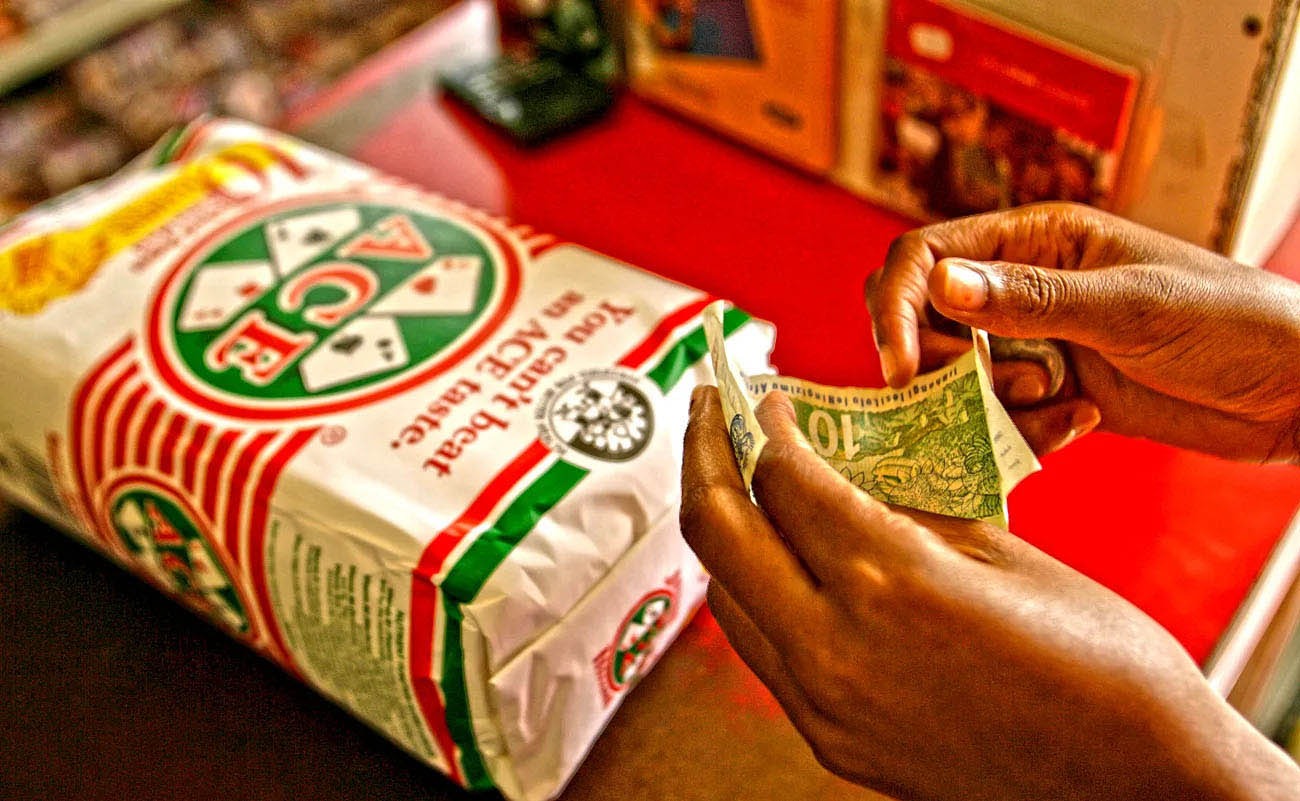
 In 1990, tobacco was the leading behavioural factor causing the most noncommunicable disease deaths. By 2021, dietary risks had become the primary factor, with 7.20 million deaths, surpassing tobacco, with 6.74 million deaths. (Photo: Gallo Images)
 ‘Africa is facing a runaway hunger problem, with 25% of South African households food insecure – that’s one in four,” Maverick Citizen editor Zukiswa Pikoli said at a webinar on Shopping & The Cost of Living Crisis in South Africa: The Reality of South Africa’s Retail Giants.
“Things are so bad that in March this year the South African Human Rights Commission will be conducting a national investigative hearing into food systems. This is aimed at addressing systemic, structural and economic causes of hunger despite national food sufficiency.”
The webinar focused on the Access to Nutrition initiative’s (ATNi) Retail Assessment 2025 which looked at how 18 leading retailers across six countries affect access to nutritious, affordable food.
South Africa’s retail environment
Shoprite, Pick n Pay and SPAR, with a market share of more than two-thirds in the sector, and where more than 80% of food is bought, were assessed, said ATNi executive director Greg Garrett.
It looked at the corporate nutrition strategies of retailers, the healthiness of their branded products, the types of products prominently promoted by retailers, and whether pricing strategies are helping or hindering access to healthier foods.
It found that retailers recognise nutrition as an investment agenda item, but this did not always translate into action.
Of the 3,496 products analysed, 87% would be classified as unhealthy when combining ultra-processed food markers (colourants, non-nutritive sweeteners, emulsifiers) and that which is high in fat, salt and sugar.
Less than one-quarter of promotional space was dedicated to healthier products.
“So, already a big issue there. But I don’t want to demonise South Africa here, because we’re finding a similar trend in other countries as well,” Garrett said.
Opportunities to improve the retail environment
Draft Regulation R3337 will introduce a new nutrient profile model, guiding what is unhealthy, said Yolanda Radu, public health law and policy expert at SAMRC/Wits Centre for Health Economics and Decision Science (Priceless SA).
The draft regulation would also introduce front-of-package warning labels for foods high in fat, salt and sugar, as well as marketing restrictions on unhealthy foods.
/file/attachments/orphans/Gregwebheadshot_570823.jpg "Greg Garrett, executive director of the Access to Nutrition initiative. (Photo: Supplied)")
“What that would address is how promotions or how food that is considered unhealthy is marketed, and so that could be a game-changer in terms of our food environment,” Radu said.
Another opportunity would be to strengthen the Health Promotion Levy, which taxes sugar-sweetened beverages, to World Health Organization-recommended levels of 20%, up from 11%. Radu said the levy worked, as manufacturers reformulated the products.
“Because of inflation, it’s sitting at a level where that 11% is more or less around 8%, so that is something that we need the government to move on quite speedily.”
Cost-of-living crisis
ATNi found that France had the most affordable healthier food baskets but remained less affordable than an unhealthy food basket, Garrett said.
“In South Africa, a healthier food basket costs 30% more than a less-healthy food basket,” he said.
People were likely to gravitate towards the affordable food basket, putting a strain on the healthcare system and creating problems intergenerationally, because the cognitive development of children was hampered without sufficient micronutrients.
“I think if South Africa can continue down the route of putting in really smart fiscal policies and taxing some of the unhealthier foods, that will help over time, [to] course-correct.”
Radu added that direct costs for the healthcare system in treating noncommunicable diseases was R33-billion.
Responsibilities of retailers
Retailers need to respond to current policies in a transparent way, and make sure they’re disclosing not only financial information but nutrition information to investors, Garrett said.
Meaningful targets were another responsibility. An example of “meaningful” was that retailers say they will “double healthy foods sales by 2035”, but if they quadrupled unhealthy sales it was less meaningful. It should be proportional.
/file/attachments/orphans/YTR_927636.jpg "Yolanda Radu, senior researcher at the SAMRC/Wits Centre for Health Economics and Decision Science (Priceless SA). (Photo: Supplied)")
Voluntary front-of-pack labelling was another way to be more transparent to consumers. Promoting healthy private-label products was another way to be responsible.
“Our materiality assessments have shown that you can make money and sell healthier food portfolios. We’ve looked at this for manufacturers, and the same would apply for retailers.”
If healthier food products are sold, companies can have higher margins than competitors who are not doing that, Garrett added.
“It will build [a] better revenue base, better profit margins and healthier populations, and it also decreases risk.”
On governance, Garrett said retailers should always have a nutrition strategy in place, and should not be marketing unhealthy foods to children.
Nutritious over insalubrious items
“Markets follow value, they’re not following virtue,” Garrett said. Markets should have that virtue embedded, so that it makes business sense for retailers to do the right thing.
As they dug into public money that’s being used to financially restructure food retailers, or in some cases strengthen their financial outlook, the assessment found that for public investments flowing into retailers in South Africa – as well as Kenya – they were not looking at health or nutrition, but simply job creation and growth.
While jobs were important, it found that the retail environment was not getting any healthier following the investments. In the Philippines some of the public money going into food retail was explicitly to improve the health outcomes of their food portfolio.
/file/attachments/orphans/BM-Neesa-Bacon_270188.jpg "In South Africa, a healthier food basket costs 30% more than a less-healthy food basket, according to ATNi’s assessment of the retail environment. (Photo: iStock)")
“Food is about nourishment, and if you’re going to invest in food as a public entity, then it should absolutely have a criteria in there that it’s also going to improve the health outcomes. Otherwise, it’s not a good investment,” Garrett said.
“We found one development finances institution that continues to fund sugar cane, and that’s fine, you’re improving jobs. But why aren’t they investing in tobacco anymore? Because tobacco became something that you can’t invest in anymore. Well, I think we need to move in that direction for certain food items as well.”
Radu added: “There should be a way of making it, maybe mandatory, that if it’s public money that is being invested in this, then we have to make sure that it obviously achieves all these public goals which should be tied to public health outcomes.” DM