




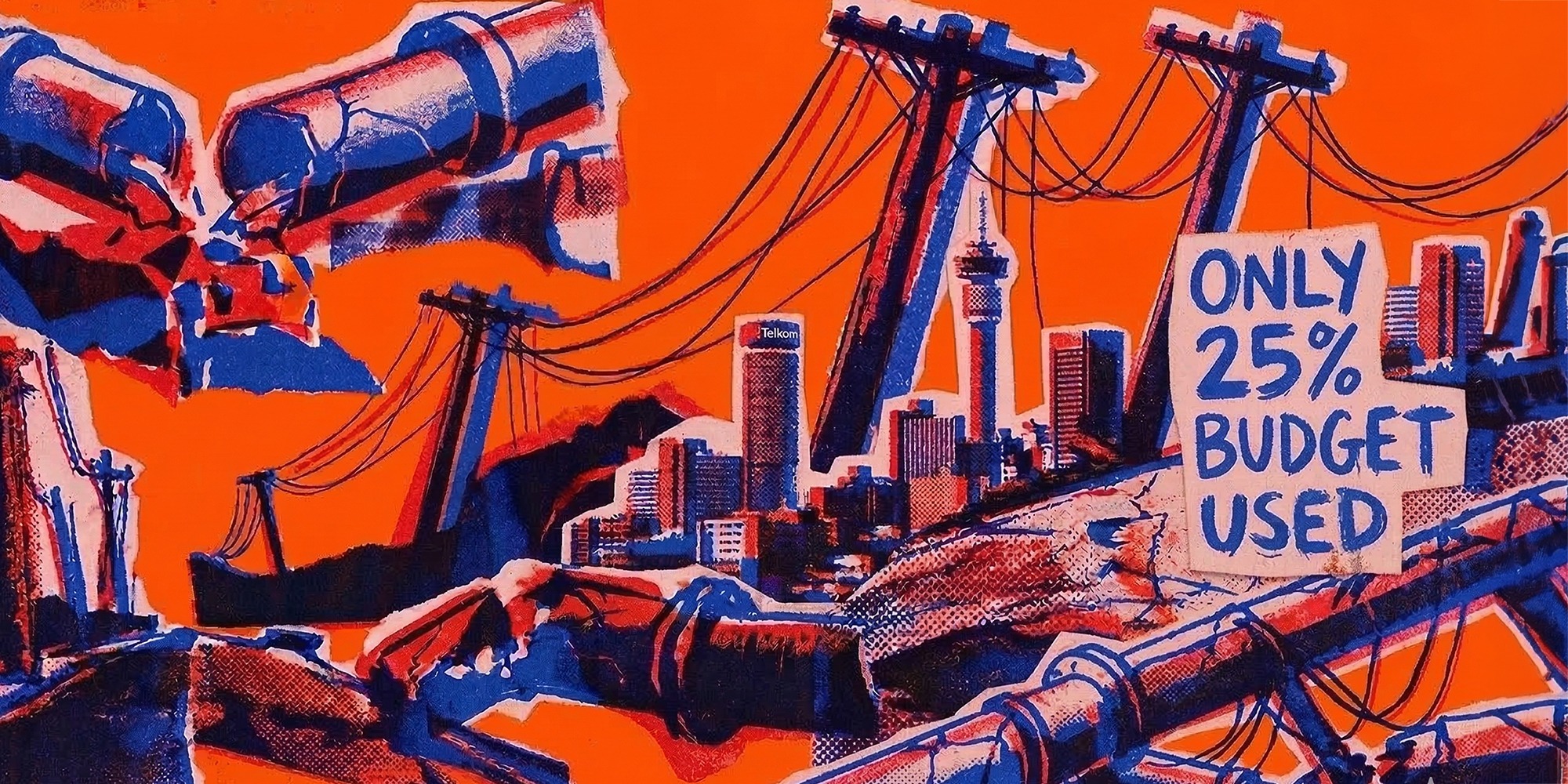
 Johannesburg is falling apart at the seams, and the budget to fix it is sitting in the bank. (Illustration: Kevin Momberg)
 The Johannesburg Crisis Alliance (JCA) has raised alarm over the City’s slow infrastructure spending, saying it reflects deeper governance failures within the coalition administration.
“We are deeply concerned about the low expenditure. We see it as symptomatic of poor governance by the coalition,” said Yunus Chamda, coordinator of the JCA.
The warning comes as financial reports reveal that the City of Johannesburg had spent just 8% of its R8.7-billion capital budget by the end of September 2025 — three months into the financial year — which improved to 26% by December, still far below the roughly 50% level typically expected halfway through the financial year.
Burst water pipes, leaking reservoirs, ageing electricity cables and potholed roads are becoming increasingly common across the city. Yet a report tabled at the February council meeting shows the City struggling to spend the money allocated to repair the infrastructure behind those failures.
/file/dailymaverick/wp-content/uploads/2023/06/DSC_3323.jpg "Potholed roads are becoming increasingly common across Johannesburg. (Photo: Leon Sadiki)")
Johannesburg’s slow start during the first quarter, July to September, also compares poorly with other major metros.
By the end of September, Cape Town had spent roughly 13% of its capital budget and Ekurhuleni about 16%, according to their respective in-year financial reports. National Treasury guidance suggests municipalities typically spend about 12% of their capital budgets by the end of the first quarter, placing Johannesburg below both peer metros and the national norm.
/file/attachments/2989/1771835601638-2320February2026OCNV5_893779.png)
Administrative delays
The City’s financial monitoring reports suggest the problem is not a lack of funding but delays in getting projects under way.
In several departments, underspending was attributed to administrative bottlenecks in procurement and payment processes. The City’s consolidated variance report notes that some projects stalled because of “delays in submitting invoices relating to existing contractors for payment processing”.
Other sections of the report cite “delays in the processing of payments for services rendered”, while some projects could not proceed because contracts had not yet become operational and service-level agreements were still being finalised.
While such explanations are not unusual in municipal capital programmes, they illustrate how infrastructure spending can lag even when budgets have already been approved.
Chris Santana, the Democratic Alliance’s spokesperson on finance, says the pattern reflects a recurring weakness in how the City plans and executes infrastructure projects.
“The slow start at the beginning of the financial year is followed by a progressive uptick in the second quarter and finally a massive push in the fourth quarter to ensure KPIs [key performance indicators] are met,” he said.
“It’s the classic hockey-stick effect.”
Municipal capital programmes often show this pattern, where spending accelerates sharply toward the end of the financial year as departments rush to commit funds before deadlines.
“When spending repeatedly follows this pattern,” said Santana, “it points to weaknesses in project planning, procurement planning and project implementation.”
Why grant funding is prioritised
Santana said that part of the spending pattern reflects how conditional infrastructure grants from the national government are structured.
These funds must be spent on specific projects and within strict timelines.
“In terms of good governance, grant funding monies must be prioritised to avoid sending free money back to National Treasury,” he said.
“Grant funding is ring-fenced — it comes with conditions, timelines and reporting obligations and cannot legally be diverted to plug operating shortfalls.”
If such funds are not spent within the financial year and a roll-over is not approved, municipalities are required to return the remaining unspent conditional grant funds to the National Revenue Fund.
“What that effectively means,” Santana said, “is that the City focuses on spending money it must spend, while own-funded and loan-funded capital projects often lag.”
Liquidity pressures
Santana also suggested that financial pressures may be influencing the pace of infrastructure delivery.
“When capital projects are deliberately paced to preserve cash flow, infrastructure delivery slows,” he said.
“Cash preservation is driving infrastructure delay — it speaks directly to the financial sustainability of the City.”
Municipalities must balance infrastructure investment with operational obligations such as salaries, bulk electricity purchases and water supply costs. If liquidity tightens, capital projects may be delayed to maintain sufficient operating reserves.
Electricity revenues under scrutiny
The City’s electricity utility, City Power, recently highlighted progress in recovering lost revenue after taking over billing responsibilities from the City.
The utility said it had made progress in stabilising finances and recovering lost income after assuming responsibility for electricity billing.
City Power says it has already recovered more than R1-billion through a financial sustainability programme targeting illegal connections, incorrectly programmed meters and billing discrepancies. The initiative aims to recover R2.9-billion by the end of the financial year.
/file/attachments/orphans/Presentation228_732415.jpg "City Power says it is recovering lost revenue after taking over billing responsibilities from the City of Johannesburg. (Photo: City of Johannesburg website)")
But Santana cautioned against assuming that electricity revenues were stabilising the City’s finances.
“Electricity carrying the books is factually incorrect if you drill down into the numbers,” he said.
According to the City’s financial data, electricity service charge revenue of about R6.63-billion has been offset by bulk electricity purchases of roughly R7.09-billion, leaving a gross loss of about R467-million before other operational expenses.
Santana also pointed to growing internal borrowing by the utility.
City Power’s sweeping overdraft account increased from roughly R15.7-billion at the start of the financial year to about R20.3-billion by the end of September, said Santana.
“City Power may take credit for its revenue progress,” he added, “but the entity is still far from financially sustainable,” he said.
A water network ageing faster than it is replaced
While financial debates continue, Johannesburg’s infrastructure continues to deteriorate —nowhere more visibly than in its water system.
Johannesburg Water estimates the city’s potable water distribution network stretches over more than 12,500 kilometres.
/file/dailymaverick/wp-content/uploads/2025/02/DSC_1239.jpg "Treated drinking water flows down Dorset Road, outside Jan Celliers Primary School and opposite Zoo Lake, following an underground pipe burst on 27 January 2025. (Photo: Julia Evans)")
International engineering guidelines generally recommend replacing about 1% of pipeline networks each year in mature urban systems.
For Johannesburg, that would equate to roughly 125km of pipeline annually.
Current replacement rates are closer to 60–70 kilometres per year, meaning large portions of the system are ageing faster than they are being renewed.
/file/attachments/2989/1771838449805-water_pipes_replacednew1_190962.png)
At that pace, replacing the entire network would take close to 200 years.
Johannesburg Water has acknowledged an infrastructure renewal backlog estimated at about R26.6-billion, reflecting decades of deferred maintenance across the city’s water system.
Burst pipes, pressure failures and emergency repairs have become increasingly common across Johannesburg, often linked to ageing pipelines that can no longer withstand pressure fluctuations in the distribution network.
The arithmetic of delay
Municipal capital budgets do not disappear when they are underspent.
Conditional infrastructure grants must either be spent within the financial year or formally rolled over — failing which the funds must be returned to the National Revenue Fund. City-funded projects typically shift into the following financial year, pushing infrastructure upgrades further down the pipeline.
But infrastructure systems do not wait for municipal procurement cycles.
Pipes continue to corrode, roads deteriorate, and electrical networks age, whether or not projects move forward.
Johannesburg’s challenge is no longer simply how much money it budgets for infrastructure, but whether it can spend that money fast enough to keep the city’s failing systems from deteriorating further. DM