



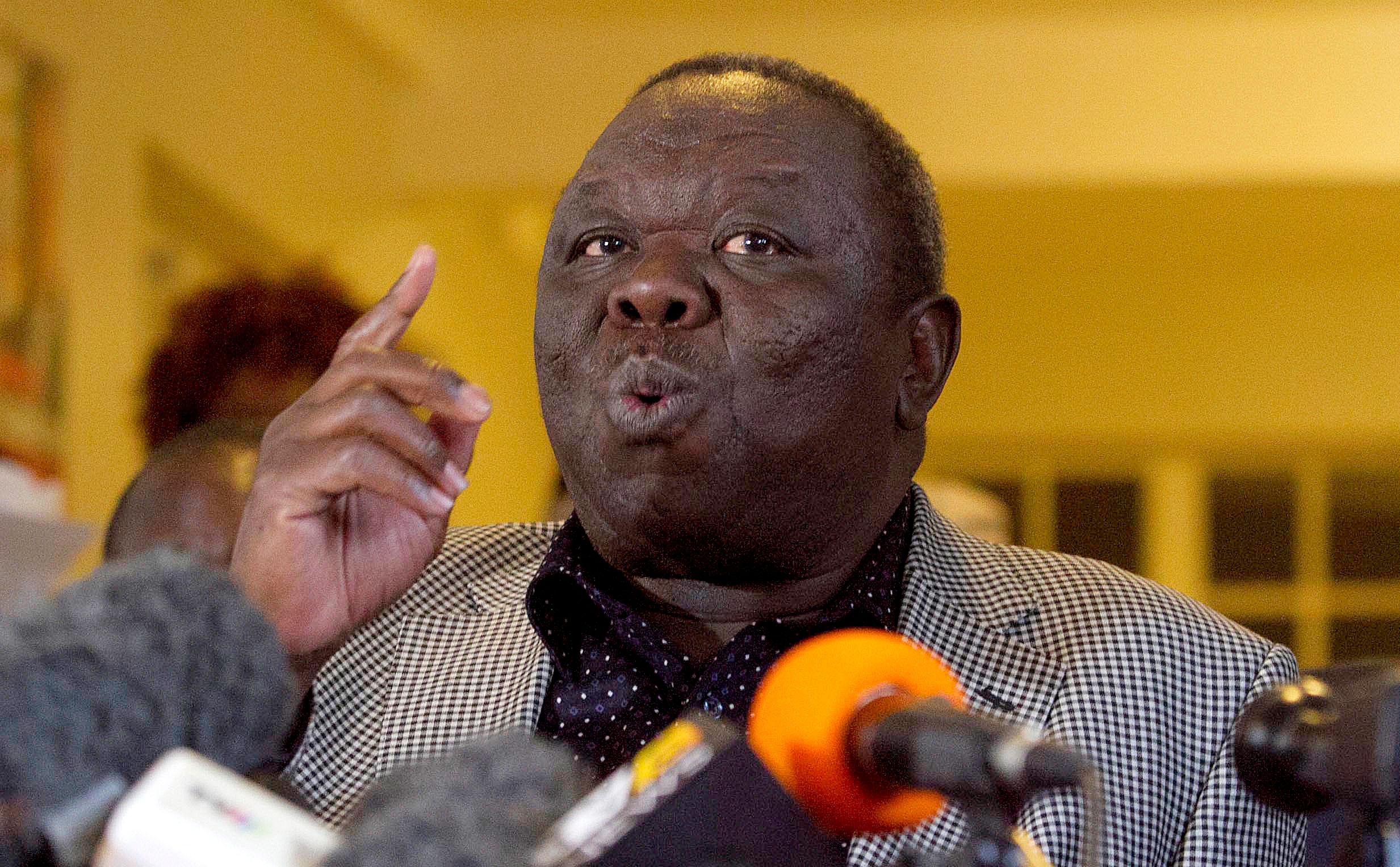
 Movement for Democratic Change leader and Zimbabwean Prime Minister Morgan Tsvangirai addresses the media after a disputed election at his official residence in Harare, Zimbabwe, on 3 August 2013. Zimbabwe's incumbent President Robert Mugabe won a seventh term in office. (Photo: EPA / Aaron Ufumeli)
 /file/dailymaverick/wp-content/uploads/2025/10/label-Op-Ed.jpg)
If Morgan Richard Tsvangirai were alive today, marking his 74th birthday, he would confront Zimbabwe with a conflicted gaze, one eye glimmering with pride, the other clouded with despair.
Pride, because his name still reverberates as a synonym for courage in the trenches of democratic struggle, a working-class titan who dared to wrestle Mugabe in his lion’s den.
/file/dailymaverick/wp-content/uploads/OD-Bizos-photo-essay8.jpg "Morgan Tsvangirai, leader of Zimbabwe’s opposition Movement for Democratic Change, embraces South African advocate George Bizos SC, defence counsel in his treason trial, at the launch in Johannesburg of his biography Face of Courage: Morgan Tsvangirai, on 4 July 2005. (Photo; EPA / Jon Hrusa)")
Despair, because the edifice he built with sweat, blood and authenticity has been vandalised into hollow spectacle: donor-fed theatrics, a suffocating cult of personality and opposition leaders confusing visibility for viability.
Would he even recognise the movement he once led, or would he recoil at the grotesque parody of resistance now paraded before us?
The old guard who once marched beside him, stalwarts of the democratic project, have either faltered into oblivion, been swallowed whole by the regime they claimed to fight, or calcified into relics unworthy of his salt.
What remains is a shredded covenant, a democratic promise betrayed by survival politics and authoritarian relapse, leaving Zimbabwe suspended between nostalgia and nihilism.
The betrayal of the covenant
/file/attachments/orphans/5714078_184113.jpg "Movement for Democratic Change leader Morgan Tsvangirai speaks at the party’s final election rally outside the Harare Showgrounds on 29 July 2013. The Presidential elections were scheduled for 31 July 2013, with Tsvangirai hoping to take power from then president Robert Mugabe. (Photo: EPA / Aaron Ufumeli)")
Tsvangirai’s life was not mere politics; it was a covenant etched in the crucible of labour strikes, civic defiance and the audacity to stare down Robert Mugabe in his lion’s den.
/file/dailymaverick/wp-content/uploads/2023/09/MC-Will-Gumede_4.jpg "Former Zimbabwean president, the late Robert Mugabe. (Photo: Pascal Le Segretain / Getty Images)")
His struggle was never a mercenary excursion for personal gain, as today’s pretenders to his legacy seem fixated on; it was a moral contract between citizen and leader, a pact of sacrifice and authenticity.
That covenant has been desecrated twice over, first by Zanu-PF’s suffocating continuity, a regime whose grip appears endless, and second by the brazen disintegration of the opposition itself.
/file/attachments/orphans/GettyImages-88415941_809371.jpg "Then US secretary of state Hillary Rodham Clinton welcomes then prime minister of Zimbabwe Morgan Tsvangirai on 11 June 2009 at the State Department in Washington, DC. Tsvangirai was on a five-day visit to Washington and was to meet President Barack Obama in the Oval Office on 12 June. (Photo: Alex Wong / Getty Images)")
/file/attachments/orphans/GettyImages-88493953_454106.jpg "Then German chancellor Angela Merkel and then Zimbabwean prime minister Morgan Tsvangirai address a press conference after talks in the chancellery on 15 June 2009 in Berlin. (Photo: Marcel Mettelsiefen / Getty Images)")
In my writings, Contracts in Ashes and Africa’s Opposition Crisis, I warned of this betrayal. Today’s opposition mistakes hashtags for strategy, rallies for substance, and visibility for viability.
Against this hollow theatre, Tsvangirai’s grounded authenticity, his uncanny ability to read the zeitgeist and forge coalitions with farmers, students, intellectuals and civil society, stands in stark, painful contrast to Nelson Chamisa’s fixation on personal charisma and his rejection of collective organisation.
What was lost was not just a leader, but the architecture of a covenant that once promised Zimbabweans dignity and renewal.
The diaspora dividend
Ironically, it is the diaspora, those millions scattered across the UK, South Africa, Australia and the US, that now embody the resilience and sacrifice Tsvangirai once personified.
From their vantage points abroad, they have become the custodians of his dream, sustaining Zimbabwe materially through remittances and morally through relentless social media campaigns and intellectual interventions, while homeland leadership squanders every opportunity.
/file/attachments/orphans/2945242_290747.jpg "Morgan Tsvangirai, then prime minister of Zimbabwe, on the second day of the World Economic Forum on Africa 2011 in Cape Town. (Photo: EPA / Nic Bothma)")
Their activism is not ornamental; instead, it is the lifeline of a nation abandoned by its elites. How tragic, then, that opposition leaders at home have grown complacent, indulging in luxurious lifestyles financed by opaque funds, while the diaspora shoulders the burden of survival and dignity.
We must remember that Tsvangirai was no ordinary politician; he was the first African leader to be welcomed into Barack Obama’s White House, a moment when Zimbabwe’s democratic struggle was dignified on the global stage. Back then, the White House was not for sale to the next African traitor, but it was a sanctuary for leaders who carried the moral weight of their people’s aspirations.
That symbolism matters as it reminds us that Tsvangirai’s covenant was international in stature, rooted in authenticity, and utterly distinct from the mercenary opportunism that defines so many of his supposed heirs today.
Generational reckoning
Tsvangirai’s birthday is not an invitation to wallow in nostalgia; it is a summons to confront the future with institutional clarity and accountability for the digital generation.
My thesis on the Gen Z biological revolution remains urgent as today’s youth are unmoved by liberation mythology, unimpressed by slogans and intolerant of empty spectacle. Instead, they demand governance that is practical, transparent and dignified.
Tsvangirai would have understood this generational shift instinctively because his politics were never about him, but about the people and their travails. He walked to work in 2005 alongside the masses, shoulder to shoulder with citizens crushed by hyperinflation and fuel hikes. That was solidarity in action, not symbolism.
One cannot imagine a “Twitterific Morgan” because he would never have reduced struggle to hashtags; for him, it was always action all the way.
Contrast this with Chamisa, the most promising opposition leader, who has literally abdicated his role, leaving Zimbabweans trapped under the pessimistic spell of a suffocating cult of personality. Eight years after Tsvangirai’s death, the opposition and civil society are experiencing the worst leadership vacuum in Zimbabwe’s 46-year history.
/file/dailymaverick/wp-content/uploads/Morgan-Tsvangirai-Nelson-Chamisa-during-a-Press-at-Harvest-House-Conference-in-Harare.jpg "Morgan Tsvangirai and Nelson Chamisa at a press conference in Harare. (Photo: Lawrence Chimunhu)")
If Chamisa truly sought to embody Tsvangirai’s kind of leadership, he would ride the bus from Harare to Johannesburg, enduring the disdain and indignity Zimbabweans face daily at the border, or traverse the crumbling Harare-Chirundu highway to expose its horror.
Such symbolic gestures, simple yet profound, are the essence of solidarity. Morgan would have done it in a flash because he understood that leadership is identification with the people, not performance for the cameras. There is no true leader who cannot walk in the shoes of those they claim to represent.
Chamisa’s fixation with waxing lyrical on Twitter, comparing Zimbabwe’s broken roads to South Africa’s decent ones, would be a smart gesture of resistance. Tsvangirai’s example reminds us that leadership is not about spectacle, but about sacrifice, presence and the courage to confront indignity alongside the people.
Resource sovereignty and democratic renewal
Tsvangirai’s struggle was never confined to the ballot box only; it was an economic insurgency against indignity. He sought not just votes, but justice through fair resource distribution, echoing my motif of Africa’s wealth, Africa’s poverty.
/file/dailymaverick/wp-content/uploads/2024/08/12282521.jpg "Zimbabwean President Emmerson Mnangagwa. (Photo: EPA-EFE / Anton Vaganov / Pool)")
To honour his legacy is to confront predatory capital and the opaque Public Private Partnerships (PPPs) that entrench dependency and hollow out sovereignty; yet under Mnangagwa, Zimbabwe has descended into the grotesque theatre of the “Mbinga” culture, a politics of spectacle and state capture masquerading as progress.
Wicknell Chivhayo, Kudakwashe Tagwirei, Scott Sakupwanya, Eubert Angel, Tino Machakaire and Kudzanai Tungwarara form a cabal whose fortunes are tethered not to markets, but to ministries, their largesse rewarded by political loyalty rather than competence.
Their conspicuous consumption corrodes institutions, normalises inequality and transforms infrastructure from a vehicle of development into a stage for the performance of power. This is not economics; it is the choreography of privilege.
Tsvangirai would have repulsed such vulgarity, fought tooth and nail against constitutional term-limit amendments, and marshalled a formidable front to resist this abomination. Yet today, Chamisa and his fellows in the opposition remain paralysed, silent before the spectacle, complicit in the erosion of the covenant. What was once a struggle for dignity has been reduced to a grotesque parody of resistance.
A man of his zeitgeist
Tsvangirai towered above Zimbabwe’s opposition stalwarts, Edgar Tekere, Margaret Dongo, Abel Muzorewa, Ndabaningi Sithole and Enoch Dumbutshena, not because he was the most polished intellectual, but because he was a man of his zeitgeist.
He shattered the myth that only Zanu-PF carried intellectual gravitas, with its Chidzeros and Simba Makonis, by surrounding himself with a formidable house of thinkers at the inception of the MDC in 1999: Tendai Biti, Learnmore Jongwe, Gibson Sibanda, Munyaradzi Gwisai, Gift Chimanikire, Jameson Timba and others.
Despite his own intellectual shortcomings, he proved that leadership was not about academic pedigree, but about courage, coalition-building and the ability to harness ideas into institutions.
He saved the economy by joining a shaky coalition government under protest, and under his stewardship, with Biti at the helm of finance, the Zimbabwe of 2012 was stable, on the rise and dignified. Workers, soldiers, police, nurses, teachers … everyone felt the relief of governance that prioritised survival over spectacle.
When the going got tough, even after disputed elections, he did not run. That is true leadership.
Where are his peers now? Where is the intellectual ballast that once anchored the opposition? Today, Zanu-PF openly toys with constitutional term limits, emboldened by an opposition that neglected the importance of parliament out of brazen ignorance.
Tsvangirai would have fought tooth and nail against such desecration, commiserating with his peers and marshalling a formidable front. Chamisa, by contrast, has failed to build a coalition of his time, believing himself to be the alpha and omega of Zimbabwe’s opposition movement.
His abdication from the Citizens Coalition for Change when challenged epitomises the fragility of today’s opposition. Like I have said before: Chamisa must return to parliament. For without institutions, without the contest of ideas, there is no covenant, only spectacle, and Zimbabwe cannot afford spectacle any longer.
Reclaiming courage
Morgan Tsvangirai’s would-be 74th birthday is not a sentimental commemoration; it is a mirror held up to Zimbabwe’s unfinished democratic covenant.
His legacy is both a blazing symbol of courage and a cautionary tale of squandered opportunities. Zimbabweans, especially Gen Z and the diaspora, must reclaim that courage, not as nostalgia, but as a living blueprint for institutional renewal and resource sovereignty.
The contract he forged with the people remains incomplete, desecrated by spectacle politics and authoritarian relapse. It is up to us to finish it, to resist the grotesque theatre of Mbinga wealth and donor-fed opposition theatrics, and to demand a politics of substance over survival.
Tsvangirai’s ghost does not haunt us to mourn; it haunts us to mobilise, to act, to reclaim dignity, and let it be said without equivocation: Nelson Chamisa must return to the masses, not as a messiah, but as a servant.
He must return to parliament, to the hard grind of institution-building, for only there can the covenant be renewed. Anything less is betrayal. DM
Wellington Muzengeza is a political risk analyst and urban strategist offering insight on urban planning, infrastructure, leadership succession and governance reform across Africa’s evolving post-liberation urban landscapes.