



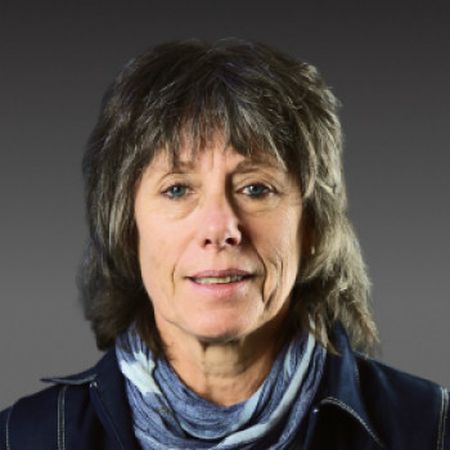
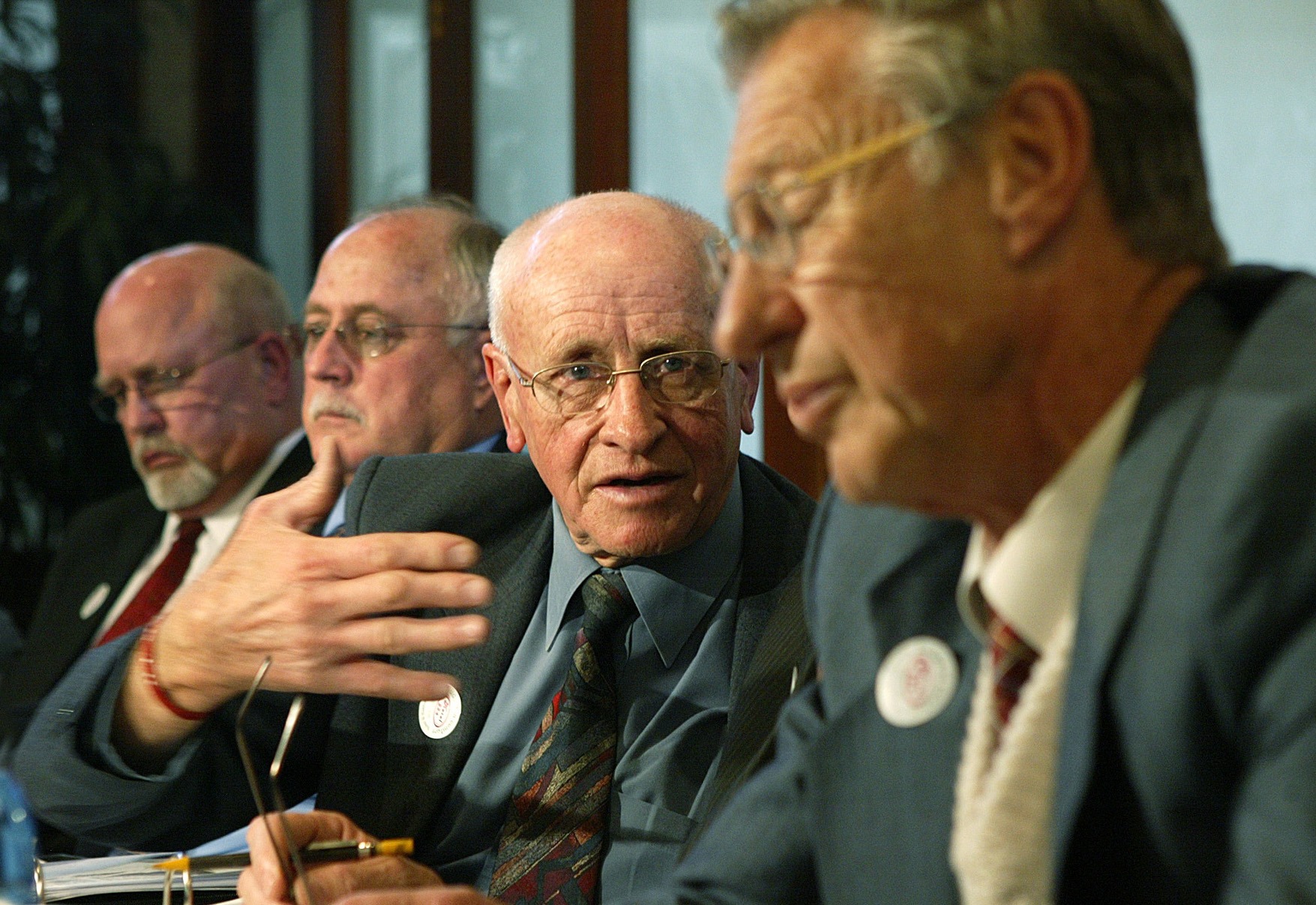
 Former Minister of Law and Order, Adriaan Vlok with former Police Commissioner, Johann van der Merwe, Gert Otto, Hermanus van Staden and Christoffel Smith after their trial at the High Court relating to the attempted murder of Frank Chikane on 17 August 2007. (Photo: Johnny Onverwacht / City Press / Gallo Images)
 /file/dailymaverick/wp-content/uploads/2025/10/label-analysis-2.jpg)
In the history of South Africa’s post-apartheid legal landscape, few documents represent the subversion of the National Prosecuting Authority (NPA) as starkly as the forged memorandum attributed to Priority Crimes Litigation Unit prosecutor, advocate Anton Ackermann.
This document, an internal office note originally drafted in 2003 to track the status of police Truth and Reconciliation Commission (TRC) dockets, forms part of Ackerman's testimony and sworn statements to the Khampepe Commission of Inquiry. Ackermann, who is recovering from a heart attack, testified last week.
/file/attachments/2989/Gemini_Generated_Image_dx2mz9dx2mz9dx2m_484040.png "Advocate Anton Ackermann.")
The memorandum was crudely altered and re-typed some years later to serve as a political weapon against the very prosecutors responsible for resolving TRC cases.
The forgery was not merely a clerical error, Ackermann told the inquiry, but a calculated attempt to frame him as a “rogue” prosecutor who was obsessively pursuing the arrest of then president Thabo Mbeki and other high-ranking ANC leaders in 2006.
The story of the forged note begins in May 2003, when Ackermann assumed office as the Head of the Priority Crimes Litigation Unit. His mandate included managing and directing investigations into cases emanating from the TRC process.
/file/attachments/2989/Screenshot2026-03-08211043_121352.png "The 2007 memorandum from advocate Anton Ackermann with regard to “Project Gnome”.")
Docket audit
Upon assuming his duties, Ackermann conducted an audit of 395 police dockets at the Pretoria office of the Director of Public Prosecutions (DPP).
Because the Priority Crimes Litigation Unit initially lacked office space, Ackermann worked between the DPP office and the VGM Building, supported by his secretary Tia Pienaar, who typed his internal memoranda.
These notes were intended to be placed directly into police dockets to track their status, most notably whether the suspects had received amnesty or if investigations were still required.
Messina landmine campaign
Among these was a note on the Messina landmine campaign, an Umkhonto weSizwe (MK) operation from the 1980s. In his original 2003 assessment, Ackermann noted that while foot soldiers had received amnesty, the criminal responsibility of the ANC leadership who gave the orders would need to be considered at an “appropriate stage”.
At the time, the original note was placed in the relevant docket, which remained in the custody of SAPS members.
In the end, there was never any intention to prosecute senior ANC leaders, Ackermann told the Khampepe commission, which was established to investigate the political suppression of investigations and prosecutions related to TRC cases.
/file/attachments/2989/Screenshot2026-03-06130452_389822.png "The Rapport article, based on fake information. (Image: TRC Inquiry records)")
Anatomy of a forgery
The forgery only came to light on 19 August 2007, following an article in Rapport newspaper which alleged that Ackermann had given written instructions to the police to continue gathering evidence against ANC leaders, for the purpose of prosecution.
The newspaper reported that it had obtained the information “on good authority”.
Startled by the report, Ackermann contacted SAPS head of legal services, Commissioner Phillip Jacobs, and requested a copy of his original office note from the landmine docket.
While it contained the content of his 2003 memorandum, it had been fundamentally altered, said Ackermann. A handwritten “6” had been added to the year 2003 next to his signature, making the date appear as 26 June 2006.
Ackermann testified that he was “100% sure” that this “6” was not in his handwriting. The letter appeared to have been written in Afrikaans and addressed to advocate Silas Ramaite, then acting National Director of Public Prosecutions.
Ackermann stated he had never, on any occasion, written to Ramaite in Afrikaans. Apart from this, the forged note used a computer font and format inconsistent with the documents Ackermann’s office produced in 2006, yet it retained a 2003 reference number and an obsolete telephone number that was no longer in use by 2006.
/file/attachments/2989/Screenshot2026-03-06122558_900576.png)
Political context and motive
The timing of the alleged “2006” note was critical. By June 2006, the NPA had already officially determined that there was no legal basis to prosecute the ANC leadership over the landmine campaigns.
By post-dating the note to 2006, the conspirators created the illusion that Ackermann was acting in defiance of his superiors and the official NPA position.
Ackermann and then National Director of Public Prosecutions Vusi Pikoli’s affidavits place then SAPS National Commissioner Jackie Selebi at the centre of complaints about Ackermann’s role. Since 2006, Selebi had repeatedly alleged to the president and Cabinet Ministers that the NPA, and Ackermann specifically, had been planning to “paralyse government” by arresting its leaders.
Selebi claimed to have “written proof” of these investigations, which he eventually presented to Cabinet ministers in July 2006.
Ackermann argued that the forgery was intended to provide a “plausible explanation” for his removal from managing TRC cases. Indeed, the friction caused by these false allegations contributed to the decision to replace Ackermann with Ramaite in the management of these sensitive matters.
Furthermore, the tension generated by the “rogue prosecutor” narrative was cited as a contributing factor in Pikoli’s suspension.
/file/attachments/orphans/000063626_677282.jpg "General Johan van der Merwe, police commissioner of South Africa during the apartheid era. (Photo: Christiaan Kotze / Media 24 / Gallo Images)<br>")
‘Project Gnome’
The discovery of the forgery triggered a request for a formal investigation. Pikoli instructed that the original document be secured from the SAPS for forensic analysis.
Despite a formal request to SAPS deputy commissioner Jacobs to deliver the original by 4pm on 20 August 2007, the document was never delivered to the NPA. The investigation into the forgery, which Ackermann referred to as “Project Gnome”, faced significant hurdles.
In an internal memorandum dated 3 December 2009, the principal admin officer, a Ms Steenkamp, had reported that the original Project Gnome file had gone missing following the closure of the Directorate of Special Operations (DSO) in 2009. The DSO was popularly known as the Scorpions.
The disappearance of the investigative file further complicated efforts to hold the forgers accountable.
/file/attachments/2989/Screenshot2026-03-09120415_615683.png "Early memorandum by Advocate Anton Ackermann about the appointment of security policeman Suiker Britz to investigate TRC cases (from court documents).")
SAPS-NPA friction
The forged note became a central point of contention during meetings of the Amnesty Task Team on TRC cases, an entity set up outside the NPA to “provide input” on possible prosecutions. Ackermann claimed this task team was unconstitutional and had attempted to impinge on the work of the NPA.
During a meeting on 16 November 2006, documents show Jacobs presented a report that included the date “26 June 2006” in brackets next to case summaries involving the president.
Ackermann, then unaware of the physical forgery, was “furious” and questioned the meaning of the 2006 date, as he knew his decisions on those matters had been finalised in 2003.
The SAPS had used the forged timeline to argue that the NPA was being inconsistent or secretive in its decision-making. For example, the SAPS representatives insisted that the task team had to be consulted on all decisions because the NPA was allegedly still exploring prosecutions against the ANC.
This created a “dead end” for the NPA’s independence, as the Minister of Justice, first Penuell Maduna and then Bridget Mabandla, as well as directors-general of various departments, began to demand oversight, which Ackermann and Pikoli viewed as unconstitutional interference.
/file/dailymaverick/wp-content/uploads/2025/10/MC-Craig-Williamson_4.jpg "The graves of the Cradock Four: Matthew Goniwe, Fort Calata, Sparrow Mkhonto and Sicelo Mhlauli in Cradock, Eastern Cape. (Photo: Gallo Images / Oryx Media Archive)")
Mbeki and Zuma’s responses
While both presidents have been in possession of all the court bundles relating to the commission, they have not specifically referred to the fake memorandum. In his application for Khampepe’s recusal, Mbeki argued that TRC cases were centred on Mandela’s guiding vision of “nation-building and reconciliation in the aftermath of years of violence, struggle and bloodshed”.
In his papers, the former president said that when tabling the final TRC report in 2003, the state had to balance the need for legal accountability against the imperatives of managing the transition to democracy.
Mbeki added that the ANC had been the “principal architect” of the Constitution and that his government had always acted with the knowledge that constitutional prescripts were binding.
Former president Jacob Zuma has been in possession of all documents with their attachments, including “secret” communications from the start of this process. His argument on the delay in TRC cases in his affidavit seeking Khampepe’s recusal was that “national interests” trumped everything as the need at the time was for a “political solution over a legal one”.
During the high-level, secret deliberations with former apartheid-era generals that began in 1998, Zuma explicitly stated that criminal prosecutions were “not in the interest of the government”. He argued that pursuing trials for past atrocities would be counterproductive to the progress of nation-building and reconciliation, as “such trials would constantly revisit the bitterness of the past”.
Both former presidents have denied interfering in the prosecution of TRC cases.
Impact on TRC prosecutions
The forged Ackermann memorandum had a devastating effect on the pursuit of justice for apartheid-era crimes, and by causing his removal from the TRC cases the architects of the forgery effectively stalled investigations into dozens of high-profile matters.
Ackermann noted that because of the political interference and the hostility from the SAPS, the Priority Crimes Litigation Unit was unable to secure the investigators needed to proceed with cases like the Ahmed Timol investigation.
In his 2025 affidavit to the Khampepe inquiry into decades-long delays in TRC prosecutions, Ackermann described the existence of such a forgery within a law enforcement agency as “disgusting”.
He maintained that he had always prosecuted “without fear, favour or prejudice”, pointing to his lead role in the trials of apartheid operatives such as Eugene de Kock and Wouter Basson as proof of his objectivity. The forgery, however, was designed to paint this objectivity as a partisan vendetta against the new democratic government.
The forged Ackermann letter remains a symbol of the “capture” of SA’s security apparatus during the mid-2000s.
It was a tool used to intimidate the NPA, mislead the Presidency and provide a pretext for the removal of principled officials. The fact that the original forged document and the subsequent investigative file “disappeared” into the machinery of the state suggests a coordinated effort to protect those responsible.
For the victims of the conflicts of the past, the forged letter was more than a lie; it was a barrier to justice that ensured many TRC-related dockets would remain closed for decades. DM