




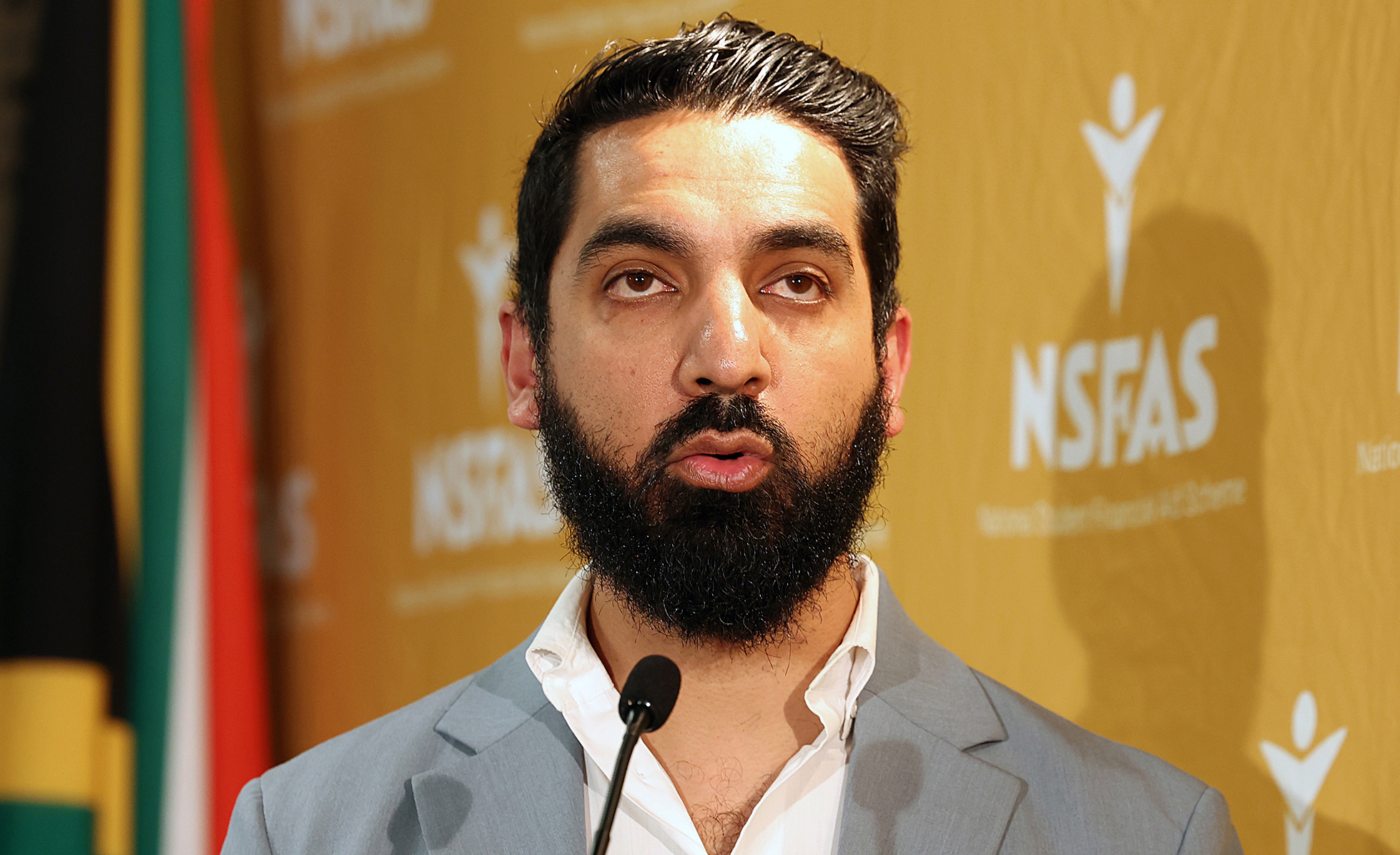
 National Student Financial Aid Scheme acting CEO, Waseem Carrim. (Photo: Kopano Tlape / GCIS)
 The National Student Financial Aid Scheme (NSFAS) is attempting to steady the ship in 2026 after a turbulent period marked by a funding crisis, governance changes and persistent accommodation disputes. At the centre of the effort is acting CEO Waseem Carrim, who told Daily Maverick that the scheme had implemented a detailed academic-year strategy aimed at ensuring a smoother start for students despite the financial strain still hanging over the institution.
The turnaround plan comes at a politically sensitive moment. Finance Minister Enoch Godongwana recently questioned whether NSFAS should exist at all, criticising the scheme for relying on external service providers to perform functions it was created to handle. Daily Maverick understands that NSFAS released its first batch of student allowances in February and March, a move Carrim says was part of an effort to ensure that no qualifying student was left without support.
“We planned internally first. We kind of laid out what we believed our academic timetable should look like. And then we went back to our stakeholders (universities, colleges and landlords) and said ‘what are your views? Can you guys comply with this kind of timetable and whatever else?’ Then we published almost at the start of December to say these are our timeframes for everything,” said Carrim.
The timetable took into account the academic calendars of universities and colleges, the timing of student residence admissions, the appeals process and the release of matric results on 12 January 2026.
“The big target for us was giving the majority of the decisions before the matric results were released because it triggers university offer letters. Once a student knows they’re not accepted at university, they go to Technical, Vocational Education and Training (TVET) colleges. So the release of funding decisions before matriculation results reduces a lot of the pressure and anxiety in the system,” said Carrim.
Universities see some improvement
Some universities say the planning has had a tangible impact. Cape Peninsula University of Technology (CPUT) spokesperson Lauren Kansley told Daily Maverick that the institution’s working relationship with NSFAS had improved.
“Overall, we have good alignment with NSFAS and are also now trialing the Pilot Accommodation Project, so we are working together on a few things. Our relationship continues to strengthen year on year,” said Kansley.
Lebogang Seale, senior manager of strategic communications at the University of Johannesburg, said the early release of funding outcomes had helped minimise registration delays for eligible students.
“NSFAS’ early planning delivered the most measurable benefit for returning students, driven by the timely upload of 2025 results and the smoother release of continuing-student outcomes. For the 2025 Grade 12 cohort, the release of 2026 first-year funding outcomes aligned with the established cycle and was issued in January, consistent with the January 2025 timeframe,” said Seale.
Carrim expressed frustration with CPUT’s handling of its housing processes, particularly after the institution faced similar problems last year.
/file/attachments/orphans/ED_545650_560868.jpg "Students from CPUT who were on the residence waiting list were stuck outside the District Six Campus on 7 February 2025 in Cape Town, South Africa. The students allegedly slept outside the premises. (Photo: Gallo Images / Misha Jordaan)")
“Where I am, I’m disappointed in CPUT. The fact that they had issues last year and they still have the issues this year tells you they are not learning from their mistakes… We may be stronger in saying that we don’t believe you can manage accommodation. We may need to intervene and take over because we can’t have our students sleeping on the streets. It affects us badly as an institution,” said Carrim.
The criticism comes as CPUT continues to grapple with placing students, with some first-years reportedly sleeping in kitchens and study rooms while waiting for accommodation.
Scheme under financial pressure
Behind the operational challenges lies a deeper financial problem. Last year, NSFAS faced a budget shortfall of about R10.6-billion for university funding. Government interventions and investigations by the Special Investigating Unit helped recover R1.7-billion from universities, TVET colleges and former students who had received funding incorrectly. Even so, the scheme remains under severe pressure. One visible consequence has been the decision to split the annual book allowance of R5,600 into two payments.
“Whether we like it or not, there are two reasons. So the one thing is that the cash flow is still under pressure. We’re still recovering from that huge deficit last year. We just wanted to be a bit safer with our cash flow, and we said let’s do it 50-50, because we released the other 50% in March.
“And then the other thing we’re still a bit worried about is the book allowance being paid with a big amount of money upfront, you know, whether or not students are actually using it. And we felt like maybe if we stagger it, it also might change student behaviour a little bit, also in terms of housing. So those are the two main reasons,” said Carrim.
Godongwana questions NSFAS’ future
/file/attachments/orphans/ED_597668_621051.jpg "Finance Minister Enoch Godongwana. (Photo: Gallo Images / Jeffrey Abrahams)")
Finance Minister Enoch Godongwana recently questioned whether NSFAS should continue to exist, arguing that the institution outsourced core responsibilities to third-party providers.
“NSFAS is supposed to be paying universities for student accommodation and everything else, but in turn, they have employed three other service providers to provide the service they were created to do. Why should we keep them?” said Godongwana.
Carrim pushed back strongly against the suggestion.
“NSFAS is important because there’s no other organisation that has a central application system that does the allocation to institutions, both universities and TVET, and that manages the disbursements. So that capacity doesn’t exist anywhere else. So if you were to take NSFAS away, I would say we know the capacity at TVET is lacking. Yes, there is capacity at universities, but there’s no central application,” said Carrim.
He added that dismantling the scheme would require legislative change.
“If you want to close it, you need to introduce a bill to that effect.”
For many students, however, NSFAS funding remains the only path into higher education. Diploma in Accountancy student Samkelo Mkenku, a first-year student at CPUT, said the application process had worked smoothly this year.
“I applied as soon as the application opened; NSFAS responded this year, and my allowances came in, then I bought groceries and clothes because I had a laptop already,” said Mkenku.
Another first-year student, Diploma in Management student Mpho Sebutse, said funding approval came quickly, but accommodation remained a struggle.
“After applying, I had to check my status. Immediately it told me that I am eligible for a bursary. I knew my status was fine, so I had to register, but I am struggling with accommodation,” said Sebutse.
According to Carrim, NSFAS disbursed more than R3.6-billion in February for books and accommodation, followed by more than R2-billion in March for university student allowances. TVET colleges received more than R600-million in February for tuition fees and a further R592-million for student allowances.
NSFAS had received 101,000 appeals, 22,000 had been approved, and 18,000 were rejected. A further 44,000 were closed, deleted or withdrawn, while about 9,000 remained incomplete due to missing supporting documents.
Looking ahead, Carrim said the scheme was focused on two long-term priorities: securing a sustainable funding model and tackling SA’s severe student housing shortage.
He added that the aim was to “address, over the next 12 months, the long-term sustainable funding model so that students themselves have certainty going into the future. Two, the accommodation for me is quite important. Addressing the accommodation infrastructure backlog in the country, particularly in rural areas,” said Carrim.
NSFAS will now handle landlord accreditation directly, ending contracts with “solution partners” that charged a 5% commission on payments. “Completing that legal review was important, as was acting on its recommendations. We picked up issues like people claiming funds for students who were not NSFAS-funded. So maybe they were NSFAS-funded, and they didn’t meet the progression criteria, but they were still being housed. Now the landlord doesn’t understand why they’re not being paid,” said Carrim. DM