
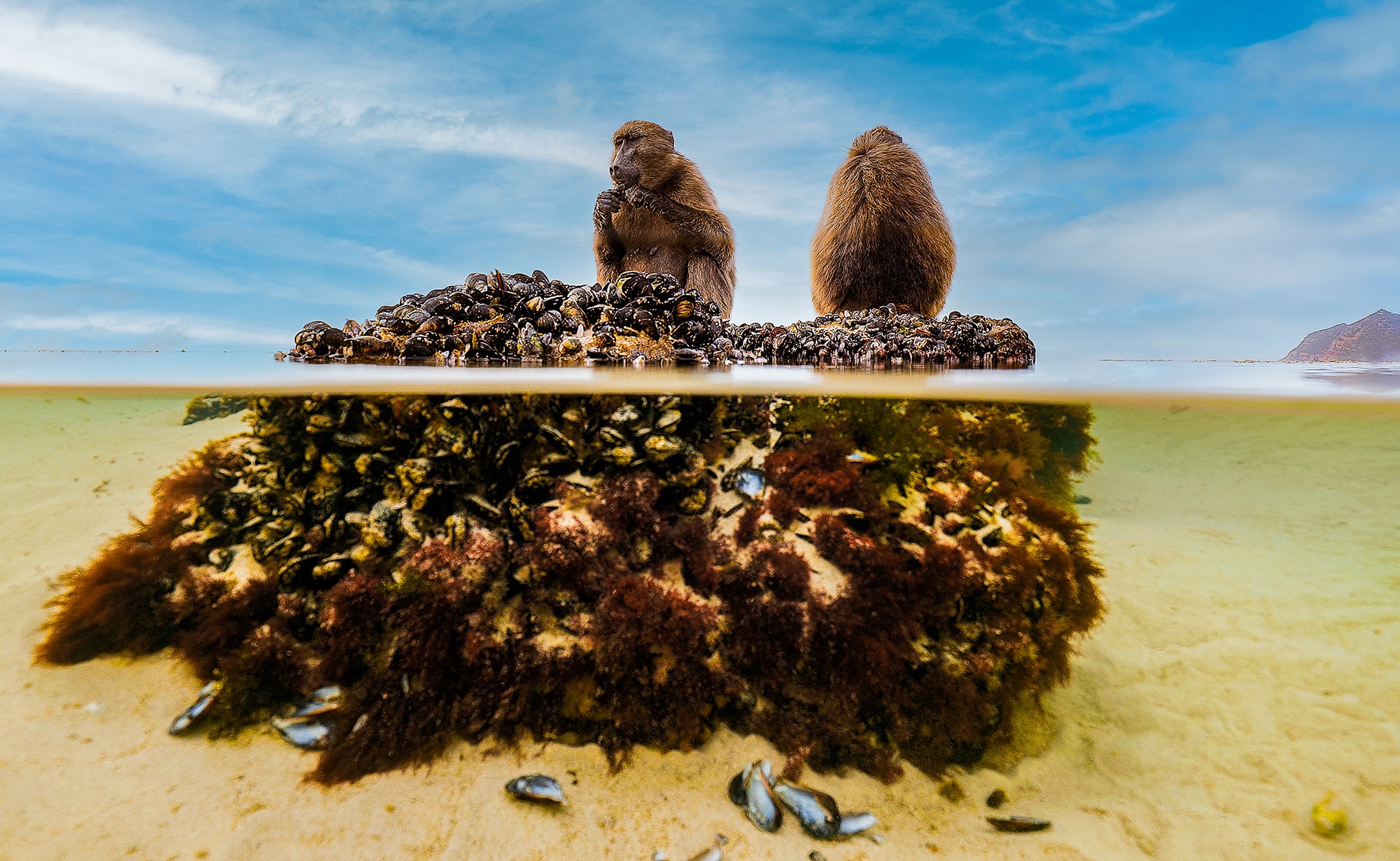
 Baboons foraging in the ocean at Buffels Bay beach, Cape Point, Cape Town. (Photo: Jason Boswell)
 /file/attachments/orphans/storiedmountainlogo_645719.jpg)
My name is Jane. At least, that’s what the rangers call me. We have other ways of naming each other – through smell, the way we grunt, who one sits beside. But Jane will do.
With my mate we’re the main baboons of a troop that moves between the slopes above Simon’s Town and the sea. Every morning I wake on the mountain, where the wind smells of fynbos and salt, and I look down at the strange settlement of humans below.
You’re a curious species. We’ve been watching you for a very long time.
From up here your places look like a puzzle. Square nests packed together. Tall poles with wires that sometimes bite us, long, shiny rivers where your metal animals rush along. But the thing we notice most is food. You scatter it everywhere.
/file/attachments/orphans/Baboon-3_455868.jpg "Checking out the grape harvest. (Photo: Don Pinnock)")
You hide it in bins. You leave it on tables behind glass doors. You keep it in bowls on counters and bags in cars. Sometimes you even plant it carefully in neat rows and water it for months – grapes, peaches, vegetables – and then act surprised when we come to collect the harvest.
Among ourselves we sometimes ask: do humans understand what they’re doing?
A baboon doesn’t store food. We don’t leave it in bins and then shout when another baboon takes what’s inside. Yet this is what you do.
One door is open, and a fruit bowl is glowing in the middle of a kitchen like a signal fire. Another house has a wheelie bin containing yesterday’s chicken bones. Down the road there are schoolchildren with lunchboxes. At the beach there are tourists who laugh and hand out oranges for photographs.
I am told we’re unusual baboons because we forage on the seashore and eat mussels. We’ve done that for as far back as time remembers. But to get there we have to travel past your nests and that’s when you think we’re raiding.
/file/attachments/orphans/20230628_121554_141572.jpg "Baboons are extraordinarily good parents. (Photo: Don Pinnock)")
Everything about you is confusing
If on the way one of my youngsters walks in to collect what’s been offered, humans wave their arms and scream as if a leopard had arrived in the living room. From our point of view, it’s very confusing. Actually everything about you is confusing.
Some of you chase us with sticks. Some shoot little balls that sting like angry bees. Some kill us. (I’ve been struggling to understand human cruelty.)
Other people are quite different. They sit quietly and watch us with respectful curiosity. A few even seem to understand our language a little.
Your fear is a loud signal to us. Calmness is another. We read both easily. Human fear often means easy food. That’s one thing humans underestimate: we’re very good observers.
We know which houses forget to lock their bins. We know which gardens grow the sweetest figs. We know where the tourists gather and which ranger whistles softly instead of shooting paintballs.
You might call this intelligence. To us it is simply paying attention.
/file/attachments/orphans/8c90c4b0-908e-483e-9bf2-e24f43f462871_265458.jpg "Morning exercises. (Photo: Don Pinnock)")
Despite what many humans believe, we don’t survive on your food. Most days we forage on the mountain. We dig for roots, chew young shoots along the roadside, search the rocks for insects and sometimes pull mussels from the shore.
The mountain feeds us well when we give it time. But the mountain can also be dangerous. Most mornings we’re disturbed by an early-morning walker and their pet predator. Our worst. Dogs. You’ve brought so many into the area.
Dogs are let off their ropes in the mountains and they chase us. This is what mostly sends us into your neighbourhoods. The mountain doesn’t have good trees to climb. We must use your houses to get away from them. We need to keep everyone safe.
Sometimes in the evenings we head up the mountains to sleep. And one of you will arrive with your dog or your gun and come and do target practice on us. This sends us back down the mountain into the town. We must think as a troop in terms of safety. So we descend, and when we do, humans say we’re invaders.
From our side it looks different. It looks like survival and following opportunity.
/file/attachments/orphans/Thepurepleasureofagroomingisallpartofsocialbondingamongchacmababoons_682601.jpg "The pleasure of a good grooming. (Photo: Don Pinnock)")
Baboons are very caring
We’re very caring. In the troop I lead, the young ones learn by watching. A mother carries her baby for weeks before letting it explore the ground. When a newborn arrives the whole troop gathers to inspect it – a quick look, a gentle, lip-smacking greeting, a baboon kiss.
Then the older young ones help watch over it while the mother feeds. We’re careful with our children. We must be. The world is not kind to baboons. Especially here.
So the greatest danger we face is not leopards or eagles. It’s you and your dogs. Many of the big males disappear each year. Some are run over on roads. Some are shot by residents with guns or air rifles. Others are taken away by authorities and never return.
You can’t imagine how much that changes a troop.
/file/attachments/orphans/BaboonfamilyDonPinnock_979007.jpg "A family huddle on a cold winter morning. (Photo: Don Pinnock)")
When males vanish suddenly, the troop’s order breaks. Young males wander between groups, searching for a place to belong. Females worry about their babies, because a new male arriving from outside might kill those that are not his. That is an old law of the wild.
Recently something strange has been happening, though. Some males are beginning to ignore that law. They accept the babies already in the troop.
Perhaps they understand that too many males are disappearing, that if the babies die the troop itself may fade away. It is difficult to say exactly what they know.
Baboons adapt quickly. Humans sometimes claim that we’re plotting against them. That we target houses or organise raids. The truth is different. We’re not that interested in you.
Usually it is just one or two adventurous youngsters, learning to adapt to a changing landscape. Testing a new kind of door, sliding it sideways, lifting it off its track if necessary. We experiment. A sliding door is a puzzle. In this way we probe weaknesses in your world.
Perhaps that’s why humans are uneasy around us. We’re too like you. Our faces are a bit like yours. Our hands can grasp and twist. When we sit on a wall studying a garden, we look like neighbours considering whether to borrow an apple.
/file/attachments/orphans/Baboons_SANParks_209639.jpg "The Peninsula’s much-contested baboons.<br>(Photo: Table Mountain National Park)")
(Photo: Table Mountain National Park)
One ranger once said that if baboons could speak to humans, we would ask them one question: do you know who you are? Because to us you’re so many different things that don’t fit together very well.
When a baboon enters a house, you show who you really are. Some throw chairs and shout. Some freeze in terror. Some speak calmly and ask us to leave. In that moment maybe you see something about your own nature.
But lately there are whispers in the troop. We hear things carried on the wind by rangers and residents: a plan to capture some of us. To place certain troops inside a fence. The males will not be allowed to have children. Visitors will walk past and watch us as if we’re in a zoo.
Baboons understand cages. Our ancestors have seen them before. Long ago humans called us vermin and wiped out whole troops. Later they trapped us for experiments.
Now the plan uses softer words: management, relocation, population control. But the end result is the same: an awful life behind fences after roaming free on the Peninsula for thousands of generations.
/file/attachments/orphans/Peninsulababoons_740386.jpg "Cars are always worth investigating. (Photo: Don Pinnock)")
The real puzzle is not us
Perhaps you believe this will solve the problem. But the real puzzle is not us. The real puzzle is why you build nests in baboon territory, scatter food everywhere and then get angry when we appear.
You could lock your bins. Close your doors. Design your nests that keep us outside. These are simple things. Instead you talk on and on about killing, capturing or controlling us.
/file/attachments/2989/DarlingofthetroopDonPinnock_855987_841902.jpg "Darling of the troop – for a while. (Photo: Don Pinnock)")
I wish you would learn to trust us. We’ve lived here for so long. We know what we’re doing. We have had to adapt to survive. We’re locked onto the Peninsula now, you’ve blocked our way to the other mountains over the flat sandlands. I’m asking you as my cousins, please adapt to us too. We mean no harm.
From the ridge above Simon’s Town I watch the sun set over False Bay. My troop settles into the rocks. Babies curl against their mothers. The young males groom each other. Far below, lights begin to glow in your nests.
Somewhere a bin lid will stay open tonight. Somewhere a fruit bowl will sit beside an unlocked door. And somewhere a human will shout in fright tomorrow when we step inside to claim what appears – at least to us – to have been offered.
From our point of view, the world you’ve built is not an enemy. It’s just very badly organised. I hope there are some humans prepared to help us, because, to be honest, I have a very uneasy feeling about our future. DM
Inspired by a film in the making called Waiting for Evolution by Karin Slater
The series so far
- The flat mountain that wouldn’t behave
- What is Table Mountain? A story of Deep Time
- Hotter, drier, wilder: reinventing conservation for a changing climate
- Table Mountain’s green cloak that took 60 million years to weave
- The fluid intelligence of Table Mountain’s rivers
- What it takes to keep Table Mountain wild
- Rough sleepers: The mountain keeps us
- Cormac Cullinan: thinking like a mountain, listening like a river
- Yellow angels: Table Mountain’s firefighting helicopters