




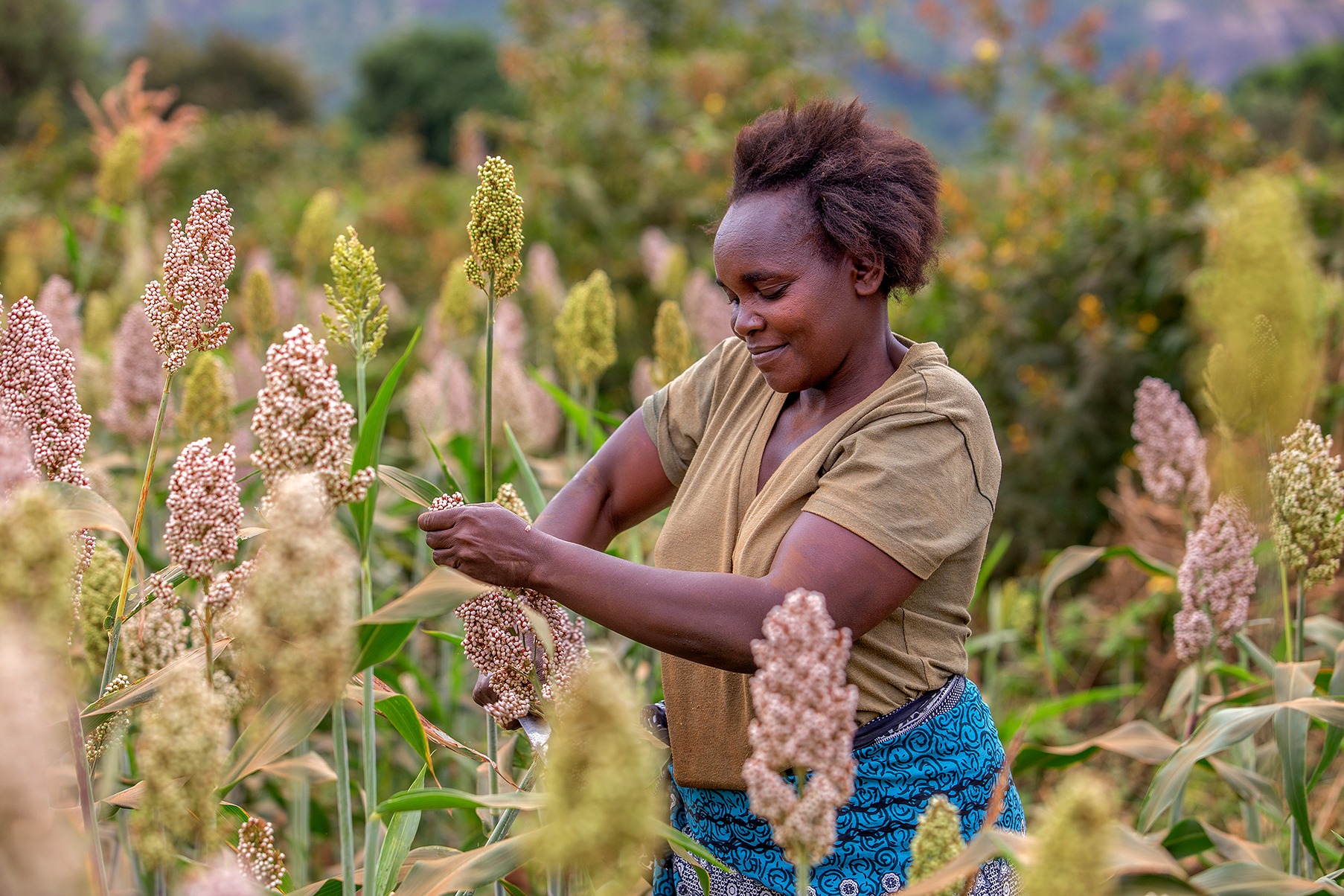
 Loise Muriithi (42) harvests sorghum at her farm in Tharaka North Sub County, Kenya, on 19 July 2016. (Photo: Mwangi Kirubi / Arete / Rockefeller Foundation / AGRA)
 /file/dailymaverick/wp-content/uploads/2025/10/label-Op-Ed.jpg)
This International Women’s Day, the United Nations asks the world to demand rights, justice and action for all women and girls. In Africa, that demand begins on the farm, where a woman rises before dawn, reads the soil, manages seed stocks, negotiates with traders, feeds her household and plans for the seasons ahead. She is a chief executive. And she is owed recognition, not charity.
When analysts examine family enterprises, they often turn to European vineyards or vast Asian conglomerates, dissecting governance models, succession plans and the delicate choreography between tradition and innovation. Yet they routinely overlook the world’s oldest and most widespread family business: the smallholder farm and the women who have always been its backbone.
Long before agriculture acquired the language of balance sheets and shareholder value, it was already organised around kinship, continuity and commercial exchange. Its roots stretch to the early neolithic Sahara, when communities across the Naba Playa and Dhar Tichitt regions began domesticating crops and livestock in response to a changing climate. What later travellers encountered was not something new, but thousands of years of refinement.
Among the most famous observers was the 14th-century Moroccan traveller Ibn Battuta. Crossing the Sahel and east Africa, he recorded sophisticated production systems, vibrant trade routes and deep agronomic knowledge passed between generations; shea oil used for cooking and rice thriving in floodplains. The women who held that knowledge were not at the margins of history. They held complex, interlinked family enterprises flourishing long before management theory gave them a name.
The legacy persists. Today, smallholder farms; those with fewer than two hectares, account for roughly 80% of holdings in sub-Saharan Africa and produce about 70% of the region’s food. They anchor a sector representing roughly 30% of continental GDP and employing more than half of the sub-Saharan workforce. The African Development Bank estimates that with the right investments, the sector’s annual contribution could more than double, exceeding R13.2-trillion ($800-billion) by 2030. That gap is not abstract. It represents incomes, jobs, food security and the vitality of rural economies.
So, why are these businesses seldom treated with the same strategic seriousness as their counterparts in manufacturing or finance?
And why are the women running them so rarely recognised as the entrepreneurs they are?
The obstacle is perception compounded with structural injustice. Smallholder agriculture is still framed primarily as a development challenge rather than enterprise. Its commercial logic is obscured by narratives of fragility and need. And its female leadership is rendered invisible by financial, legal and political systems that were not designed with her in mind. Yet the core ingredients of successful family capitalism are already present.
IMD Business School points to long-term orientation, patient capital, resilient governance and strong values. African smallholder women practise these principles instinctively, planting orchards whose fruit they may never taste, conserving soil and seed for future generations and organising labour through dense community networks. Their time horizons are measured in seasons and decades, not quarters.
/file/attachments/orphans/MONICAMODESTAKAMANGE-RICEFARMERATITUNUNDUKAMANGEWARDPAWAGAVILLAGEIRINGATANZANIACaptured2021-Mar-17_361114.jpeg "Rice farmer Monica Modesta Kamange at Itunundu, Kamange Ward, Pawaga Village in Iringa, Tanzania, on 17 March 2021. (Photo: Supplied)")
In aggregate, these millions of family farms constitute the continent’s largest and most distributed ownership structure. No other sector concentrates productive assets across so many households or spreads income across so many rural communities. What is missing is not ingenuity but institutional scaffolding that allows women enterprises to grow, since they cannot, always, hold title to the land they work, for instance.
Larger family-linked agribusinesses across the continent offer instructive clues. Tanzania’s Bakhresa Group and Zambia’s Zambeef Products PLC have reduced succession risk through formal charters separating family interests from corporate strategy. Zambeef has gone further, professionalising through public listing and rigorous governance.
Even smaller commercial operations, such as South Africa’s Chamomile Farming, recognise that longevity depends on treating the family itself as a professional unit. For every success, however, thousands of farms remain caught in cycles of low margins and vulnerability. The constraint is not capability. It is systemic neglect: financial systems, infrastructure and policy rarely design with the agrarian family firm in mind and even less its female chief executive at the centre.
Three ways to move forward
Change requires coordinated action across three priorities.
🌱Redirect demand to strengthen local enterprise. Africa imports R1.66-trillion ($100-billion) in food each year, much of which could be grown at home. Urban households can treat buying local produce as an investment in domestic entrepreneurship and in the livelihoods of rural women. Supermarkets and processors can shorten supply chains by working with organised farmer groups. Public procurement can favour domestic aggregators. This is not protectionism. It is sound economics that keeps capital circulating within national, regional and continental markets.
🌱Treat harvest and post-harvest loss as an infrastructure emergency. When 30% to 40% of production disappears because of inadequate storage, transport or energy, the issue is not charity but competitiveness. Governments must prioritise rural roads and power access. Development financiers and ag-tech investors can expand solar cold chains and mobile warehouse-receipt systems. Every functioning business depends on logistics; agriculture is no exception.
🌱Deploy patient, tailored capital and technology. Finance must respect the biological rhythms of farming. Banks and fintechs can use mobile money histories and satellite data to build more accurate risk profiles for farmers who lack formal collateral. But capital alone is insufficient if the women who need it cannot always legally own land, open accounts independently or seek redress when contracts are broken. This is where the IWD 2026 call for justice becomes concrete. Legal reform closing the gap between rights on paper and rights in practice is the prerequisite for economic transformation. Extension services should marry indigenous expertise with climate-smart methods, while digital platforms must connect farmers not only to information but to markets, insurance and peer networks; turning isolated smallholdings into nodes within a professionally managed enterprise ecosystem.
The smallholder farmer is not a relic of the past. She is the chief executive running an enterprise that has survived colonial disruption, structural adjustment, climate volatility and repeated market shocks. What she lacks is not ingenuity but recognition and the rights, justice and institutional backing that recognition demands for a partnership to build the future.
/file/attachments/orphans/VegetableInputsDistricutionandProductionPlotsNigeria_725280.jpg "Vegetable Inputs Districution and Production Plots Nigeria.
<br>(Photo: Supplied)")
(Photo: Supplied)
Grant these businesses the analytical rigour and institutional backing routinely afforded to family firms elsewhere, and the results could be transformative. We will not merely be correcting a historical blind spot. We will be honouring the rights of millions of women and partnering with millions of entrepreneurs already embedded in the landscape, whose success is inseparable from Africa’s food sovereignty.
Their justice is long overdue. DM
Carl Manlan is chief of partnerships and business development at Nairobi-based Alliance for a Green Revolution in Africa (AGRA).