




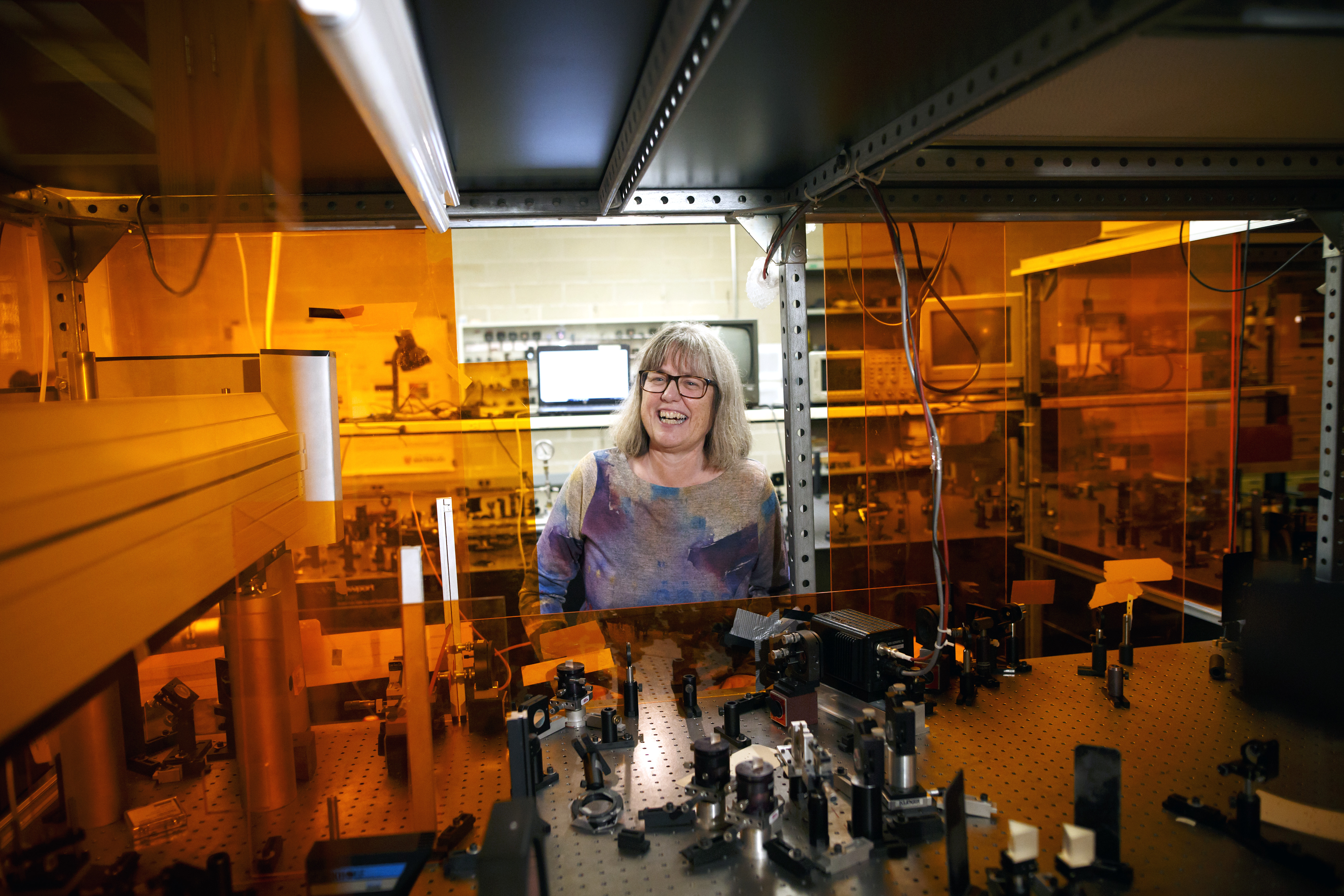
 Professor Dr. Donna Strickland shows off instruments in her lab following a news conference at the University of Waterloo to field questions about her shared Nobel Prize in Physics, October 2, 2018 in Waterloo, Canada. Strickland won for her work on ultrashort lasers. The other two recipients were laser physicists Arthur Ashkin and Gérard Mourou. (Photo by Cole Burston/Getty Images)
 /file/dailymaverick/wp-content/uploads/2025/10/label-Op-Ed.jpg)
Every year around this time, South African women in science wake up to calls from journalists or awards bodies eager to celebrate their work with front-page coverage and prestigious accolades.
Most of these moments of visibility come with a gendered lens. Recognition often frames them as “women in research” rather than simply as cutting-edge researchers – which they are.
By April, however, the glow of International Women’s Day fades. These world-leading scientists return quietly to their work, changing the world while still fighting to be recognised as senior leaders in their fields.
Late last year, Eugénie Kayitesi, an agricultural researcher at the University of Pretoria, called on the sector to “do better” at keeping women visible beyond token media moments.
And she’s right.
The issue is not simply about recognition. A lack of visibility contributes to what researchers call the “leaky pipeline”: more women than ever are entering science careers in Africa, yet far fewer advance into senior leadership roles where they can influence funding, research agendas and policy.
A report in BBC Africa recently noted that “women across Africa are earning STEM degrees at nearly the same rate as men, yet far fewer go on to build careers in science and technology”.
In fact, African women enter STEM careers at a slightly higher rate than the global average – 30% compared with 28% globally – and 47% of STEM graduates are women. Yet only 10% become CEOs and just 12% reach senior leadership roles in tech companies.
“Only 29% of doctoral candidates are women,” says Dr Linda Meyer, former head of operations at Universities South Africa. “In senior professional, engineering and research roles, representation declines further, hovering between 23 and 29%. This pattern is not accidental; it is systemic.”
/file/attachments/2989/1Quarraishaportrait_787253.jpg "Quarraisha Abdool Karim is a world-renowned South African infectious diseases epidemiologist. Her groundbreaking research has transformed HIV prevention for women in Africa and she has established funding grants specifically to create opportunities for women scientists. She is the first female President of the World Academy of Sciences for the advancement of science in developing countries (TWAS) and the co-founder of the Centre for the AIDS Programme of Research in South Africa (CAPRISA), where she is the John C. Martin Chair in Global Health and Associate Scientific Director. Her work has profoundly influenced the global HIV prevention landscape over the past three decades, particularly in enhancing understanding of the evolving HIV epidemic and developing prevention technologies for women.<br>")
That word – systemic – matters.
Because the consequences go far beyond equality statistics.
When women are missing, knowledge is shaped differently
Women remain underrepresented on funding panels and in high-level research decision-making spaces. That doesn’t just affect gender parity. It shapes the knowledge ecosystem itself.
Funding determines which questions are asked.
When women are absent from senior decision-making spaces, research priorities risk reflecting a narrower set of perspectives. With scientists constantly competing for limited resources, inequitable funding patterns don’t only disadvantage women – they limit what society learns.
Public visibility also plays a powerful role
Evidence shows that male voices dominate media coverage of science, including, for example, during the Covid period in South Africa. Over time, that visibility builds authority and public trust. The result is a familiar pattern: male experts become the default voices of science, while women are positioned as secondary commentators.
In a country with some of the highest rates of gender-based violence and femicide in the world, this dynamic matters. Anything that reinforces the idea that women are “less than” men in their fields contributes to broader inequalities in society.
So the question is not simply how to get more women into science.
The question is how to ensure they remain visible, influential and supported throughout their careers.
What can the research sector do?
For too long, the burden of improving gender equity has fallen largely on women themselves. Institutions, funders and research organisations need to take the lead.
- Recognise and reward public engagement: Science communication and public leadership platforms are essential for building credibility and influence, yet this work is often undervalued in academic systems. Institutional incentives, media training and communication support can make a real difference. Kayitesi has spoken openly about this challenge, noting that “women are not raised to be on the forefront of anything”. Cultural expectations around women’s visibility in Africa can shape how comfortable researchers feel speaking publicly. As she put it: “The system was not built for me.” That system needs rebuilding;
- Broaden expert databases: Audit spokesperson lists and conference panels to ensure they include a wide range of women experts. Every interview, keynote or panel discussion is an opportunity to platform women scientists – and to show young STEM students that they belong in those spaces too;
- Address structural barriers: Women often carry heavier service and leadership responsibilities than male colleagues. Studies show that 12% of women in STEM leave the field prematurely due to the “double bind” of family pressures and gender bias. A 2021 study by O’Connell and McKinnon found that “entrenched biases, stereotypes, double standards, harassment and gender-based violence in research environments impact women’s participation in STI”. Institutions must address these barriers from every angle – from funding and childcare support for researchers with family responsibilities, to stronger policies that tackle workplace bias and harassment;
- Move beyond symbolic inclusion: Occasional profiles or one-off speaking opportunities are not enough. Real change requires sustained visibility. Over the past five years we have been working with the Science Granting Councils Initiative and partners at the Human Sciences Research Council to embed gender equality and inclusivity practices across the research funding ecosystem, ensuring gender is on the table when funding decisions are made. Institutions can make a huge difference by aligning their policies with the kinds of equity and inclusion priorities that we need to see acted on; and
- Take up space: Researchers themselves can also take steps to claim their deserved space as trusted leaders in their fields, not just “women in science”:
- Building relationships with journalists helps establish credibility over time. Once media platforms recognise your expertise, they are more likely to return to you as a trusted voice;
- Clear positioning also matters. Many scientists are not taught to see themselves as “brands”, but a concise explanation of your work and why it matters helps audiences understand its value;
- Choosing a few communication platforms – LinkedIn, public talks or media commentary – and using them consistently can also build recognition; and
- Investing in leadership and communication skills alongside research expertise ensures important work reaches broader audiences and greater influence.
Because if knowledge shapes society, then it matters who is shaping that knowledge.
/file/attachments/2989/2PHOTO-2025-06-24-13-10-44copy_890045.png "Members of 13 science granting councils from across Africa met in Cape Town last year to transform science systems by mainstreaming gender equality and inclusivity in their research funding processes. <br>")
/file/attachments/2989/3HSRC_GEI_CTJul23last_day-3_543939.png "Scientists have tremendous power to shift perceptions by taking up media opportunities and growing skills for public engagement.")
There’s a powerful report I love called the A-Z Guide of Why Gender Matters in Research and Innovation. It’s worth reading: contained therein are the myriad reasons we won’t solve the world’s biggest issues if women are missing in science pursuits. Pick a sector and you’ll find a reason that women need to be leaders in research.
International Women’s Day should not only celebrate representation. It should challenge us to build systems where women’s expertise shapes leadership, funding decisions and the public conversation about science, long after the headlines fade. DM
Robert Inglis is co-founder of the Science Spaza youth science engagement initiative and director of Jive Media Africa, a science engagement and communication agency which has provided support to the research sector for more than 20 years.