
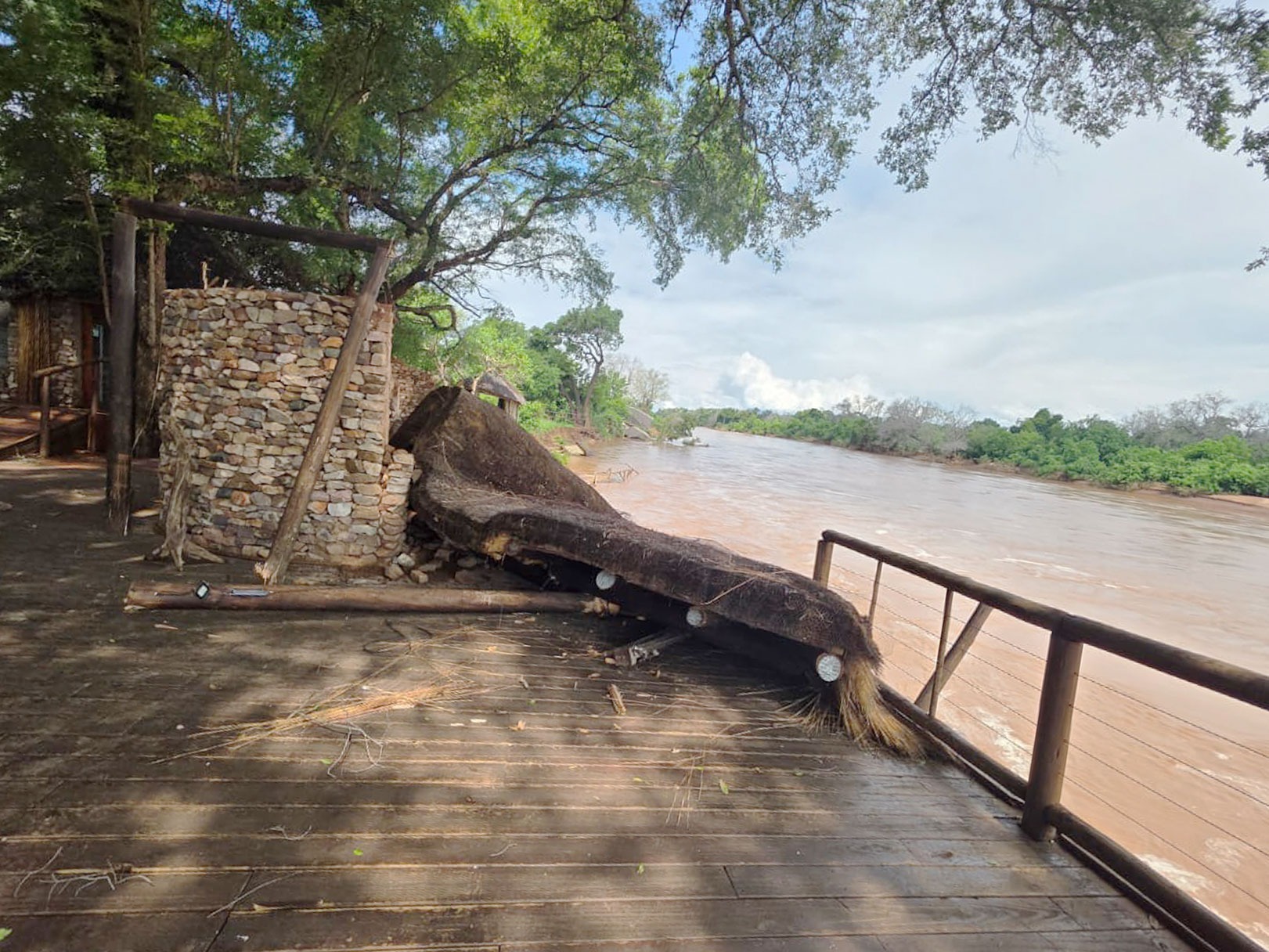
 Pafuri floods. (Photo: Godfrey Baloyi)
The forces that destroyed Pafuri Tented Camp in the far north of Kruger tell a tale of two rivers – one too full, the other too empty. The result was devastation.
The luxury camp stands on the banks of the Luvuvhu River near its confluence with the Limpopo at Crook’s Corner. In past storm events, floodwaters in the Limpopo pushed back against the Luvuvhu. In 2000 and 2013, when both rivers flooded together, the Luvuvhu had nowhere to go. It stalled, backed up and spread across the floodplain in a slow inundation. Little damage.
This time it was different.
The Limpopo was relatively low, flowing within its usual channel, while the Luvuvhu – swollen by massive rainfall dumped on the Soutpansberg – roared out of Lanner Gorge west of the camp. It ripped into the river’s sandy, rockless banks at every bend, gouging out the base of the camp and undermining structures that crashed into the raging water. Parts of it are probably somewhere in Mozambique.
When you live on a wild river, you watch the weather warnings. They knew a flood was likely. Camp manager Godfrey Baloyi evacuated the guests, and Kruger senior ranger Richard Sowry warned him to monitor the rising water. Bridges were already closing, the road south toward Punda Maria was impassable. The only escape was via Pafuri Gate.
As reports of extensive flooding came in, Baloyi evacuated the remaining staff. After securing what he could, he set off north for the gate. Halfway there he realised he’d left his laptop in his office.
/file/attachments/orphans/Pafuri-floods_870041.jpg "The aftermath of the Pafuri floods. (Photo: Godfrey Baloyi)")
“I can’t do without my computer,” he said, shaking his head at the memory. He turned back. The access road to a nearby camp was already a river – roaring, brown, impassable. He reversed, parked behind the kitchen, disconnected his laptop and packed it into his vehicle. When he tried to start the engine, nothing.
Immobiliser failure. Silence.
He called Brent Evans, a guide stationed near Mozitsomo Pan. No response. Brent’s radio was off.
Meanwhile, floodwater was spreading across the tar road beyond the pan. Evans, concerned that he had not seen Baloyi leave, switched on his radio: “Godfrey, the water is now approaching the road. Where are you?”
“Brent,” he replied, “please come and help me. This car won’t start.”
By the time Evans arrived to tow him, water was beginning to flow over the road. Five minutes later, Baloyi would have been stranded, with water running into camp, the kitchen and elevated decks his only possible refuges.
/file/attachments/orphans/Pafuri-floods-3_838430.jpg "Damage after the Pafuri floods. (Photo: Don Pinnock)")
“I could have survived five days, I guess,” he says, “helping myself to food and perhaps a drink while I waited. Unless, of course, the whole camp went – me with it.”
The camp belongs to the Makuleke community, who won back 26,000 hectares of this land in SA’s first successful land claim in 1998. It’s run as a concession by RETURN Africa, which leases the land, pays 10% of gross revenue directly to the community and employs almost 70 Makuleke staff, from housekeeping to management.
It is, as RETURN Africa founder Peter John (PJ) Massyn likes to say, a restitution model made visible: land, people and business interlocking. But it is built on a floodplain. “Dad,” PJ’s son told him: “you built in a floodplain. The clue’s in the name.”
Massyn knew that. In 2013, after a previous flood washed away the original Wilderness Safaris camp, he and his partners rebuilt knowingly on the same magnificent bend of river.
The Luvuvhu was the camp’s lifeblood. The deck leaned almost into its current. The river’s moods were its theatre. To move back from it would have been safer, perhaps. But it would not have been Pafuri.
The riverbank here is alluvial soil, with no bedrock to brace it. On the outer bends, the current bites. Once it starts cutting, it undercuts the roots of magnificent old trees – nyala berry, jackalberry, leadwood – until they tilt and topple into the flow.
For several days after the flood no one could enter. They watched from a distance. Kruger staff posted updates. There’s a particular dread in not knowing the extent of damage, Massyn said – the imagination fills gaps with ruin.
When he finally reached the site, he felt what he calls a mixture. In places, the bank had retreated by up to 30 metres. Once the river began cutting into the outer bend, it undercut trees and structures above.
“The devastation was obvious,” he says. “I was aghast.” There was a sense of the immensity of this natural force. These things are humbling.
The Riverview Lounge deck had collapsed into the river. A walkway dangled into space. Where Tent Seven once stood, the Luvuvhu now flowed. Four tents – numbers four to seven – were gone. The Baloyi Centre, the dining and conferencing lapa named for Godfrey with its views over the river, had been torn away.
/file/attachments/orphans/don3_706268.jpg)
/file/attachments/orphans/don1_880742.jpg)
/file/attachments/orphans/don2_782068.jpg "Illustrative images: Pafuri Camp before and after the flood. (Photos: Don Pinnock and Godfrey Baloyi)<br>")
“But there was also a sense of relief. The back-of-house facilities were spared.” The damage, catastrophic as it looked, was surgical. The river had cut and retreated; it had not drowned the entire camp. The loss was severe, but not total.
Both Massyn and Baloyi insist the camp will be rebuilt. For the Makuleke community, it’s a significant economic engine.
“There’s a lot of money going into the local economy,” Massyn says. “If we don’t get everything together, it’s difficult for everybody.”
That process is now under way. When access was restored, Baloyi and a team returned to salvage what they could. They worked in the river itself, pulling debris free while crocodiles cruised nearby. Brent stood guard with a rifle from higher ground.
Massyn says insurance will not cover all the damage, but RETURN Africa had a strong year before the flood and has secured additional funding. The next hurdle is regulatory approval to rebuild – and time.
“We cannot miss our winter season,” he says. “That’s our critical one.”
The rebuild will probably shift structures further back from the newly cut bank and incorporate lessons from the latest event. Massyn is clear that the company was not unaware of the risk.
“We don’t want to create the impression that we were oblivious,” he says. “We knew this was the risk. This is not our first rodeo.”
For Baloyi, who also experienced the 2013 flood, this one stands out for its force.
“The river was angry,” he says. “It was the strong flow. Nothing stopped it.”
Neither man speaks of abandoning the site. The floodplain is part of the identity of the place. The river that took the deck is the same river that draws visitors north to this remote and startlingly beautiful corner of Kruger. But weather systems are becoming unpredictable. Floods will come again. This is not a river anyone can tame. DM