




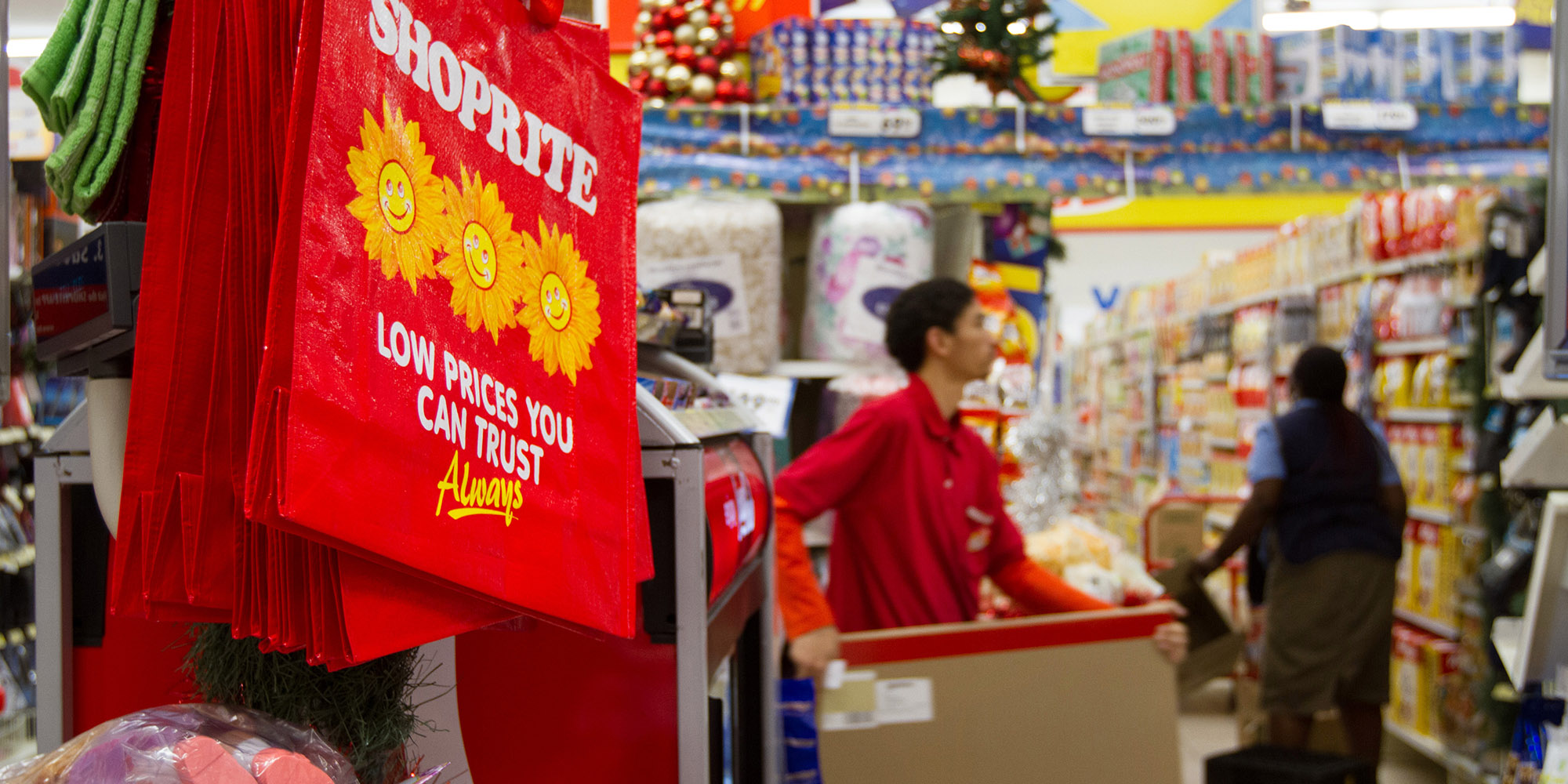
 A Shoprite store in Cape Town on 21 December 2016. (Photo: Dean Hutton / Bloomberg via Getty Images)
 The retail sector is responsible for providing direct employment to hundreds of thousands of South Africans, as well as livelihoods for literally millions more throughout the value chain. The economic process that begins with farmers and producers, before flowing through to retailers as the critical access point for consumers, is big business.
After covering several retail updates in my Phantom Shares column this year, I couldn’t help but add two more retailers to the list.
After all, the Shoprite group says it is the largest private sector employer in South Africa, with more than 168 000 employees. And if we’re honest, Woolworths probably helped stem the bleeding in middle class emigration, as people realised that they had zero chance of affording food of similar quality overseas!
Jokes aside, both companies are doing well at the moment, albeit for such different reasons.
Shoprite: low prices, big margins
Shoprite’s results for the 26 weeks ended 28 December 2025 show that they grew sales by 7.2%. That number isn’t nearly as impactful as the value of those incremental sales, with an additional R9.2-billion having flowed through Shoprite’s business in this period.
The dividend per share increased by 7.7%, which implies that there’s a consistent story across the income statement. That’s not quite true though, since there are pressures on trading profit margin in this environment.
The reason for the margin pressure is simple: a lack of inflation in food. This is great news for customers, but it leaves retailers in a position where it’s difficult to recoup their own cost inflation pressures.
Just because your trolley didn’t go up in value doesn’t mean that Shoprite didn’t give staff an increase, or incur higher energy costs or pay more to the municipality for rates and services. That last point is particularly important in South Africa.
The near-zero inflation comes through in like-for-like sales, which strips out the effect of new stores being built. On this metric, Shoprite was up just 2.7%. They managed to unlock some additional volumes and win market share, but it’s quite clear that this isn’t enough to offset the underlying inflationary challenges in the existing store base.
There’s a deeper level of analysis that really drives the point home: in the Supermarkets RSA segment, like-for-like sales increased by only 1.9%.
It’s therefore little wonder that Shoprite is investing in what they call the “adjacent businesses” – like Petshop Science and UNIQ – that bring additional growth opportunities into the group. Those chains are still small in the group context though, contributing R909-million in turnover this period vs R115-billion turnover from Supermarkets RSA (and R137-billion for the group).
Despite the difficulties in growing like-for-like sales, Supermarkets RSA achieved gross margin of 25.3% (only slightly down from 25.5% in the comparable period). This is an astonishing level for a value retailer, particularly since it is net of all delivery costs in Sixty60. We can clearly see from Shoprite’s pricing that this isn’t because of high prices, so it can only come from efficiencies and Shoprite’s negotiating power with suppliers.
Will the situation in Iran put upward pressure on inflation? Will Shoprite be able to lock in better store-level margins in that situation? Or will food inflation remain stubbornly low, forcing Shoprite (and competitors) to keep looking for efficiencies?
We don’t know yet. But what we do know is that waking up in the morning and competing with the Shoprite juggernaut is a tough way to start the day. The bear case for Pick n Pay and SPAR is that they are up against a truly world-class retailer with the wind in its sails.
But what about Woolworths Food?
/file/dailymaverick/wp-content/uploads/2025/07/P17-kara-woolworths.jpg "Illustrative image: The new Woolworths Food Emporium in Durbanville, Cape Town, offers a ‘sensory journey’ with curated sections, such as a florist and a sushi bar, designed for the intuitive flow of customer behaviours. (Images: Unsplash)")
Woolworths Food: pricing power in a blue ocean strategy
There’s much more to Woolworths than just being South Africa’s favourite source of tasty organic treats. The group has been through some tough times, particularly in Australia, but seems to have steadied the ship in the latest period.
Although the Fashion, Beauty and Home (FBH) business put in a decent performance in this period despite the tough scenes in the apparel market, it’s Woolworths Food that we are most interested in for this comparison with Shoprite.
Woolworths Food grew sales by 7% for the 26 weeks to 28 December 2025. On a comparable-store basis (similar to the like-for-like concept at Shoprite), they were up 5.2%. The core difference lies in price inflation, with price movement of 4.6% for the period. If you compare this to the near-deflationary environment at Shoprite, you can immediately see the difference in pricing power.
This is a blue ocean strategy at play, where Woolworths has differentiated itself in the bright-red ocean of competition in the grocery market. They have a loyal following among high-income South Africans who enjoy the finest things in life. And for more aspirational shoppers on the hunt for deals, Woolworths sometimes has specials that are highly competitive with what you’ll find at the more value-focused players like Checkers.
Checkers has made great strides in keeping Woolworths Food honest and competing successfully with them in many categories, but there’s still nothing quite like the business-class experience of shopping at Woolworths Food.
South Africans are also enjoying the on-demand shopping offering, with Woolies Dash sales up 23% year-on-year and contributing 7.2% to SA Food sales. They still have some catching up to do, as Sixty60 grew by 34.6% and contributed 10.3% towards sales in Supermarkets RSA.
Another battleground with Shoprite is in the pet market. Woolworths acquired Absolute Pets in 2024 and has been trying to open them as close as possible to Woolworths Food stores. The pet store in the small shopping centre in my suburb has been acquired by Absolute Pets, putting it literally a couple of doors down from the Woolies. This shows how important it is for retailers to get their hands on leases when they are trying to grow a specific chain.
Woolworths refers to “pet locations” to describe the combination of Absolute Pets and WPet, with 270 such locations in the footprint. Shoprite certainly isn’t playing around either, scaling Petshop Science from 22 stores in FY22 to 173 stores in the latest period. It’s worth noting that Shoprite achieved this without making a major acquisition.
I’ll end off on perhaps the most surprising metric of all: gross profit. Woolworths Food achieved a gross margin of 24.8% in this period, which is lower than the 25.3% that Shoprite achieved in Supermarkets RSA. And remember, that is Shoprite’s entire local business, including Usave at the bottom end of the LSM curve.
Perhaps the perfect food retailer would have the Woolworths Food quality and the Shoprite efficiency. Competitors can thank their lucky stars that no such retailer exists. At least, not yet. DM