




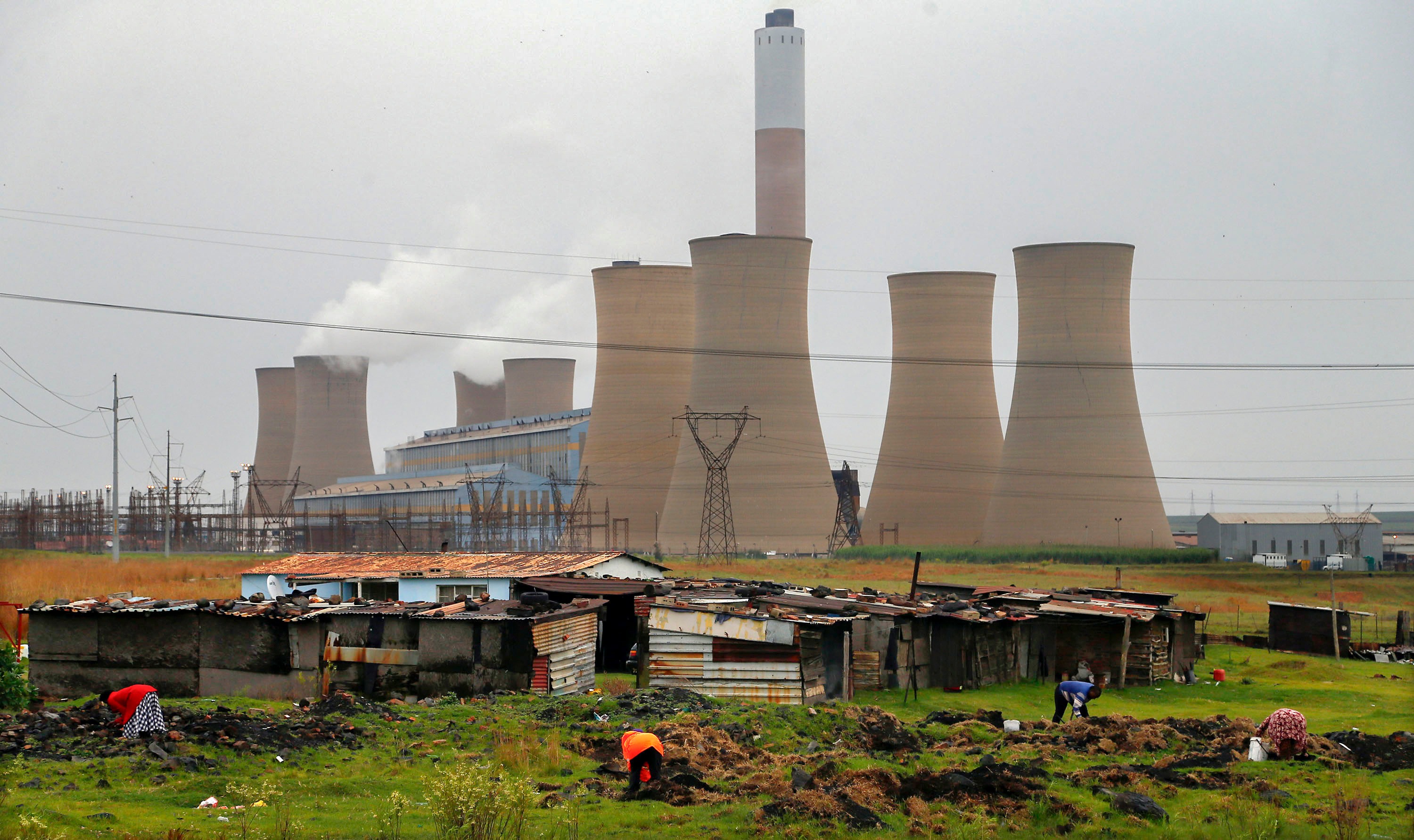
 People close to the Komati power station in Mpumalanga search for coal on 8 November 2021. (Photo: Felix Dlangamandla)
 The most surprising thing about Eskom’s Just Energy Transition-related Komati shutdown is that it’s the first of its kind in the world. South Africa has led the world in so many fields that we could be mistaken for being tired of winning, given the exchange rate against the euro and pound and general state of the economy of perennial green shoots.
Kimberley – the town of the Groot Gat – got electrified along the same timelines as London (1882). Because diamonds. About 80 years later Komati was commissioned in the Mpumalanga coal fields, for a narratively symmetrical cost of R80-million.

Those 1,000MW anchored the energy economy until it was shuttered in 1990, only to be brought fully to life again by 2012 in the early State Capture years. It’s final close came a decade later with the national power supply gap at four times its original output.
The public narrative was not kind, despite the Just Energy Transition good intentions.
Setting the record straight
“I hope you’re recording this because there are a few things the media gets wrong about Komati,” Dr Dana Gampel, corporate specialist, strategy and business development manager at Eskom, told Daily Maverick after she took part in the clean cooking panel at the African Energy Indaba.
Yes, the microphone was recording because this is the exact person who managed the JET-related parts of the Komati decommissioning.
Contrary to the prevailing public narrative that the transition is engineered to permanently destroy livelihoods, Gampel was resolute that replacing jobs is the ultimate, if delayed, objective. “So, a lot of people say we’re not going to be able to replace [all] the jobs. But that’s precisely what we are in the process of doing.”
However, the road to replacement has been heavily potholed by what the Presidential Climate Commission identified as a severe spatial and temporal disconnect. Gampel openly acknowledged that the necessary job replacement “is not going to happen immediately, which was one of the lessons learned”.
“One of the lessons learned is that we needed to have a lot more projects ready when the station... was decommissioned so that people could be upskilled and ready to go into those positions,” Gampel admitted.
Because the facility’s rigid shutdown schedule vastly outpaced the procurement and establishment of new industries, the host community was instantly plunged into an economic vacuum.
This admission is echoed by international partners operating on the ground. Tshego Neeuwfan, South Africa country delivery lead at the Global Energy Alliance for People and Planet – which partnered with Eskom to fund the Komati Training Facility – told Daily Maverick in a separate interview that he concurred with Gampel regarding the “absence of forethought in making sure that they are absorbing industries that then take on the workers that used to subsist from the coal value chain”.
“Without radical mobilisation of support and sensors up front... before you actually switch off... you’re just creating a hardship.”
Managing ministerial expectations
Part of managing this hardship involves tempering political rhetoric with operational reality. Gampel walked back recent claims regarding the scale of alternative industries at the site, specifically addressing executive comments about biomass production.
“If I can correct something that the minister [Deputy Minister of Electricity and Energy Samantha Graham-Maré, who chaired the panel] said… She was saying that we’re doing alien invasive removal. We’re pelletising... But I don’t want you to give the impression that that’s already in full-scale production... At other places it is, but not yet at Komati. That’s the intention of what we want to do at Komati,” Gampel explained.
There are, however, tangible innovations emerging from the ashes. Literally.
To build a circular economy and advance clean cooking, physical hardware is being manufactured from station waste. Gampel confirmed the existence of prototype cooking stoves “made out of the ash” from Eskom stations, a proof-of-concept initiative aimed at taking a historically useless byproduct and turning it into something that can “feed a family”.
/file/attachments/orphans/unnamed_124265.jpg "Caption: Dr Gampel surveys the clean cooking competition lined up next to the Eskom proof of concept formed out of coal ash from power station waste.<br>(Photo by Lindsey Schutters)")
(Photo by Lindsey Schutters)
The atomic clock
Eskom is now weaponising the harsh socioeconomic lessons of Komati to pivot its long-term strategy towards an entirely different baseload technology. The localised economic devastation seen in Mpumalanga is serving as a primary justification for deploying small modular reactors at other retiring coal sites.
Speaking at the indaba’s Nuclear Forum side-event, Eskom chief nuclear officer Velaphi Ntuli drew a direct line between the two transitions.
“What we’ve seen happen in Komati where the community have been devastated when those facilities were shut down – that would not happen if we deploy small modular reactors.”
He was, of course, referring to what Eskom calls a “coal-to-nuclear strategy”. The power utility calculates that “up to 77% of the coal plant jobs can be transferred” to these repurposed nuclear facilities.
Credit where it’s due
As for the broader JET framework, Gampel was quick to point out that the institutional thinking predates the recent, highly publicised executive eras (De Ruyter and Marokane).
“The work that we started doing around the Just Energy Transition started, like, in 2017, which is way before Dan [Marokane] and way before André [de Ruyter],” she noted.
She also had rare praise for the utility’s leadership, commending them for championing future sustainability while battling the immediate systemic crisis of keeping the lights on.
/file/dailymaverick/wp-content/uploads/2023/03/Komati.jpg "Shadow economy: Mpumalanga is home to six of the nine Eskom coal-fired power stations scheduled to shut down by 2035. (Photo: Dianah Chiyangwa)")
Ultimately, the Komati pilot is exactly that: a pilot.
“In the world, we’ve never done it in this way before... It’s an action learning project, right? We’re learning as we go along because we didn’t know,” Gampel said.
The question for South Africa’s remaining coal fleet is whether Eskom can learn fast enough to prevent the next host town from needing a tombstone of its own. DM