




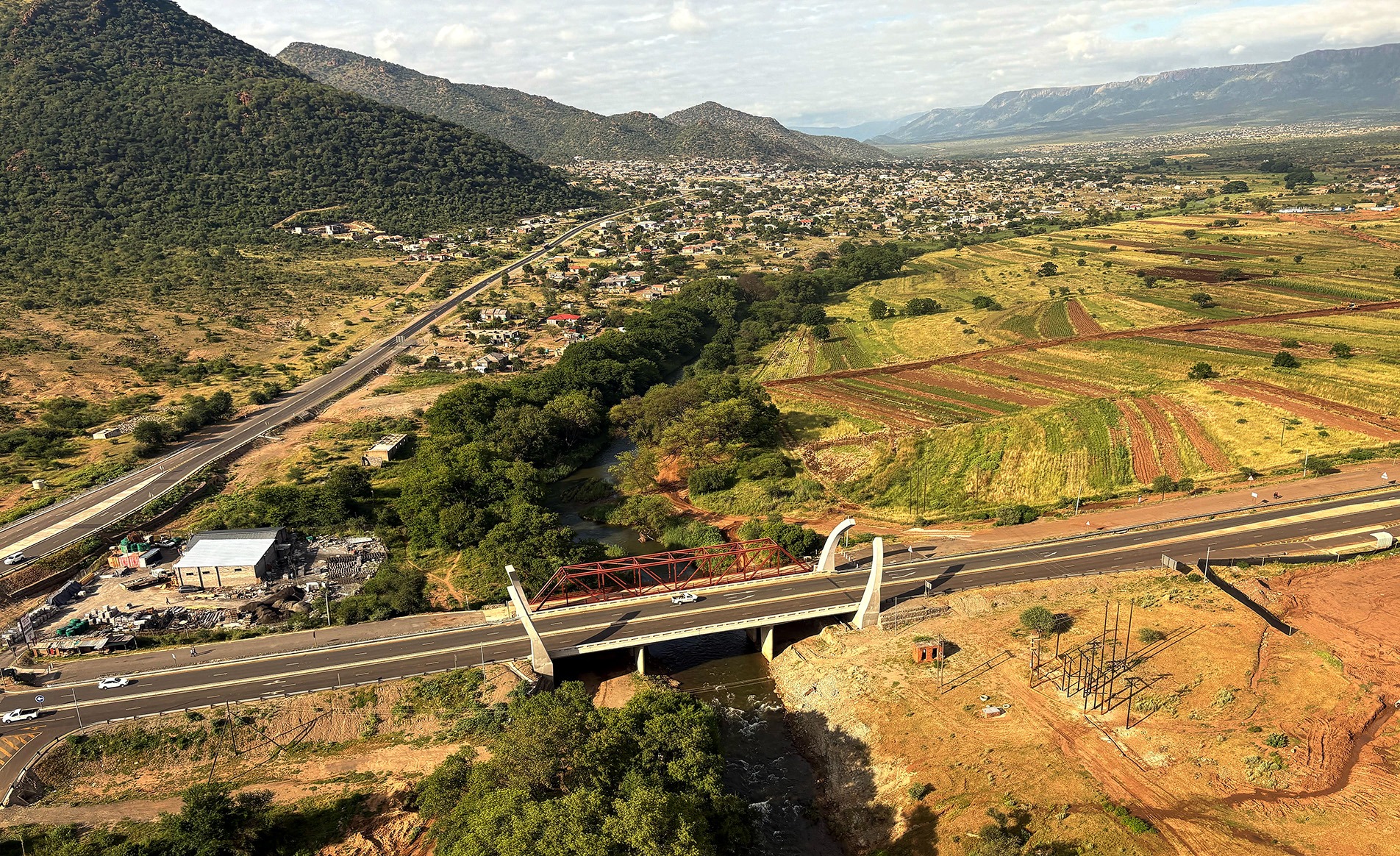
 The Steelpoort River bridge has opened up an economic bottleneck on the platinum belt’s eastern limb. (Photo: Ed Stoddard)
 Peace is holding on in the platinum belt’s formerly restive eastern section in Mpumalanga and Limpopo, providing a model for other South African mining regions and unlocking a flow of dividends to shareholders and communities.
In a presentation during a recent Daily Maverick visit to the region, Anthonie Joubert, the head of security for Northam Platinum’s Booysendal mine, highlighted a slide showing that the mine had no production losses linked to work stoppages and protests for the past three consecutive calendar years – 2023 to 2025.
/file/attachments/orphans/Screenshot2026-03-09at0904copy_477665.jpg "Source: Northam Platinum")
That is a dramatic turnaround from 2021 and 2022 when the mine, which has a north section in Limpopo and a south section in Mpumalanga near Mashishing, lost a cumulative total of about R600-million in production.
“It’s night and day compared with where we were,” Joubert said.
The number of security incidents around the twin mines remains elevated, though below the peak of 47 reached in 2021. In 2025, for example, there were 30 incidents compared with 19 in 2022, when there were significant production losses as a result.
/file/attachments/orphans/BSDProductionLossCommunityUnrest_856591.jpg "Source: Northam Platinum")
But incidents that spiral into a blockage of roads leading to the mines have been nipped in the bud by the presence of 84 public order police officers who respond quickly to any sign of disturbance.
A proper police presence alone does not explain the advent of relative social stability in the region, though.
The approach has been three-pronged, with policing the sharp end of this trifecta.
The second prong – perhaps more meaningful than the policing – has been the cooperation among the mining companies in the area on a range of fronts.
In 2022, a consultancy was hired to engage with the communities. Its key finding was that the mining companies’ development projects linked to their social and labour plans (SLPs) would have a greater impact if they combined their resources.
“What they picked up was that we were doing lots of standalone projects that were impactful, but if we combined them they would be more impactful,” said Wonderboy Kekana, Northam’s operations executive.
The third prong is that a CEO forum and all the general managers of the mining operations in the region – the so-called southern cluster mines of the eastern limb – meet monthly to review their projects as well as the security situation, including the sharing of intelligence.
“Effectively, the mining companies are working together, and cooperatively we have been doing stuff over and above the SLPs. We’ve also had a lot of help from the government from a policing point of view,” said Northam CEO Paul Dunne.
Mining companies invest in infrastructure
The combined muscle of the companies in the area – Northam, Valterra Platinum, Glencore, Impala Platinum, African Rainbow Minerals and Assore – has produced results that would have been far more difficult to achieve if any of the projects had been pursued by a single company.
The crowning achievement has been the construction of an imposing R127-million steel bridge in Limpopo over the Steelpoort River. This piece of infrastructure, which connects communities across the river, has triggered the building of a new mall nearby.
/file/dailymaverick/wp-content/uploads/2022/06/fdngwaabe7.jpg "A single-lane steel bridge will be reconstructed by Booysendal to allow improved access to the villages in Limpopo. (Photo: Felix Dlangamandla)")
This might provoke a rolling of eyes – just what South Africa needs, another mall! – but malls are hallmarks of prosperity that unlock economic activity and create jobs in impoverished rural areas.
Roads are also key. A drive down the R577, which stretches 19km from Booysendal South and is an artery for other platinum group metals (PGM) and chrome producers, is a jarring trip over jagged potholes. On one 11km stretch, nearly 4,000 potholes were filled – almost 400 potholes per kilometre.
The work under way to repair the road, which is used by more than 1,000 heavy vehicles per day, is scheduled for completion by December 2027 at a cost of R446-million. The mining companies are footing 51% of the bill, the Mpumalanga government the rest.
Decrepit sewage works that threatened to foul the streets of Mashishing are also being repaired in a drive led by the mining companies.
/file/attachments/orphans/058A2553_790759.jpg "Mashishing sewage works under repair on 30 April 2022. (Photo: Felix Dlangamandla)")
From mining protests to community development
When Daily Maverick first toured the region in the winter of 2022, its social and economic landscape was riven by fear and loathing.
Shadowy procurement mafias and rank opportunists ginned up protests to block roads around the mines. Mining trucks were hijacked and vandalised, dramatically raising the region’s investment risk profile. State failure compounded the simmering tensions as roads, sewage works and other government services fell into disrepair.
/file/attachments/orphans/058A2562_195408.jpg "Mashishing sewage works under repair on 30 April 2022. (Photo: Felix Dlangamandla)")
A second visit in late 2023 revealed a gradual easing of tensions. And now, more than two years later, tangible results – notably the ending of production losses from unrest – are evident.
“We have seen a greater deal of stability with our host communities and this speaks to not only the physical infrastructure such as the Steelpoort Bridge, but also how we procure from our host communities,” Valterra CEO Craig Miller said.
/file/attachments/orphans/unnamed1_876392.jpg "The Mashishing sewage works under repair on 18 February 2026. (Photo: Ed Stoddard)")
“The PGM operations on the western limb now want to emulate our model,” Kekana said.
Richard Stewart, the CEO of Sibanye-Stillwater, which has PGM operations around Rustenburg, confirmed this was the case.
“We are engaging among the various companies to see how to do it,” he told Daily Maverick.
/file/attachments/orphans/fdngwaabe6_690950.jpg "A single-lane steel bridge will be reconstructed by Booysendal platinum to allow an improved access to the villages in Limpopo. (Photo: Felix Dlangamandla)")
/file/attachments/orphans/fdngwaabe4_632725.jpg "The single-lane steel bridge to be reconstructed by Booysendal platinum. (Photo: Felix Dlangamandla)")
With PGM prices on the rebound, the companies want to maintain this hard-won stability – while hoping that rising prices and looming local government elections do not present as red flags to opportunists.
And it’s not just on the eastern limb. On Monday, 2 March, Rio Tinto announced the approval of an R8.5-billion investment for Richards Bay Minerals’ Zulti South project, which had been suspended in the face of a surge of violence in the area that included the murder of a general manager.
Copper cable theft and illegal gold, chrome and coal extraction still bedevil South African mining. But the significant decline in community unrest, which mirrors a decline in union militancy, has removed a major risk in the industry’s investment profile at a time of rising prices.
And the ultimate winner will be the South African economy. DM
Ed Stoddard is a Business Maverick contributor.
This story first appeared in our weekly DM168 newspaper, available countrywide for R35.
/file/attachments/orphans/DM-06032026-001_299413.jpg)