




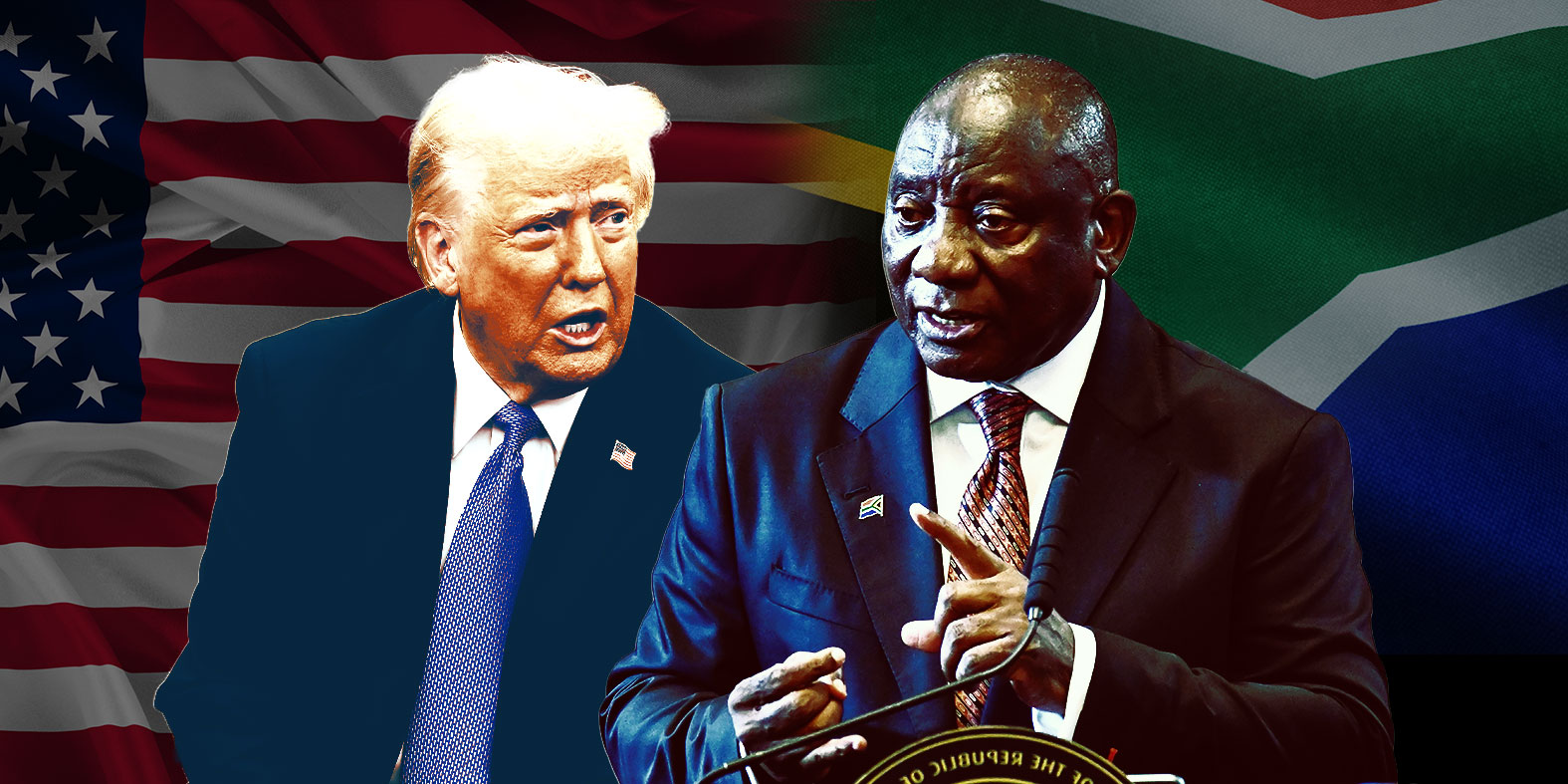
 Illustrative Image: US President Donald Trump. (Photo: Anna Moneymaker / Getty Images) | SA President Cyril Ramaphosa. (Photo: Gallo Images / Jeffrey Abrahams) | Flags. (Image: Freepik)
 /file/dailymaverick/wp-content/uploads/2025/10/label-Op-Ed.jpg)
During his bilateral meeting with German Chancellor Friedrich Merz in the Oval Office on Tuesday, 3 March, US President Donald Trump threatened to cut off trade with Spain. Markets reacted immediately, with the iShares MSCI Spain ETF dropping by 5.6% within minutes of the remarks, reflecting investor insensitivity to even rhetorical escalation from Washington.
Spain’s apparent offence was its refusal to allow US forces to use its military bases for the operation linked to the strike on Iran, alongside its resistance to a US-backed Nato commitment that members increase defence spending to 5% of GDP by 2035.
Trump stated that he had instructed Treasury Secretary Scott Bessent to “cut off all dealings with Spain” and suggested that he possessed the authority to impose embargoes and halt all business with the country if he chose to do so.
/file/attachments/orphans/RC25XJAB168D_803565.jpg "US President Donald Trump and German Chancellor Friedrich Merz meet in the Oval Office at the White House on 3 March. (Photo: Jonathan Ernst / Reuters)")
The US Supreme Court recently made the correct call in striking down tariffs imposed under the International Emergency Economic Powers Act (IEEPA), curtailing the administration’s ability to rely on emergency powers as a general trade instrument.
In response, the administration shifted to Section 122 of the Trade Act of 1974, introducing a temporary 10% import surcharge justified on balance-of-payments grounds. Unlike IEEPA, Section 122 is capped in both scope and duration. It cannot sustain an open-ended embargo, nor does it authorise the wholesale termination of commercial relations.
To “cut off all dealings” with a country would require a formal national emergency declaration under IEEPA, followed by the activation of sanctions authorities administered by the Treasury Department’s Office of Foreign Assets Control. Even then, such a move against Spain would carry significant geopolitical consequences. Spain is embedded within the European Union’s (EU) common trade policy, and any unilateral US action would escalate into a dispute with Brussels.
Spain’s institutional context is precisely what makes the situation instructive for South Africa. Spain is not an isolated middle power; it operates within a larger customs union with collective retaliatory capacity.
Structured escalation
South Africa, by contrast, negotiates and absorbs trade shocks largely on its own. It does not enjoy the economic weight or institutional shield of the EU. If rhetorical escalation similar to that directed at Spain were redirected toward Pretoria, the strategic calculus would be very different.
This is the new worst-case scenario for South Africa-US relations.
The most plausible vehicle for structured escalation would be Section 301 of the Trade Act of 1974, the US’s principal statutory instrument for responding to foreign trade practices deemed discriminatory or unjustifiable.
Section 301 does not require a declared national emergency. It requires only a formal investigation by the Office of the United States Trade Representative (USTR) and a determination that US commerce is being burdened by foreign measures.
Once such a finding is made, the president may authorise retaliatory tariffs, suspend trade concessions, or impose other trade restrictions. These measures are procedurally grounded and more resistant to judicial challenge than the IEEPA-based tariffs recently invalidated.
South Africa’s domestic policy framework contains several areas that Washington has previously characterised as non-tariff barriers. The 2025 National Trade Estimate Report on Foreign Trade Barriers, published by the office of the USTR, identifies localisation requirements in public procurement, empowerment and equity thresholds affecting foreign firms, agricultural import standards, and industrial policy measures as areas of concern. In a deteriorating diplomatic environment, these could provide the factual basis for a Section 301 investigation.
Currently, South Africa faces a 10% tariff under Section 122, down from the 30% rate imposed in August 2025 before the Supreme Court ruling. That relief, however, should not obscure the continuing presence of Section 232 duties under the Trade Expansion Act of 1962.
Trade restrictions
Section 232 authorises the president to impose trade restrictions on imports deemed to threaten US national security. In June 2025, Trump signed a proclamation increasing the tariffs on steel to 50%, aluminium to 25%, and cars and car parts to 25%, applying to all countries unless exempted through bilateral deals. South Africa has no such exemptions and remains exposed, particularly in the automotive and metals sectors.
The worst-case scenario for SA-US relations is therefore not an abrupt embargo, but a phased tightening of economic pressure using existing statutory authorities. Diplomatic tensions could escalate over foreign policy alignment or regulatory disputes. A Section 301 investigation could follow, leading to targeted tariffs on high-value exports. Section 232 duties could be maintained or expanded. Preferential access under the African Growth and Opportunity Act could face renewed scrutiny.
The probability of this scenario playing out may be low, but its plausibility is grounded in statute, not speculation. Institutions often dismiss low-probability, high-impact risks precisely because they appear politically distant. Intelligence failures rarely occur because information is unavailable; they occur because warning signs were not stress-tested against adverse contingencies. Scenario planning is therefore not alarmism; it is disciplined imagination applied to legal and economic structures that already exist.
The new worst-case scenario is not inevitable, but it is legally possible. That distinction alone warrants serious preparation. DM
Ofentse Donald Davhie is a research associate for the Centre for Risk Analysis (CRA) with a focus on political risk and foreign policy.