




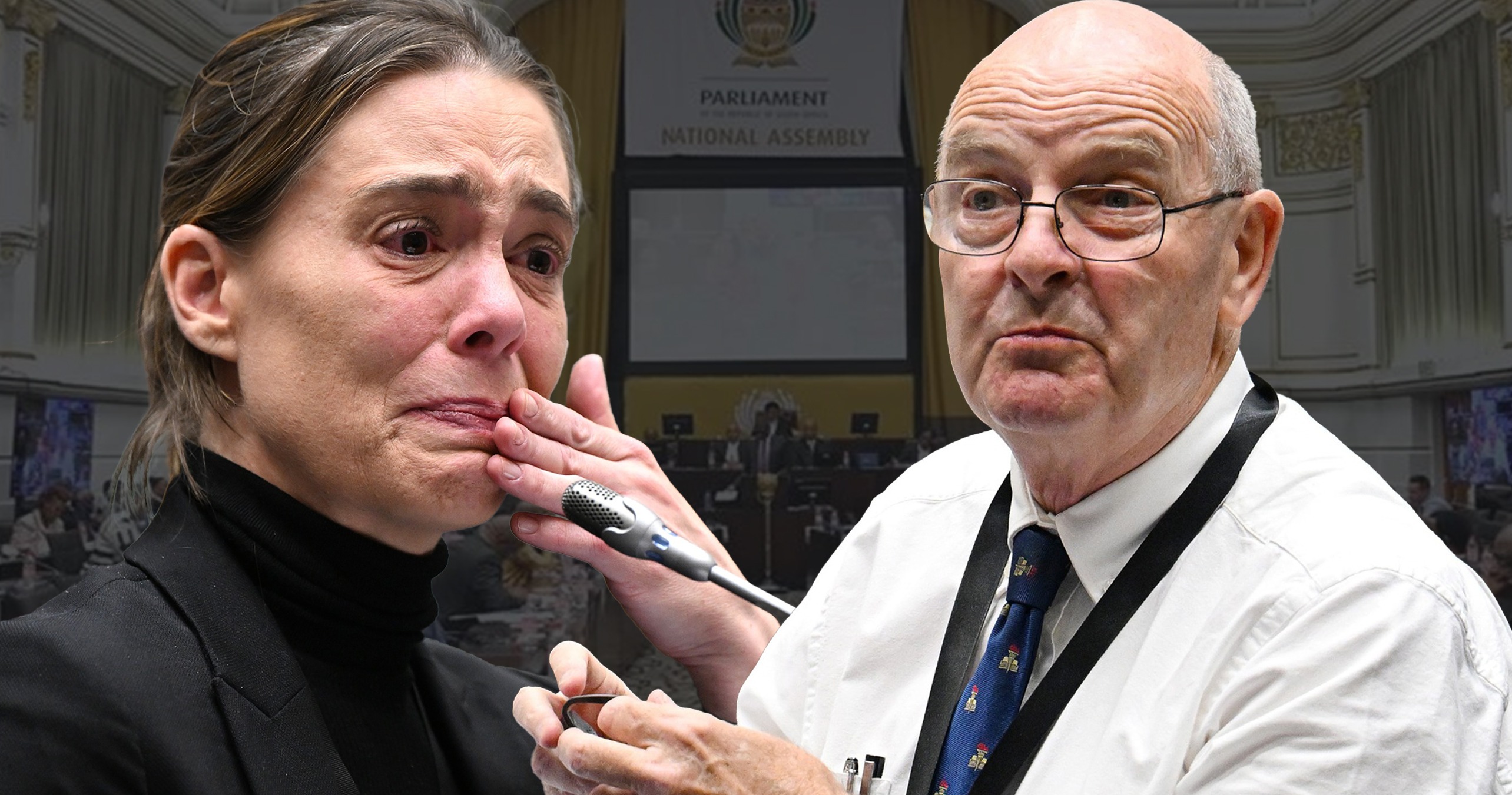
 Illustrative image | Attorney Sarah-Jane Trent at Parliament's ad hoc committee. (Photo: Phando Jikelo / RSA Parliament) | Paul O'Sullivan is testifying for the second day before Parliament's ad hoc committee. (Photo: Phando Jikelo/ Parliament RSA)
 South Africa’s law enforcement scandal is exposing the depths of distrust among some of the country’s highest-ranking law enforcers.
It’s also revealing how different individuals are reacting and dealing with being implicated in the biggest post-apartheid policing implosion.
On Thursday and into the early hours of Friday, 5 and 6 March 2026, two individuals testified before Parliament’s ad hoc committee investigating allegations that a crime cartel has infiltrated the criminal justice system.
While the two are connected, they now signify the opposite ends of the scandal-reaction spectrum.
Forensic investigator Paul O’Sullivan and a former employee, attorney Sarah-Jane Trent, were the witnesses before the parliamentary committee, and their demeanours couldn’t have been more different.
Tears, trauma and O’Sullivan
O’Sullivan, who has testified at the committee hearing before, was his usual bombastic self, whereas Trent, appearing for the first time, came across as exceptionally fragile.
She wept several times, explaining that it was a response to “trauma”.
The ad hoc proceedings are streamed live and therefore accessible to the public.
Trent previously worked with O’Sullivan, and about a decade ago, they assisted the Independent Police Investigative Directorate (Ipid) with some investigations, including into former acting national police commissioner and corruption-accused Khomotso Phahlane.
/file/attachments/orphans/WhatsAppImage2026-03-05at193552_513426.jpeg "Attorney Sarah-Jane Trent appeared before Parliament's ad hoc committee investigating accusations that a cartel has infiltrated South Africa’s criminal justice system. (Photo: Phando Jikelo / RSA Parliament)")
This has been the focus of the ad hoc committee proceedings – O’Sullivan and Trent’s proximity to Ipid, and whether they conducted state work targeting certain police officers and ministers without the authority to do so.
In other words, whether they infiltrated Ipid and meddled in high-level state matters.
At the time, Robert McBride was the head of Ipid. (He took up this position in 2014, was suspended and was re-appointed from 2016 to 2019.)
In January, he testified before the ad hoc committee, and during those proceedings, Trent and O’Sullivan were repeatedly referenced.
Apology and air kisses
O’Sullivan was the first of the duo to take to the witness stand on Thursday. It was his fourth time appearing before the committee.
He resumed his testimony after he abruptly walked out of proceedings last week, infuriating MPs.
O’Sullivan started contritely on Thursday, saying: “I unreservedly apologise to the Speaker of the National Assembly and all members of Parliament.”
Ad hoc committee members have described UK-born O’Sullivan as a bully, a suspected foreign government spy and someone who intimidated others to get what he wanted, and this continued on Thursday.
It has not fazed him much.
On Thursday, ActionSA’s Dereleen James accused him of trying to overthrow the government, which he denied.
The situation was also especially fraught between O’Sullivan and ad hoc committee member David Skosana of the uMkhonto Wesizwe party.
At one stage, Skosana put it to O’Sullivan that he is racist, to which O’Sullivan hit back: “I totally disagree with being called a white racist.”
/file/attachments/orphans/ED_595175_343051.jpg "Paul O'Sullivan testified at the parliamentary ad hoc committee in February 2026. He has been a witness during four sets of hearings and concluded his testimony on 5 March 2026. (Photo: Brenton Geach / Gallo Images)")
After finally concluding his testimony before the committee on Thursday, he walked out, blowing kisses and elaborately bowing to MPs, including Skosana.
This was far from how O’Sullivan’s former employee, Trent, came across. (She left O’Sullivan’s employ in 2022 and does not seem proud of the experience connected to him, because she no longer tells people she worked there.)
Private interactions and public interest
Trent’s time testifying before the ad hoc committee was bound to be one of two extremes – either she’d display steely confidence to deal with MPs hellbent on getting her to admit certain things, or she’d crack.
It went the latter way.
This is connected to what happened in January when McBride was a witness before the ad hoc committee.
ActionSA’s James surfaced here again.
/file/attachments/orphans/pic2_106928.jpeg "Former Ipid head Robert McBride testified before Parliament's ad hoc committee in January 2026. (Photo: Phando Jikelo / RSA Parliament)")
While McBride was testifying, James had put it to him that, based on cellphone records she had acquired, he had an affair with Trent, which he denied.
It subsequently emerged that Trent was of the view that police “stole” her cellphone and illegally accessed its contents (which is what James used in Parliament).
Read more: ‘Mkhwanazi tried to disrupt Ipid probe into ex-acting cop boss Phahlane’ — McBride
So, accusations that she meddled in state affairs (issues of public interest) and that she had an intimate relationship with McBride (issues of a personal nature) underpinned Trent’s appearance before the ad hoc committee from Thursday into the early hours of Friday.
She initially came across as nervous yet confident when she started testifying, but became rattled when asked about the assistance she and O’Sullivan once gave to Ipid.
Trent eventually broke down, crying, and the committee took a break to allow her some breathing room.
‘I was kidnapped’
She carried on testifying, tearfully at times.
Trent denied infiltrating Ipid.
She testified about an incident in February 2017 when police officers arrested her for allegedly pretending to be an Ipid officer (and when the investigation into Phahlane was in full swing).
According to her testimony and an affidavit she submitted to the ad hoc committee, Trent said: “It is my view that I was effectively ‘kidnapped’, owing to the circumstances of the incident.”
Simply put, she alleged she was basically abducted in retaliation for the Phahlane investigation.
Ad Hoc Committee investigating the allegations made by Lt Gen Nhlanhla Mkhwanazi: Ms Sarah-Jane Trent, explains how she went with Mr Paul O’Sullivan to Gen Phahlane’s house with IPID. @ParliamentofRSA #pktt @SAPoliceService pic.twitter.com/64duICXrfC
— Justice-and-security-Cluster (@JustSecuCluster) March 5, 2026
Trent added that it was during that 2017 incident that police “stole” her cellphone.
On Thursday, when asked about the nature of her relationship with McBride, she replied: “We had a semi-social relationship, but nothing sort of serious . […] We met for meals, not a lot.”
Trent said they were not in a romantic relationship, but rather something social involving an attraction.
“It wasn’t infiltration,” she added.
‘A situationship’
Committee chair Soviet Lekganyane asked Trent if she and McBride had been “friends with benefits”, and she exclaimed: “Are you allowed to say that on national TV?”
Evidence leader advocate Bongiwe Mkhize told Lekganyane there was a new word for what he had described – a “situationship”.
James, who had initially addressed the relationship between McBride and Trent back in January, had a chance to question her in the early hours of Friday.
She asked Trent why she had earlier cried profusely, to which Trent replied: “It’s this PTSD. […] I was completely fine, and then all comes rushing back, and it’s very overwhelming and embarrassing.”
AD HOC COMMITTEE | ActionSA’s Dereleen James tells Paul O’Sullivan, “You were plotting to overthrow this government.” He responds, “You have been watching too much TV.” pic.twitter.com/4KK3z3b4Gi
— SABC News (@SABCNews) March 5, 2026
James retorted: “The things you’ve done [are] embarrassing.”
Trent insisted she “was crying because of what happened to me”, and James again hit back, telling her she had lied under oath and was “not the victim here”.
James said: “Paul O’Sullivan left you out to dry the night of the [presumably 2017] arrest; he drove off. And today, you are sitting here still trying to cover for him when you have only this one opportunity. Really?”
Impact and repercussions
Some may view Trent’s tears as an attempt to induce sympathy and distract from her past actions.
Others may see them as the mark of someone dealing with very real trauma in Parliament, in front of some of the country’s most prominent politicians, while knowing they’re being screened live on national television.
Overall, Trent now comes across as someone who, either by her own doing (which she flat-out denies) or the devious intent of others, ended up on one side of two battling law enforcement factions in South Africa.
Read more: Beneath SA’s cop scandal — intensifying distrust and multiple investigations into law enforcers
The likes of McBride and O’Sullivan seem to be on one side, while KwaZulu-Natal police boss Nhlanhla Mkhwanazi, who sparked the probes into the overall scandal last year, and his allies, appear to be on the other.
Given how staggering the ever-amplifying scandal is, it’s easy to forget the granular impact it is having.
The fresh scandal now also eclipses other massive past policing-political controversies and may drown out the repercussions.
Trent’s conduct in Parliament, however you view it, serves as a reminder of the macro and micro effects of State Capture – its public and personal impact. DM