
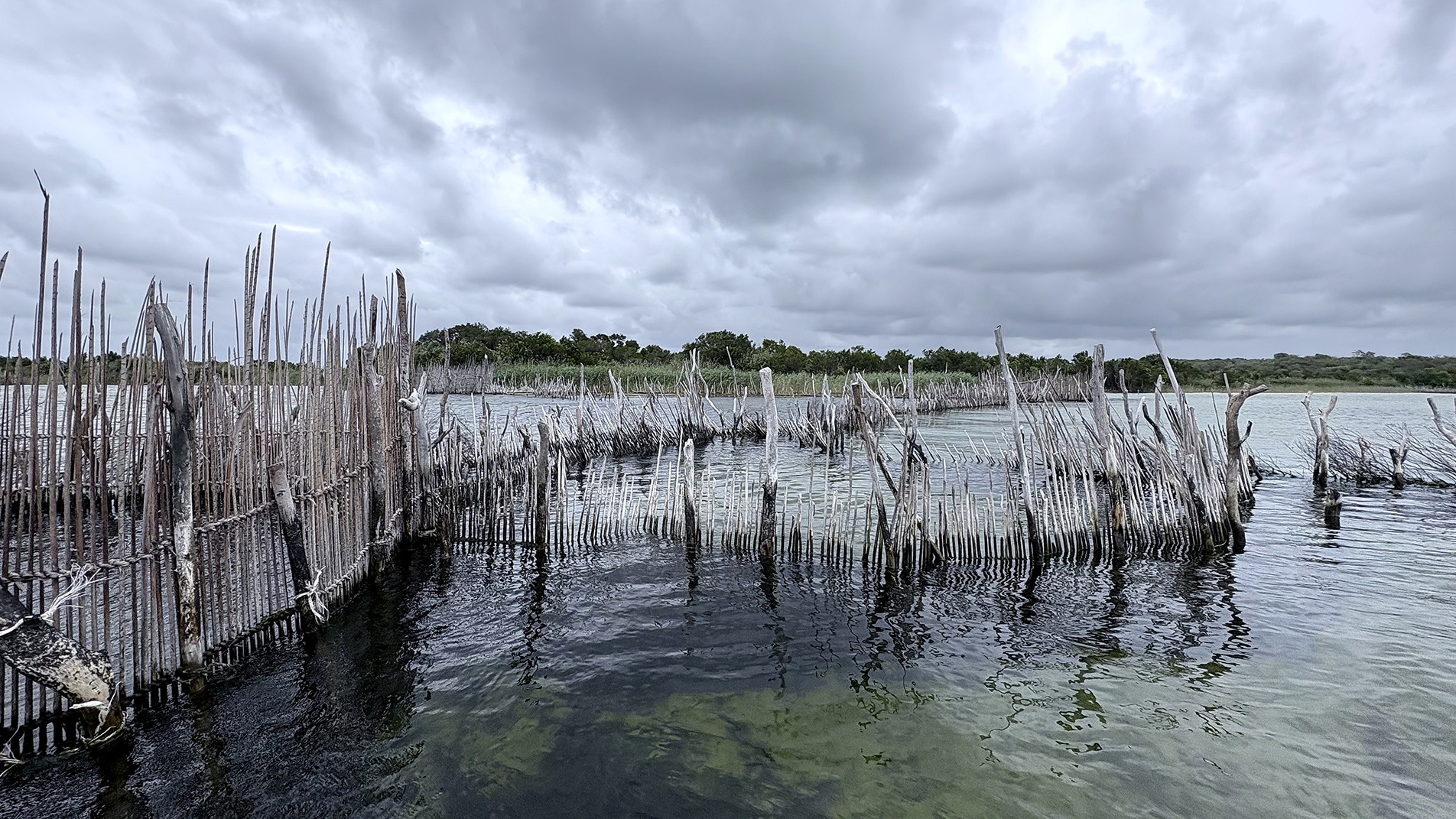
 The United Nations recognises the need to include Indigenous knowledge and values in global efforts to address climate collapse, biodiversity loss and other environmental pressures. The kind of intergenerational knowledge that Fano Tembe has learnt from his father and grandfather reflect an ethos of a light-touch relationship with the ecosystem. (Photo: Leonie Joubert)
This is a story of a hippo, a Kosi Bay fisherman and a buffalo thorn tree. It’s also about the erasure of these kinds of stories, and the people who animate them.
Jerry Mngomezulu, now 68, was but a lad at the time. Eight, maybe nine. His grandfather, Bhodwe, had been wading through the first lake’s shallows to check the family fish trap near the estuary mouth, when he came upon a hippo. The fearsome grazer trampled him, leaving the old man with a head injury that, two months later, took him from this world.
Bhodwe’s story should be remembered in the foliage of a woodland canopy. The Thonga have long used the branches of the buffalo thorn to lead the departed to their final resting place, where mourners may plant a thorn tree as a living headstone.
The marker for Bhodwe’s grave should have joined the copse of others like it, a kind of arboreal lekgotla for generations of Mngomezulu ancestors.
/file/attachments/orphans/3TourismIMG_4293_647352.jpg "The Thonga people have practised this fishing method for more than 700 years. Today, though, they have limited access to their ancestral lands since they were evicted when Kosi Bay was declared a nature reserve and is now a Unesco World Heritage Site. (Photo: Leonie Joubert)")
But most of the trees that once stood here are gone, and with them any knowledge of where each grave lies. Since the Mngomezulu family left Kosi Bay’s shores in the 1980s, most of the cemetery’s trees have been cut down or razed by fire. There’s a rangers’ building and parking lot in the vicinity, but only an old-timer like Jerry will remember where the site is, or be able to identify the one or two remaining thorn trees that mark the resting place of an elder.
Bhodwe’s descendants would later be among the 120 families who abandoned their ancestral homes ahead of this estuary and four-lake system being declared the Kosi Bay Nature Reserve in 1988.
/file/attachments/orphans/10PortraitJerryMngomezulIMG_5545_219129.jpg "KBDCC coordinator Jerry Mngomezulu says the group’s repeated requests to meet with various state authorities have been ignored, leaving the evicted Thonga families feeling invisible.
<br>(Photo: Leonie Joubert)
<br>")
(Photo: Leonie Joubert)
Historical records are messy, but it seems that an estimated 1,800 people left quietly and under their own steam, rather than risk a heavy-handed state eviction. They didn’t know if they’d get compensation – either land or money – but in the end, they got neither.
Four decades since becoming a protected area, these shores are now a globally recognised coastal ecosystem, and part of the iSimangaliso Wetland Park, the country’s first Unesco World Heritage Site. Kosi Bay is the last stop at the northern end of the reserve that stretches 220km from St Lucia to the Mozambican border, four clicks north of the Kosi Bay mouth.
But the tourism gains brought by conservation have come at a cost for a community whose unique fishing culture goes back more than 700 years. Some of them – the old-timers who remember the evictions, and the younger generation who are born democratically free but outside the reserve – say they have not benefited from tourism, and feel excluded from the planning and governance of a sector that’s profiting from their loss.
Light-touch livelihoods
When Robert “Scotty” Kyle arrived on the muggy shores of Kosi Bay in the early 1980s as the conservation authority’s first fisheries scientist, the place was something of a mystery.
It was known that Thonga families had long subsisted around the lakes’ shores, catching fish in their distinctive traps that, historically, were handed from grandfather, to father, to son, going back generations. It was understood that they tended small vegetable gardens in the sandy, nutrient-starved soils around their homes. Theirs was a meagre life, most records from the time note, where people topped up their livelihoods with wages sent home by the menfolk who’d trekked to the mines for work.
Tourism, authorities argued, could bring an injection of growth into this otherwise moribund economy, with recreational fishing the biggest likely drawcard.
Not much was known about fish stocks, how many fish the locals were catching in their traps, or if there might be competition between the locals and visiting anglers.
Kyle set about filling this knowledge gap, a study that earned him his doctorate. Four years later, he showed that between the Indigenous fishing families and the small number of anglers already casting their lines here, the combined off-take was negligible. There were more than enough fish to go around.
“Tourists were catching one out of every 100 fish,” the now-retired Kyle recalls. “Local people were catching (nearly) four fish out of every 100.”
Rounding the combine off-take to 5%, that was still leaving 95% of the fish population to reach their spawning grounds.
Today, the Indigenous fish traps are as much a tourism drawcard as the trophies that lure the anglers or others wanting to visit this unique wetland ecosystem.
Lore of the lakes
Late one morning, 28-year-old tour guide Fano Tembe wades into the first lake’s shallows, leading a group of tourists along the fishing kraal fence in the hope that a few stray mullet or rock salmon will have found their way down the chute where the basket awaits. Here, the trap’s loosely bound poles interlink like fingers, corralling larger fish, but allowing smaller ones to wiggle through and continue on their journey out to sea.
Tembe carries his injunga, a traditional fishing spear made from a branch of the umpahla or coastal silver oak, with sharpened wire tied to the business end.
“When you use the spear you must be careful,” he cautions, before leading his charges to one of the same traps that his father and grandfather and uncle have tended for decades. “Remember the fish are not stationary.”
He’s already shown his guests how to wield the spear, should they find quarry in the trap, but he knows that few get it right on their first try. The water plays tricks with the light; it bends the curve of the throw; the fish are swift.
“Aim (for) about half a metre, then take the shot,” he instructs. “Make sure you apply a lot of power. If you’re soft, you’re not going to catch the fish.”
For Tembe, who has been fishing like this since he was a kid, the tool becomes a javelin when he strikes. It’s this kind of cultural muscle memory that gives the tourists’ experience a special favour.
If you spear a fish, he says, you’ll feel the vibrations.
“Then you pull (the spear) a little bit. Not all the way, because there’s no hook, and (the fish) can still slip away.”
Tembe is a descendent of one of the Thonga families that was displaced when the park was born, but is one who can say he’s benefited from the resulting ecotourism. After Covid disrupted the family income and he had to abandon his near-completed engineering studies, he took a guiding job with a local tourism operation.
Like so many others, he is part of the Tsonga diaspora, who resettled wherever they could find land outside the park, according to Dr Jackie Sunde, an environmental scientist at the University of Cape Town’s One Ocean Hub Small-Scale Fisheries research team. Many settled just outside the newly erected fence, some moved to Manguzi, a town about 25km away, others trekked as far afield as Richards Bay, a four-hour drive south.
Those who have traps are still allowed to tend them, but are nevertheless regarded as visitors to the park.
Tembe lives within walking distance of the kraals he and his brother Simon are taking over from their ailing father. They tend the traps on behalf of the family, but also bring visitors here as part of the tourism experience.
Boat-man of Third Lake
“They call me Rasta,” says Mthokozisi Nsele (37), laughing as he lifts his baseball cap so he can run a hand over his shaved crown. “I used to have dreadlocks but now I’m getting madala so there’s nothing growing here.”
Nsele is also from a long line of Thonga fishers. They were also displaced in the Eighties, and some still tend kraals. Like Tembe, Nsele’s career took a turn with Covid. He lost his job as a trainee skipper, and decided to go it alone. Today, he’s the skipper and boss of Kosi Thonga Safaris, a two-boat operation that runs from the jetty in Lake kuNhlange, also known as Third Lake.
/file/attachments/orphans/13LakekuNhlangemooringIMG_4231copy_774696.jpg "Thonga local, tour operator and skipper Mthokozisi Nsele moors his two boats at the jetty in Lake kuNhlange. The dense cluster of raffia palms towers over the boats. (Photo: Leonie Joubert)")
/file/attachments/orphans/7MthokozisiNseleIMG_4225_882606.jpg "Mthokozisi Nsele comes from a long line of Thonga fisher people, although he now runs his own two-boat tourism operation in Kosi Bay. His Indigenous roots and knowledge of the technology give his guiding experience a special flavour. (Photo: Leonie Joubert)
<br>")
Nsele knows the old ways, and draws on his cultural roots to show tourists why the fish traps have such a light touch on the lakes’ system, something confirmed by three decades of fish trap numbers that followed Kyle’s baseline study in the early Eighties.
The way the kraals are positioned close to the shore; how they leave the central channel open so the big shoals can migrate freely between the spawning grounds at sea and the safe nursery spaces where the returning juveniles can mature; the structure of the traps and the natural materials used to build them. All of this is geared towards plucking the occasional fish from the edge of a migrating shoal. This is quite unlike the industrial-scale off-take of modern gill-netting, which is practised illegally by some in these waters.
These three generations of fishers are custodians of the last vestige of an Indigenous technology that was likely used widely along this coastline but is now only practised here. Yet even as these traps attract tourists and give Tembe and Nsele a livelihood, families like the Mngomezulus feel invisible to conservation authorities and forgotten by the state.
Inheritance and erasure: iSimangaliso and the missing headstones
Today, Mngomezulu coordinates the Kosi Bay Displaced Communities Committee (KBDCC), representing some of the evicted Thonga families. The group held a march in September 2025, in which they gave a petition to iSimangaliso officials. It listed years’ of grievances, but the central charge was that they feel excluded from the protected area’s decision-making and planning, much of which affects how the tourism sector grows here and who benefits.
/file/attachments/orphans/9PosterwordingIMG_5469_323468.jpg "The march to hand a petition to iSimangaliso authorities. (Photo: Leonie Joubert)")
/file/attachments/orphans/9InvisibleScreenshot2026-01-28at105724_798265.jpg "Marchers handed a petition to iSimangaliso authorities. (Photo: Leonie Joubert)")
The iSimangaliso Wetland Park has responded to the petition, addressing each point of grievance – many of the issues raised fall outside of this management authority’s jurisdiction – but even if bureaucratic and public participation processes are adhered to or explained away, this cannot return what the displaced families say was taken from them 40 years ago.
“The community fabric was dismantled,” writes Mngomezulu in the KBDCC’s communique with the management authority. “We left our homesteads, grazing land, farming/agricultural land, abandoned our fish kraals as some of our communities left and settled far away.”
Now, if the descendants of the displaced want to visit their ancestral lands or the graves, they have to do so by park rules, during opening hours, and with its permission.
“It is not fair to be restricted in our own forefathers’ land,” Mngomezulu says. “Tourism is not saving us. We were moved (to) allow tourism. (It is) like creating a playing ground for the elite to come and enjoy our place.”
Nsele has similar reservations about how far-reaching the tourism benefits are for the Thonga community. Some may be employed by the formal tourism sector as guides or at lodges, some may benefit from selling hand-made baskets and reed mats, some may have gone through tourism training, or been helped to start a small business.
“The only people who benefit from the reserve are us, in tourism,” says Nsele. “Someone who is not in tourism is not benefiting. That’s why they feel excluded.”
If the park wasn’t protected, people like him wouldn’t have what they have now, says Nsele. But for those who had to leave in order for this protection to happen?
“You can’t expect them to protect (the reserve) if they don’t have anything to eat.”
This might partly explain the illegal gill-netting, which has broken in like a thief in the night. The traditional fish traps are a cottage industry by comparison. Gill-netters enter the reserve, usually under the cover of night, with nets produced on industrial looms that are tens of metres long. Operating from small boats, they can earn from one night’s haul what a tour guide might earn with a month’s wages.
Older customs vs newfangled ways
Fano Tembe may have grown up in the age of mobile phones and fast foods – he admits to preferring a takeaway burger over home-cooked fish – but he’s faithful to the methods handed down to him, such as how to build and maintain a fish trap.
/file/attachments/orphans/5FanospearunderwaterP9200118_626174.jpg "Fano Tembe shows how to use the injunga, a traditional fishing spear. It’s made from the wood of the silver oak with a sharpened nail wired to one end. (Photo: Leonie Joubert)</p>
<p>")
Take the hand-turned rope made from the giant strelitzia that they use to bind kraal poles and funnel baskets.
You collect a pile of drying leaves and separate out the stalks using a sharp knife, he explains. Then you cut these into shorter pieces – some hard, some soft – and roll them together.
The result: a chunky chord that lends itself to bulky knots and wide gaps between kraal poles.
/file/attachments/orphans/11StrelitziaropeIMG_4525_786923.jpg "The Thonga use hand-turned rope made from the leaf stalks of the giant strelitzia to bind the fish fence poles in place and construct the baskets. Local custom doesn’t allow the use of synthetic rope, although some people ‘break the rules’, according to Fano Tembe and others. (Photo: Leonie Joubert)<br>")
“It’s not an easy job,” says Tembe, “but it can take less than an hour to make two metres.”
It’d be easier to buy nylon rope, which wouldn’t need to be replaced every six months or so. But this would introduce more plastic into the environment. And finer rope means smaller knots, which could result in narrower gaps between poles, which would corral younger fish in the traps.
Some fishermen do break the rules, according to Tembe, and the occasional garish blue or red line along a kraal’s flank testifies to this. But for the most part the community polices itself.
/file/attachments/orphans/11strelitziaropeIMG_4509_382465.jpg "Fish fence poles used by the Thonga. (Photo: Leonie Joubert)</p>
<p>")
/file/attachments/orphans/6mangrovesIMG_4009_792925.jpg "Mangrove trees are a source of hardy materials for building the fish kraals. (Photo: Leonie Joubert)")
There’s lighthearted banter as Tembe leads his guests back from the trap, even though they’re empty handed. No fish to spear today. Lunch nevertheless awaits: a tropical stumpnose fresh off the open coals, its silver and occasionally charred scales glinting like fine tableware as it rests on a strelitzia leaf the size of a platter. The guests tuck in, dressing the flaky white meat with peanut soup. For those bold enough, there’s a shot of home-brewed wine from the infamous lala palm before the next stop on the programme, snorkelling at Kosi Bay mouth.
/file/attachments/orphans/12StumpnoselunchIMG_4462_193179.jpg "After Fano Tembe has guided tourists to his family’s fish traps, he and his colleagues serve a lunch of tropical stumpnose, roasted over open coals and served with peanut soup and lala palm wine. (Photo: Leonie Joubert)<br>")
/file/attachments/orphans/12StumpnoselunchIMG_4450_370615.jpg "Tropical stumpnose roasted over open coals. (Photo: Leonie Joubert)</p>
<p>")
Park records will capture these tourists’ visit. The tour operator will tally up how much money they brought to these remote shores. Their social media posts will crow about the splendour of the place, all of which will tell a story of a demonstrable conservation win. But hidden in the negative spaces between these data points is the erased canopy of buffalo thorn trees that should cast a gentle shade over the resting places of Bhodwe Mngomezulu and others buried long ago along the shores of this now famous string of lakes. DM
Leonie Joubert is on a multiyear mobile journalism project that’s investigating how the climate crisis is unfolding on our doorstep, in our lifetime. Story Ark – tales from southern Africa’s climate tipping points is an award-winning collaboration with the Stellenbosch University School for Climate Studies and the Henry Nxumalo Foundation which supports investigative journalism.