



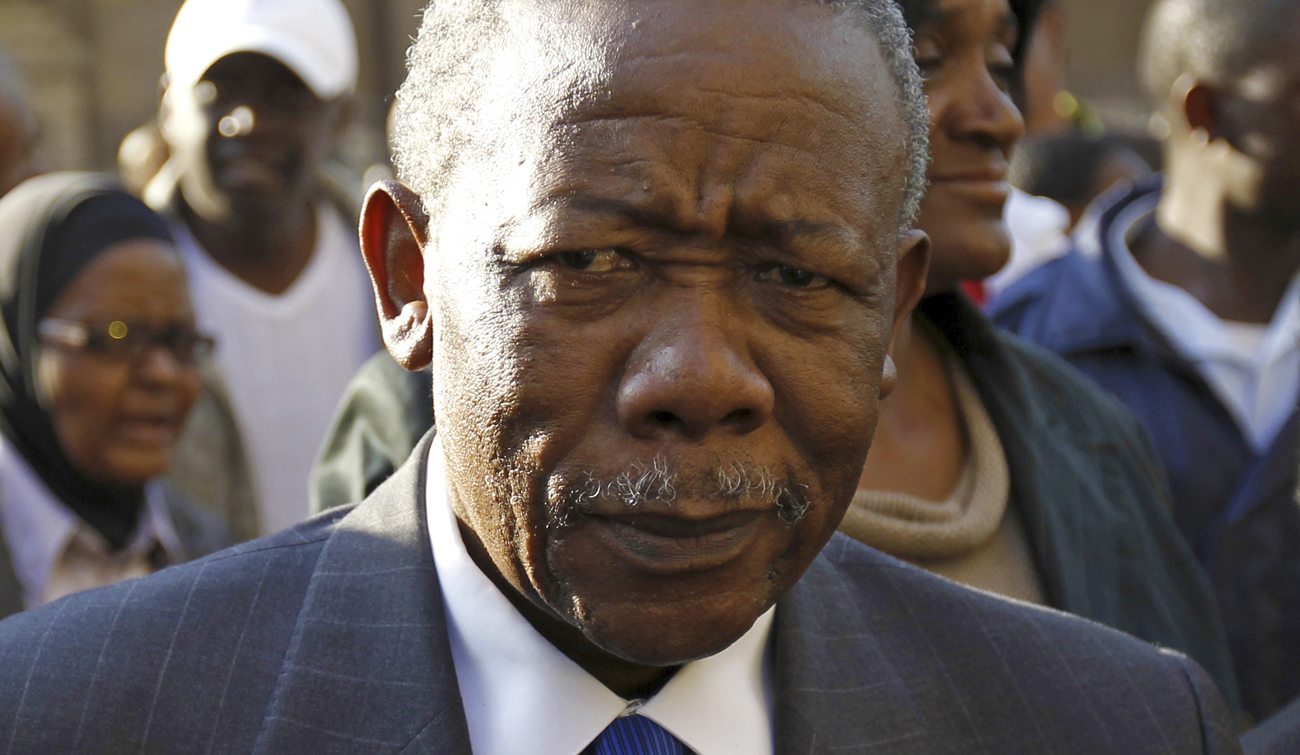
 Jackie Selebi, the former head of the South African Police Service. (Photo: Reuters / Siphiwe Sibeko
Anton Ackermann, key witness in the probe into delayed apartheid era atrocity prosecutions, testified on Thursday to the Khampepe inquiry that former national police chief Jackie Selebi had been convinced that the advocate had “a compelling case” against former president Thabo Mbeki, which had not been true.
“There was no case against the president or any other prominent ANC members who had been refused amnesty,” Ackermann emphatically informed commissioners.
It appears from the evidence presented on Thursday that the narrative, that first circulated in the early 2000s, that Ackermann – as head of the Priority Crimes Litigation Unit (PCLU) in the National Prosecuting Authority (NPA) – was gunning for 37 ANC senior leaders, had been concocted by former security police members.
/file/attachments/2989/Screenshot2026-03-05103430_713313.png "Notes taken by advocate Anton Ackermann during his tenure at the PCLU, that form part of the court documents.")
Selebi gave it legs
How the alleged conspiracy to arrest ANC leaders gained legs through Selebi was also set out to the panel.
The story of the potential charging of Mbeki was first brought to life by Jan Wagenaar, lawyer for implicated apartheid-era generals, and was snapped up immediately by the conspiratorially minded Selebi. This was a decision which set the dominoes in place for decades-long delays in prosecutions for Truth and Reconciliation Commission (TRC) human rights abuse cases.
Even after Ackermann and the first head of the NPA, advocate Bulelani Ngcuka, had met Mbeki’s intelligence head Billy Masetlha, as well as Penuell Maduna [then Minister of Justice in 2004], to reassure Mbeki that there was no docket, Selebi continued to believe there was.
/file/attachments/orphans/000065674_445492.jpg "Former police commissioner Johan van der Merwe (left), at the hearing in Pretoria into former apartheid minister of law and order Adriaan Vlok on 17 August 2007. (Photo: Deaan Vivier / Media 24 / Gallo Images)")
Intimidation
“It was clear to me the case against the president was being relied on to intimidate the NPA [by the old guard] into not prosecuting security branch members,” Ackermann told the inquiry.
It was Wagenaar, said Ackermann, who had spread the word that “a solid case had been made implicating the president” and that two SAPS members dealing with liberation movement “terrorism” cases had proof of this in completed dockets.
At the time, Ackermann, then head of the PCLU, had been ready to arrest and prosecute key security police suspects who had poisoned Reverend Frank Chikane in April 1989.
These were former minister of law and order Adriaan Vlok, former police commissioner Johan van Der Merwe and security policemen Gert Otto, Hermanus van Staden and Christoffel Smith.
/file/dailymaverick/wp-content/uploads/2025/07/ED_517555.jpg "Former president Thabo Mbeki. (Photo: Gallo Images / Sharon Seretlo)")
‘No case against the president’
“Due to the fact that neither the lawyer in question nor the SAPS members [said to be investigating the case] could on any occasion produce a docket containing evidence implicating the president, I instructed Macadam [advocate Chris Macadam] to go through the relevant TRC evidence in order to establish if there was any merit in the allegations against the president”.
The allegations by Selebi were untrue, said Ackermann, and there is no doubt that “Minister Maduna reported back to Mbeki”. In order to centralise matters, Ngcuka had called for all TRC-related cases to be brought to his office at the NPA.
Ngcuka had told Mbeki’s representatives at this meeting that “having perused all the relevant TRC material, there was no case against the president or any other prominent ANC member who had been refused amnesty”.
Maduna was replaced by Bridget Mabandla as Minister of Justice. Dr Silas Ramaite, who acted as NPA head after Ngcuka’s resignation in 2004, has testified to the commission that Mabandla had called the NPA to place a moratorium on all TRC prosecutions.
/file/dailymaverick/wp-content/uploads/David-TRCfailures1.jpg "Former police colonel and apartheid assassin Eugene de Kock. (Photo: Leon Botha)")
Chikane prosecution – horns of a dilemma
Ackermann said he did not need evidence to prosecute the perpetrators in the Chikane poisoning matter as much of the apartheid chemical warfare programme had been exposed in the trial of Wouter Basson, who headed the unit. Ackermann had been the prosecutor in that matter
But Chikane, as Director-General in the Presidency and Secretary of Mbeki’s Cabinet, had somehow been drawn into the conspiracy and had been pressured to relent on the prosecutions of his poisoners.
After Ackermann had successfully prosecuted Eugene de Kock, head of the security police’s covert C1 unit at Vlakplaas, he had hoped De Kock would become a witness in order to expose overall covert unit head, Krappies Engelbrecht and police commissioner Johan van der Merwe as well as notorious security policeman, Basie Smit.
“I thought he would implicate them. I was under the impression he would approach us [as the PCLU] . But I was told by someone he was off limits and that he was inside the TRC camp and from that moment he was out of my reach”.
De Kock switches sides
The TRC camp that Ackermann referred to on Thursday was the “secret” external Amnesty Task Team (ATT) set up outside the NPA after the TRC cases were handed down.
It was comprised of Deon Rudman of the Department of Justice as chair, Yvonne Mabule and Vincent Mogotloane from the National Intelligence Agency (NIA), Gerhard Nel and Lungisa Dyosi from the NPA and Ray Lalla from the South African Police Service (SAPS). Crucially, the PCLU – the unit actually tasked with the prosecutions – was excluded from these deliberations.
Ngcuka had made arrangements with three or four police commissioners on the task team to meet advocate Mokotedi Mpshe, who later replaced Ramaite as acting head after Ngcuka’s resignation in July 2004.
At the meeting, attended by Ngcuka, the SAPS was invited to identify the documents relevant to the president, which they had been “unable to do”.
“Ngcuka then instructed SAPS commissioners to have all the SAPS dockets removed forthwith and for the two SAPS members working with advocate Paul Fick [head of the prosecution team] to vacate their offices at the DPP’s premises”.
Selebi stops arrests
When the planned arrest of Chikane’s poisoners was about to take place, Ackermann informed Wagenaar, their lawyer, that they should present themselves to court to be charged and that he would not oppose bail.
Wagenaar had responded that this would not be happening as there was some sort of “special dispensation” for his clients, which he had gone to discuss with Ramaite.
Rev Chikane, who was an adviser in Mbeki’s office, said that while he was not against the prosecutions, he also did not want them to proceed. In a meeting, Ackermann had informed Chikane that it was not up to him to decide; he, as a prosecutor, represented the public and the law and that he was ready to proceed.
“I stood up and walked out. The cluster was not happy about my conduct,” Ackermann told the inquiry.
Selebi had seconded a General Jan Jacobs, attached to the legal division, to the task team. Jacobs had ignored Ackermann’s explanation and was adamant that Chikane was against the prosecution and therefore it should be halted.
He had been told “the national commissioner [Selebi] does not want this to go further” said Ackermann.
‘Terrorism’ charges
Ackermann said that later, Ngcuka had informed him that Selebi had addressed a meeting of the directors-general and alleged that Ngcuka was preparing to have the president arrested and charged with “terrorism”.
“Ngcuka further informed me that commissioner Selebi was in possession of a video recording in which I had admitted that the president was due to be arrested. I was then shown the video recording of my meeting with commissioner Lalla”.
Lalla had secretly recorded the meeting, an act for which he was admonished by Ackermann, who had been “very angry” about it.
Selebi had also complained about the NPA’s possession of police dockets as these “apparently contained evidence that would be used to prosecute the president and other high-profile ANC leaders”.
Ackermann said he denied both the arrest attempt and that “so-called relevant” police dockets existed, but no one cared to take note. The story was too good to ignore and so Selebi ran with it.
After a meeting in Cape Town, Selebi had alleged that the NPA had been planning to “paralyse government” by arresting “large numbers of prominent government officials who had previously been involved in MK activities”.
The disgraced national commissioner later scuppered investigations by refusing to supply detectives and investigators to finalise TRC cases.
On Selebi’s behaviour, Ackermann said “it would appear commissioner Selebi has an obsession concerning a non-existent attempt on my part to prosecute the president and other prominent ANC leaders”.
Selebi, he added, might have been placed “in an embarrassing position” as a result of his original allegations, which were disproved, Ackermann suggested. His unquestioning rise to the bait thrown out by the old apartheid generals stood them in good stead in the end, it appears. Until now.
Selebi also erroneously believed the PCLU was part of the Directorate Special Operations in the Scorpions, which was untrue. DM