




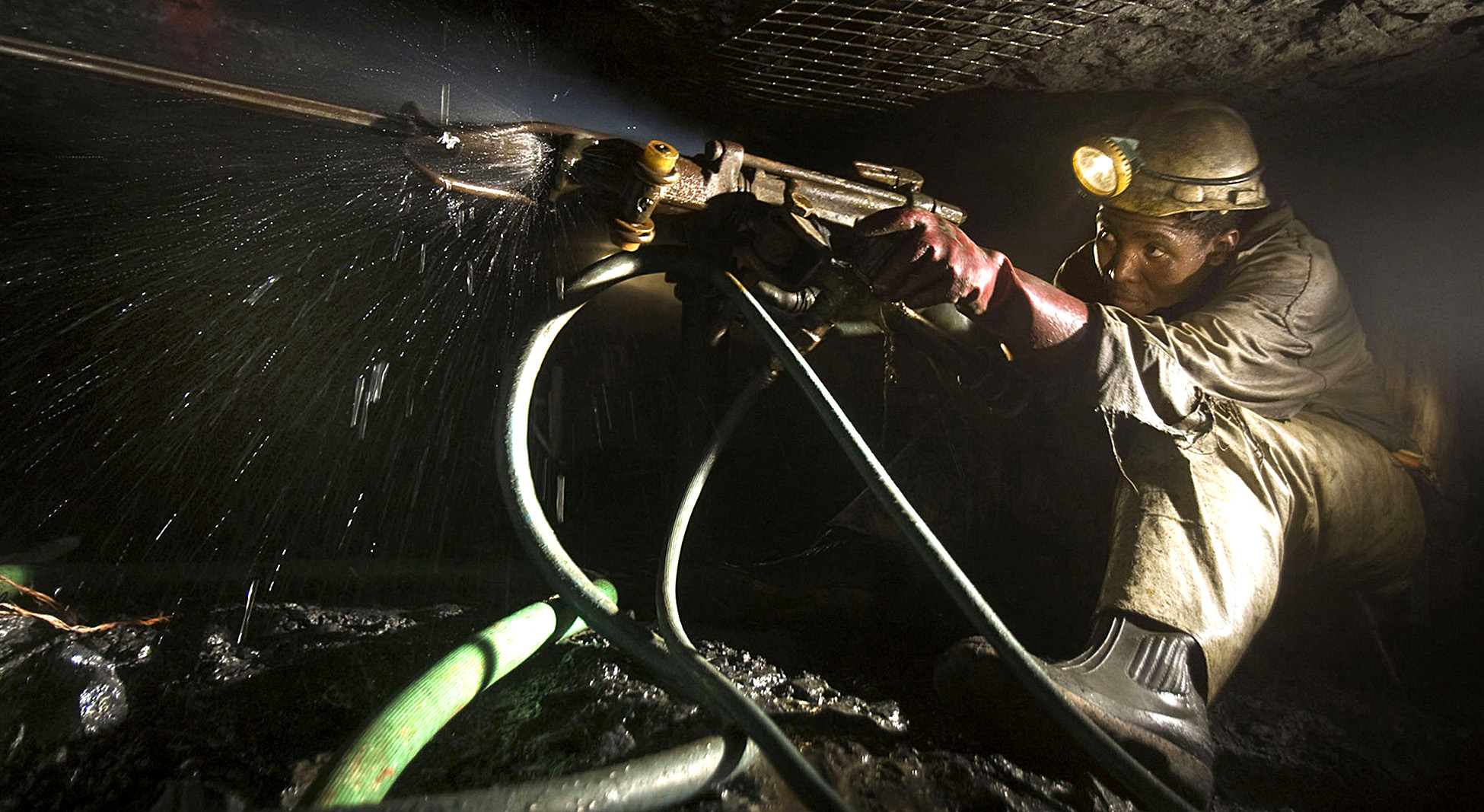
 Mineworkers use a drill on the rock face as they works deep underground at the Impala Platinum mine in Rustenburg. (Photo: Nadine Hutton / Bloomberg via Getty Images News)
 The results season for South Africa’s platinum group metals producers (PGMs) has wrapped up, and compared to last year, it’s been a glittering one, marked by surging prices, profits, dividends – and taxes paid to the National Treasury.
One of South Africa’s competitive advantages in the global economy is its resource endowment. On the PGM front, South Africa accounts for about 70% of the world’s known reserves and supplies. And currently, there is renewed demand, lighting a fire under prices that had been depressed for the past few years.
Over the past 12 months, platinum prices have more than doubled to close to $2,200 an ounce while palladium has risen 75% to around $1,682, according to Johnson Matthey data.
/file/dailymaverick/wp-content/uploads/2025/09/Valterra-Investor-Site-Visit-0222.jpg "A 4.7kg platinum bar – the end product of a long process at Valterra Platinum’s precious metals refinery near Rustenburg. (Photo: Supplied)")
Prices have cooled since the recent peaks scaled in late January, and the escalating conflict in the Middle East is seen as heating up global inflation and potentially hitting economic growth, which would be a drain on PGM demand.
But overall, the fundamentals are largely in place for a sustained rally.
Lifted EU ban brings relief
One game changer came in December when the European Commission announced that it was effectively lifting the scheduled ban on the sale of internal combustion engine (ICE) vehicles from 2035 – partly under pressure from countries such as Germany, which have huge auto industries.
In its place, the EU is aiming for significant reductions from new cars in the CO2 emissions linked to climate change.
The primary demand for PGMs for decades has been for autocatalysts in ICE engines. And a major constraint on PGM prices in recent years was the rise of electric vehicles (EVs), which don’t use the metals.
“The continual downgrade in the penetration rates of EV vehicles – we believe there is a strong likelihood that will continue,” Impala Platinum CEO Nico Muller said during a media call on Thursday after the company reported its interim results.
“It is our view that the rate of electrification of vehicles is declining and will continue to decline.”
His view has been echoed by other South African PGM CEOs in recent results presentations, including Northam Platinum’s Paul Dunne, who noted that this shift in EU policy was underpinning much of the renewed optimism in the sector.
Another factor has been the rise of hybrid vehicles, which require more PGMs than ICE vehicles.
Concerns about tightening supplies after decades of underinvestment in South Africa’s PGM sector have also been a catalyst for the rebound, as well as a global economy that had seemed to be on the mend.
Treasury windfall
Among other matters, this is reaping a windfall for the South African Treasury as it attempts to stabilise the country’s mounting debt levels at 78.9% of GDP and steadily reduce this burden.
With little room for error in a slow-growth economy, the Treasury needs all of the help it can get.
“2021 and 2022 were bumper years for mining taxes in South Africa. Ordinarily, mining constitutes 10% of corporate income tax, but in 2022 it amounted to 40%. That windfall was driven by PGMs (especially rhodium) and iron ore in 2021 and PGMs and coal in 2022,” Morgan Stanley analysts said in a recent note.
“If spot prices hold, we’re heading back into windfall territory for 2026 and 2027, driven by PGMs and gold.”
Implats’ CFO Meroonisha Kerber said the taxes and royalties the company paid in the six months to the end of December amounted to R4-billion compared with R800-million in the same period the previous year. That number could double again in June if the PGM rally is maintained.
Northam paid almost R1-billion in taxes in the same timeframe, more than double what it paid in the first half of its previous financial year, while its royalties almost tripled to R630-million.
Sibanye-Stillwater paid R2.4-billion in taxes in FY 2025 compared with almost R1.4-billion in 2024.
The numbers
⛏️Valterra’s headline earnings for FY 2025 almost doubled to R63.48 per share and a special top up brought its final dividend to R11.5-billion or R43/share – equal to 71% of headline earnings.
⛏️Northam paid a record R2.8-billion in interim dividends as its half-year headline earnings per share soared to 1,524 cents from 61.1 cents in the previous comparable period.
⛏️Implats reported a fivefold increase in headline earnings of R9.3-billion or 1,035 cents per share.
⛏️Sibanye-Stillwater’s headline earnings surged from R1.8-billion in 2024 to roughly R6.9-billion in 2025, a dramatic turnaround driven by stronger gold and PGM prices.
/file/dailymaverick/wp-content/uploads/2025/09/Valterra-Investor-Site-Visit-B-1799.jpg "A massive ladle pours a red-hot PGM mix into moulds at Valterra Platinum’s Converter plant near Rustenburg. (Photo: Supplied)")
A lot is at stake for South Africa in this PGM rally, which – along with gold’s record run – has helped to underpin the volatile exchange rate of the rand. The dividend flows have raised the sector’s profile on the radar screens of investors, domestic and foreign.
A prolonged conflict in the Middle East could take some of the momentum out of this rally while continuing to boost gold’s status as a “safe-haven” asset.
“We are an industry marked by long winters and short summers,” Implats’ Muller said.
For now at least, the rays of summer are shining on the industry. DM