




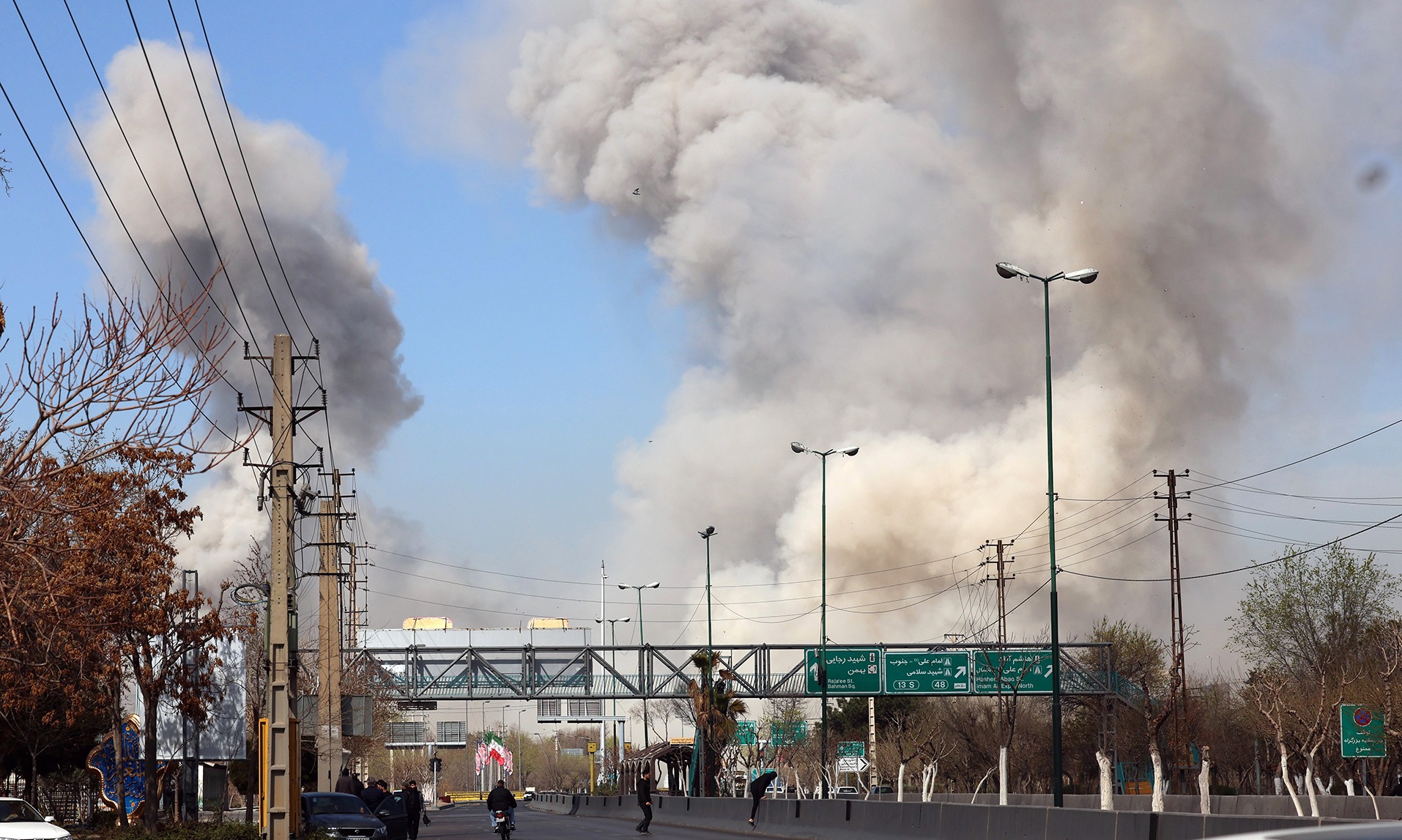
 People scatter for safety as smoke rises after an airstrike in central Tehran, Iran, on 5 March 2026. A joint Israeli and US military operation continues to target multiple locations across Iran. (Photo: EPA / Abedin Taherkenareh)
 I’m interested in how the illegal war is reported by different news agencies, especially given uncritical coverage of previous US wars. And how will the UN respond to unauthorised use of force?
Ferial Haffajee, politics and Joburg writer, responds:
I find myself switching from the BBC, Sky, CNN to Al-Jazeera more and more often to understand a perspective from Iranian people themselves and also from specialists in the Middle East. Coverage is less uncritical than it was in previous incursions in Afghanistan and Iraq.
I found this interview of Department of International Relations and Cooperation (Dirco) DG Zane Dangor with Victoria O’Regan very enlightening on international law and what should and should not happen.

Will we see a siege of the Cape of Good Hope by the US to secure safe passage for oil tankers around Africa?
Peter Fabricius, foreign affairs writer, responds:
This question reflects a wider geographical misunderstanding about this conflict. Last year, Iran’s proxies, the Houthis in Yemen, began attacking shipping in the Red Sea in retaliation to US and Israeli attacks on Iran. The Red Sea, of course, leads to the Suez Canal and then to the Mediterranean.
So the Houthi attacks forced many countries and shipping companies to detour around the Cape of Good Hope. But the Strait of Hormuz, which Iran has now threatened to close, is the gateway to the Persian Gulf, which, of course, offers no thoroughfare to the Mediterranean. So no one will be detouring around the Cape.
Why is it that countries that have nuclear weapons get to decide who else can have them? I’m not saying it’s a good thing for Iran to have nukes, but it does seem somewhat hypocritical for countries to use the fact that Iran might be developing nukes as a valid reason to attack.
Victoria O’Regan, politics and foreign affairs writer, responds:
Great question, and one that doesn’t have a straightforward answer. It’s as much a moral question as it is a political and legal one.
The 1970 Treaty on the Non-Proliferation of Nuclear Weapons (NPT) essentially governs the nuclear landscape we have today. The agreement aims to prevent the spread of nuclear weapons. Almost every country in the world – including the so-called nuclear-weapon states, which are the US, Russia, UK, France and China – has signed the NPT.
These five countries are defined as nuclear-weapon states because they had all tested nuclear weapons before 1967, and under the NPT, were allowed to keep them. Iran is also a signatory to the NPT. Israel, India and Pakistan never signed the NPT, while North Korea left in 2003. (Israel has long maintained a policy of “nuclear ambiguity” surrounding its nuclear capabilities, but is widely believed to possess nuclear arms.)
This is a great video explainer by Al Jazeera.
Considering the ideal outcome of both the Venezuelan and Iranian campaigns, there have been more than just some well-founded rumblings of similar campaigns being undertaken by the US against Cuba and the ANC/EFF alliance in South Africa. What are your sources saying?
Fabricius responds:
I think Cuba and South Africa are in very different positions in relation to the US. One can imagine a military attack on Cuba, although it might be that by deposing Nicolas Maduro’s government in Venezuela and thereby cutting off oil supplies to Cuba, the Trump administration may be hoping to effect regime change in Cuba indirectly without military action.
I do not foresee any realistic possibility of a US military attack against South Africa, a functioning democracy, member of the G20, etc. It would be very widely condemned by Europe, etc. And incidentally, the last time I looked, the ANC and EFF were not in an alliance.
MTN is in a joint venture with the Islamic Revolutionary Guard Corps (IRGC) and runs the Iranian internet. The closing of the internet by MTN was required to start the genocide in Iran, which caused 40,000 deaths in two days. MTN should be liquidated and the proceeds paid to the families of Iran’s genocide.
Lindsey Schutters, business writer, responds:
Whoa... Thanks for the question, but it is not that simple. Much like our B-BBEE and equity ownership laws, MTN only won the contract because Turkcell couldn’t put a deal together that complied with Iran’s 49% limit – which is what that legal dispute is about.
Now, with that in mind, MTN-Irancell serves about 42% of the mobile market in Iran, which is about 60 million SIM cards. The core of the business partnership was to help build the network of over 17,000 towers, which allowed Iran to grow its internet penetration to 92%, connecting millions of people.
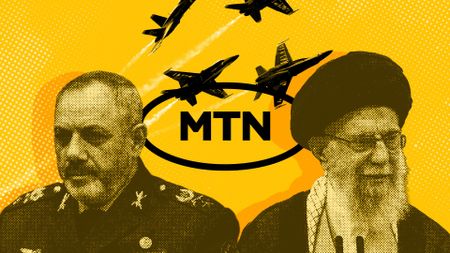
Yes, MTN realised around R24-billion in dividends from 2016-2018, but I feel it’s unfair to hold it accountable and culpable for the actions of the Iranian government. They entered the country as a technology builder and an important bridge in the technology divide.
How many missile launchers does Iran have and how many were destroyed? What is the way to free Iranians from the oppressive theocracy and give them a proper democracy?
John Stupart, newsletter editor and defence writer, responds:
Iran had one of the largest, most varied missile inventories in the entire region, and arguably even worldwide. While initial strikes by Operation Epic Fury (Pete Hegseth’s newest potential tattoo idea, no doubt) were successful in wiping out several of these missile-launching sites, there remain various underground launch, storage and production facilities that were not part of the initial target plan for the US-Israeli attacks.
This is a long-winded way of saying that Iran had many missile sites and launchers, with significant stockpiles out of smart bomb reach. If they can continue to attack Middle Eastern targets, there is a real risk of US and Israeli anti-missile inventories being stretched thin. If the missile shield breaks, the region becomes a complete no-go zone for air and sea travel.
How do Iranians find liberty amid this huge mess? That’s a really difficult one to answer. Without any real possibility of peace just yet, Iranians will probably suffer yet longer before things can even hope to improve. In this regard, loath as I am to admit it, Donald Trump is correct in his assessment that Iranians will never have a better chance to “rise up” and seize control of their country.
/file/attachments/orphans/GettyImages-2264910347_981685.jpg "Iranian flags hang from a building in Shahid Borujerdi residential complex in southeast Tehran, Iran, on 5 March 2026. The building was heavily struck by Israel and the US during Operation Epic Fury a day before. (Photo: Kaveh Kazemi / Getty Images)")
Can it be labelled a war already? Has there been that declaration from the aggressor that they’re going to war with Iran?
Stupart responds:
Despite glorifying its newly named Department of War, the Trump administration is reluctant to call this exactly what it very much is: a war. Doing so requires Congressional debate and accountability. There’s no appetite for that in the White House right now.
/file/attachments/orphans/GettyImages-2263711931_298856.jpg "In this handout photo released by US Central Command, US sailors transfer ordnance on the flight deck of Nimitz-class aircraft carrier USS Abraham Lincoln in the Arabian Sea on 27 February 2026. (Photo: US Central Command via Getty Images)")
Has Dirco used the same pre-emptive strike argument in the case of Russia attacking Ukraine or is that another case of double standards in our foreign policy?
O’Regan responds:
Although Dirco has been reluctant to explicitly condemn Russia for the attack on Ukraine, it has stated that the attack violates the United Nations Charter.
In his interview with Daily Maverick, Dangor said: “Just as we say that Russia’s use of force against Ukraine, irrespective of their concerns [about] Nato, is unlawful… That’s why we basically also very clearly stated that, irrespective of our engagements with Russia, the territorial integrity and sovereignty of Ukraine remain sacrosanct.”
Is this war about Iran being an existential threat? In which way?
Stupart responds:
It may be lost in the coming weeks that Iran is no peaceful, nice state. The Ayatollah’s regime is one of violence, repression and outright terror. Their nuclear programme remained a lingering question mark throughout the region, particularly in Israel, but not limited just to the Middle East.
Diplomatic levers could still have been turned, however, including complete isolation of leaders, sanctions of family, family’s family and so on. But Iran was not a friend to anyone, including South Africa (even if some of our leaders naively believe so still).
/file/attachments/orphans/GettyImages-2264273696_426097.jpg "Pro-Iran protesters take part in a rally in Sana’a, Yemen, on 1 March 2026, held to condemn the US-Israel aerial attacks on Iran and the killing of Iranian Supreme Leader Ali Hosseini Khamenei and several military officials. (Photo: Mohammed Hamoud / Getty Images)")
How do the US and Israel think that, after they have militarily destroyed Iran with no boots on the ground, they will achieve their objective of changing Iran?
Stupart responds:
They cannot. Strategic bombing never worked in World War 2 and it’s never worked since. Moreover, the Trump administration’s objectives and justifications for going to war in the first place shift almost daily. It may be prudent to ask instead whether America genuinely wants Iran to change for the better, or to simply just be powerless for generations to come.
There is talk of using the Kurds as a proxy force to effect change, but given Iran’s predominantly Shia background, and the Kurds own memory of US interventions, this is likely to create more problems faster than you can say “insurgency”.
Has America lost any assets in the war yet, ships, aircraft, war infrastructure on land?
Stupart responds:
The US has lost six soldiers and several rather-expensive F-15 Eagle strike fighters, most of the latter by friendly fire. Several bases have come under attack, but, given the enormous military presence in the Gulf region, casualties and damage have been relatively light.
This is a critical component of American war-fighting. If casualties and damage start to mount, conservative Americans may start to questioning this whole thing.
/file/attachments/orphans/RC2DYJAYVGIQ_169423.jpg "Smoke rises after Israeli strikes in Lebanon, following an escalation between Hezbollah and Israel amid the US-Israeli conflict with Iran, as seen from Marjayoun, Lebanon, on 5 March 2026. (Photo: Reuters / Karamallah Daher)")
As much as South Africa promotes non-alignment, it is clear our stance weakens us in the world. Should we not have a clear stance that we won’t align with any state that does not promote human rights and democracy?
Stupart responds:
I’m unconvinced that we exist in a global order that’s capable of coalescing around liberal democratic ideals any more. Thus, for South Africa, tacking our sails against the Trumpian winds is risky, but so too is sailing straight towards what we all considered to be the moral compass of the world order.
Nobody is championing that cause right now, and we would do well to maybe, well, just keep quiet for a few years, diplomatically speaking, that is.
We’re not doing ourselves any favours by feting Russia, China or Iran in recent years, but neither should we preclude bilateral relations with states that might be considered reprehensible. We’re a small to middle power in an ocean of bigger fish. South Africa has to attach itself to someone, but who that is isn’t exactly clear to me right this minute.
/file/attachments/orphans/RC2GYJANA8T0_834035.jpg "A woman in a wheelchair and other displaced people from the southern suburbs of Beirut gather at Martyrs’ Square in Beirut, Lebanon, on 5 March 2026 after an Israeli army warning prompted residents to evacuate during an escalation in hostilities between Hezbollah and Israel, amid the US-Israeli conflict with Iran. (Photo: Reuters / Khalil Ashawi)")
The embassies are closed. How are we supposed to get out?
O’Regan responds:
Dirco has strongly advised SA citizens in the Middle East to “take immediate advantage” of the resumption of limited commercial flights out of the region amid the ongoing military action.
Daily Maverick reported that Emirates resumed limited flights from Dubai International Airport from Wednesday, and has since restarted flights to South Africa (Cape Town and Joburg) on Thursday and Friday.
Etihad Airways, in Abu Dhabi, has also resumed limited operations. Qatar Airways has also begun a limited number of relief flights as of Thursday
You can contact Dirco officials whose email addresses are contained in this article.
You can also call the numbers on the graphic below. DM
/file/attachments/orphans/WhatsAppImage2026-03-03at193056_104137.jpeg "Illustrative image | Emergency Contacts for South Africans in the Middle East. (Photo: ChatGPT)")