




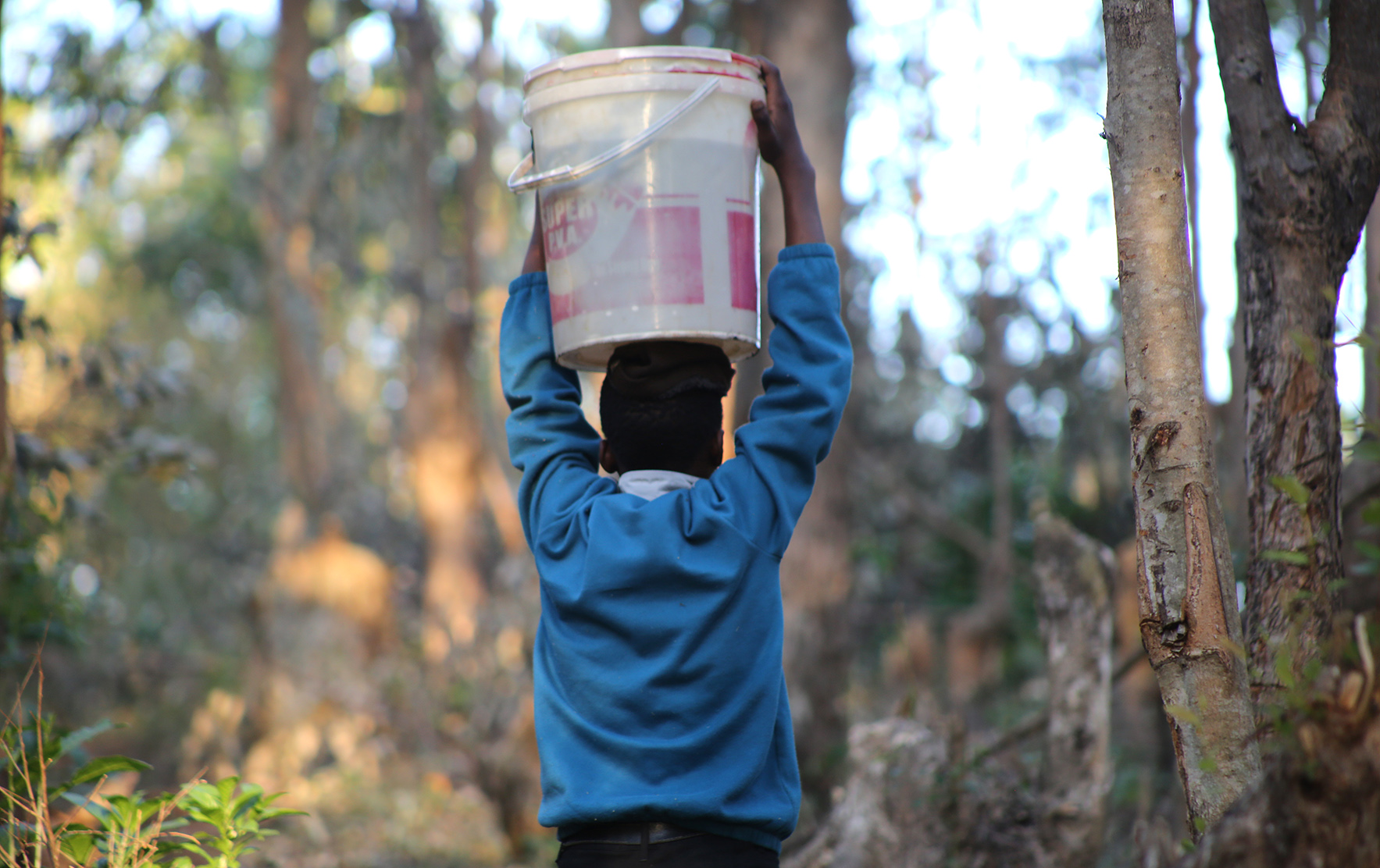
 A child fetches water from a river in Port St Johns, Eastern Cape. Rural communities are disproportionately affected by SA’s water crisis. (Photo: Hoseya Jubase)
 South Africa is at a critical juncture when it comes to water service delivery, with a suite of new interventions being rolled out by the national government. Yet rural communities, which bear the brunt of the water crisis, continue to be sidelined.
In recent weeks, the South African Human Rights Commission called for water outages to be declared a national disaster. President Cyril Ramaphosa, in his State of the Nation Address, committed to establishing a National Water Crisis Committee. The Water Services Amendment Bill, which seeks to professionalise service delivery through a new licensing scheme and enhance ministerial oversight mechanisms, is currently being considered by Parliament.
Water was spotlighted in Finance Minister Enoch Godongwana’s Budget Speech, which confirmed a R27.7-billion medium-term allocation for a performance-based grant for metros to improve their water and electricity services.
/file/attachments/orphans/WhatsAppImage2026-02-12at2224511_979301.jpeg "President Cyril Ramaphosa delivers his Sona on 12 February. (Photo: Phando Jikelo / Parliament of SA)")
This political prioritisation is amply justified — and arguably overdue. Three decades into SA’s democracy, a gulf remains between the constitutional aspiration that everyone should have access to water and the lived realities of millions, especially residents of informal settlements and former homelands.
Municipalities — with whom primary responsibility for water service delivery lies — are in a dire state. Just 41 out of 257 received clean audit outcomes in 2023/24, and 73% of municipal Water Services Authorities are “poor” or “critical” performers, with inevitable consequences for service delivery.
The impact of the water crisis is not evenly spread. In the Eastern Cape — a largely rural former homeland — 20% of households still lack access to water infrastructure, compared with just 1% in Gauteng. So why are rural communities being neglected by new policy and budgetary interventions such as the R27.7-billion grant package for cities like eThekwini and Johannesburg?
Holistic response
The water crisis demands an innovative, inclusive and holistic response: one which puts rural and other marginalised communities at the centre, and which responds to the profound lack of capacity in most local governments.
This is the emerging consensus among a group of more than 40 activists, organisers, policy analysts, litigators and affected people, convened by the Equality Collective on 25 February at a webinar entitled Securing Water Rights in Rural Municipalities: Challenges, Strategies and Opportunities.
Poor municipal service delivery has proved stubbornly resistant to court judgments affirming the right to water. As it turns out, we cannot simply litigate our way out of municipal dysfunction. Thuto Gabaphethe, an attorney at the Centre for Applied Legal Studies, acknowledged that while litigation has clarified constitutional obligations, assisted in holding the state accountable, and provided a basis for dispute resolution, it has limits.
/file/dailymaverick/wp-content/uploads/2022/08/MC-NMB-Luvuyo_4.jpg "In the Eastern Cape — a largely rural former homeland — 20% of households still lack access to water infrastructure. (Photo: Black Star Images / Spotlight)")
Litigation is burdensome for communities and resource-sapping for local governments. This resource drain is especially problematic for rural municipalities, which tend to have more serious infrastructure backlogs, a higher proportion of indigent households, and more limited own-revenue-generating potential.
If not supplemented by community-led, capacity-enhancing measures, court orders made in these contexts may fail to produce tangible results — as has been the case in the Eastern Cape village of Centane, where a string of orders dating from as far back as 2015 have yet to achieve meaningful change.
A bold alternative
Against this backdrop, Samuel Twala, chairperson of the Harrismith Water Heroes (HWH), presented a bold alternative: self-supply. Launched in 2018, HWH is a coalition of residents, farmers and businesspeople who, under one of the worst-performing water services authorities, Maluti-a-Phofung, experienced water outages lasting more than 40 days. Using local skills and privately sourced equipment, they fixed major leaks, installed pumps, procured water treatment chemicals and restored the bulk supply pipeline — effectively acting as an unauthorised water services provider.
However, the first prize for HWH had always been to work with the municipality, not bypass it. It was only the acute water crisis combined with profound dysfunctionality and a lack of effective channels for public participation that led HWH to take matters into their own hands as a short-term stopgap.
Having gained leverage through their radical self-supply strategy, HWH forced greater functionality within the municipality, and Twala now represents the “voice of the community” on an official Maluti-a-Phofung Water Steering Committee, convened in collaboration with the National Department of Water and Sanitation.
The power of partnership is the founding premise of the Equality Collective’s Amanzi Kumntu Wonke (AKW) project. Project coordinator Noluvo Mandukwini highlighted how community-generated data across 32 reservoirs in the Mncwasa Water Scheme had buttressed municipal capacity and built trust with key officials, leading to the expansion of the project to two new areas: Dwesa and Centane.
Moreover, AKW’s technical support for the municipality’s assessments and business plans unlocked R29.5-million in public investment to refurbish the water scheme. The result? Between August 2022 and January 2026, water reliability in Mncwasa nearly doubled — climbing from 41% to 81% — and transformed daily life for more than 30,000 residents.
As Mandukwini put it, “Our communities have power and deep expertise. By working with municipalities, communities can create sustainable and scalable change.”
/file/attachments/orphans/Cleaning-Kei_186457.jpg "Community members cleaning essential water infrastructure that fell into disuse at Kei Mouth, Eastern Cape, on 1 February. (Photo: Elilze Haber / Kei Mouth Times)")
Partnerships like those exemplified by the AKW project do not currently have a clear and explicit legislative basis, and municipalities are often reluctant to partner with communities. AKW is the exception, not the rule: similar initiatives are few and far between. But major law and policy changes are afoot.
As policy analyst Kathy Eales explained, the Water Services Amendment Bill presents a unique opportunity to change the status quo and to place community–municipality partnerships on a stronger statutory footing — though the Bill currently makes no mention of this. It will be up to civil society to call on Parliament to correct this omission.
At this pivotal moment — with water service delivery officially in crisis and set to be a top priority in the run-up to elections — budgetary measures focused on metros and centralist, technocratic legal reforms aimed exclusively at professionalisation and top-down oversight are not enough. Many of the interventions under way are necessary and laudable. But it is also time to recognise the power of active communities and give them a clear mandate to move from the periphery to the centre of local governance. DM
Tatiana Kazim is the research and advocacy lead at the Equality Collective. Tinotenda Muringani is the research and advocacy officer at the Equality Collective.