




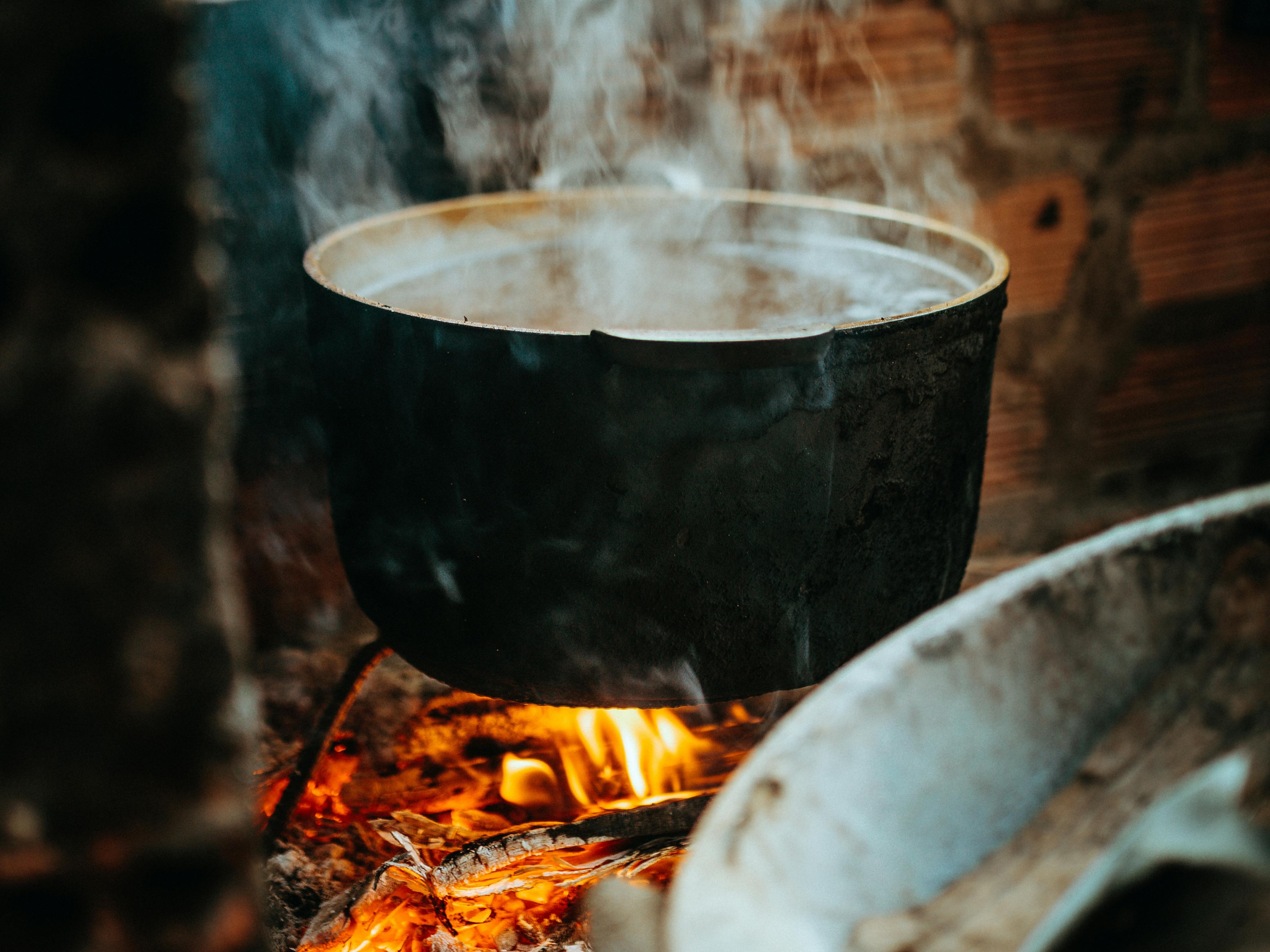
 Pot-au-feu was originally known as pote-fieu and literally meant a pot hanging over a fire. (Photo: Pexels)
 I usually end my essays with a paragraph or two describing something delicious I tasted in the past week, because no matter how stormy the weather gets or how hectic my life becomes, I can still find respite in good food. Last week, though, I had such an extraordinary tasting experience that I want to start with this meal. It was a pot-au-feu in an unpretentious little restaurant in the countryside, and it made me realise once again that my earthly pleasures are often connected.
Great food can lead to great books (or vice versa), to art and music, to lessons in history, politics and life in general. My pot-au-feu meal lured me into a rabbit hole of fascinating internet information.
I discovered, for instance, that the Louvre has an oil painting, Les apprêts du pot-au-feu, by Bounieu (1740-1814), depicting the accessories and ingredients of the meal, which I promptly borrowed to illustrate this post. And I was delighted to find a reference to pot-au-feu in a beloved book by a beloved French author: “All these spicy foods end up heating your blood and are not worth, no matter what you say, a good pot-au-feu.” (Madame Bovary, Gustave Flaubert).
If you’ve read my travel memoir, My Year of Fear and Freedom, you’ll know that I spent a whole day following Emma Bovary’s fictional trail through the town of Rouen, ending up in a “literary hotel” bearing the name of Flaubert.
We couldn’t afford to stay in the hotel on our tight traveller’s budget, but we stopped for coffee and visited the informal Flaubert museum in the foyer. (“A stuffed version of Flaubert’s famous parrot hangs from the ceiling, and a life-size statue of the author gazes at the colourful bird with perpetual longing,” I wrote on page 245.) I also wrote about the gift shop and the bookmarks with Flaubert quotes that we bought – and that I lost somewhere during our peregrination, alas.
But I remember the quote on one of the bookmarks (“A memory is a beautiful thing, it’s almost a desire that you miss”) because our recent pot-au-feu feast instantly became that kind of memory.
The back-story is that this sought-after pot-au-feu is prepared only six times in the year, only one Sunday a month during the winter months, in the restaurant Le Croquant in the fortified medieval town of Monpazier. Towards the end of last year I tried to book a table, twice, without success.
Fearing that the winter would pass before I could taste the meal, I booked many weeks ahead for the penultimate pot-au-feu of the season. Thanks to a last-minute cancellation and a waiting list, I was even able to squeeze in two friends at our table. They are a couple from South Africa and Uruguay, so we spoke French, English, Afrikaans and Spanish during our meal. A multilingual gathering, you could say, although the food on the table was undoubtedly French.
Now I understand why pot-au-feu, originally known as pote-fieu and literally meaning a pot hanging over a fire, is regarded as France’s national dish. This is quite a distinction in a country famed for fabulous food, but Anthelme Brillat-Savarin, the grandfather of French culinary writers, explained it to the rest of the world.
French cuisine is simply the best, he stated (without any false modesty), because the foundation is so good – and the foundation is pot-au-feu. The revered Larousse Encyclopaedia agrees with Brillat-Savarin that pot-au-feu is the basis of French gastronomy: “It is through (pot-au-feu) that our national cuisine is distinguished from all the others.”
In the Middle Ages it was a simple, hearty peasant dish of meat and marrow bones cooked very slowly in a bouillon or broth, adding herbs and root vegetables like carrots, turnips and leeks (available in the cold season). Through the ages, different types of meat, tripe and vegetables were added, according to the region, until it became quite a bourgeois dish, which many peasants could no longer afford. The Périgord region, where I live, is the heartland of foie gras and truffles, which explains why our pot-au-feu also included these two luxurious ingredients.
When the German writer Goethe travelled through France shortly after the Revolution, as a “passionate spectator” of the first counter-revolutionary campaign, he was sufficiently impressed with this emblematic dish to include a precise description of its preparation in his book Campaign in France in the Year 1792: “A large iron pot was suspended from a hook, which could be raised and lowered by means of a rack; in the pot was already a good piece of beef with water and salt. We added carrots, turnips, leeks, cabbage and other vegetables.”
Proof, if proof is still needed, that there is a place for culinary writing even in famous books dealing with battles and war – and that not only French writers fell under the spell of the French pot-au-feu.
/file/attachments/orphans/Foiegrasinbrothmarrowbonewithvealtartareoxtailhidingunderceleryravioli_MaritavanderVyver_545293.jpg "Foie gras in broth; marrow bone with veal tartare; oxtail hiding under celery ravioli. (Photo: Marita van der Vyver)")
Traditionally, the meat and the broth were served separately, as two meals or two courses, but the magnificent pot-au-feu we enjoyed last Sunday was divided into no less than five mouth-watering courses, each served with a different version of the broth – and crowned with two delectable desserts. The long and leisurely meal, ideal for a rainy winter’s day, started on a high note, with a chunk of steamed foie gras in clarified bouillon – and then the notes just got higher.
The second course was a marrow bone cut length-wise so we could scoop out the marrow, accompanied by a tartare of veal on a slice of bread. I’m not a big fan of steak tartare, usually finding it too rich after a bite or two, but this was the first time I tried veal tartare. It was a simple case of seeing it, tasting it and being conquered by it.
The next treat was oxtail with celery ravioli, the sharp and refreshing kick of the celery complementing the strong flavours of the meat. This was followed by all those lovely root vegetables, still colourful and slightly crisp, cooked to perfection in the same bouillon before it was emulsified with foamy burnt butter. Here the famous black truffle of Périgord, always a game changer, had its chance to shine – though as a disciplined background player, not outperforming the more modest vegetables.
The bouquet final, as the French call the last showy bursts of colour concluding any fireworks performance, consisted of the three beef cuts of different tastes and textures that any traditional pot-au-feu has to include – a gelatinous meat like the shank, a fatty meat cut from the shoulder, and a lean meat like the cheek – with potatoes and a thick white herb sauce.
By this time I’d consumed more meat in one meal than I usually eat in weeks, but fortunately my Frenchman is a true carnivore. Each time I couldn’t finish a plate, he happily helped me out. Although the main reason I didn’t finish any of the meat dishes, I have to confess, was because I was afraid I’d be completely sated by the time we reached the two desserts.
I’m the kind of person who believes that life is short, so you should eat your dessert first. This time I waited patiently for my dessert(s), and thanks to careful planning (and a greedy partner) I could thoroughly enjoy the homemade ice cream with saffron, as well as the pièce de résistance, a meringue decorated with a creamy white and red confection in the form of a rose. A spectacular ending to a spectacular meal.
/file/attachments/orphans/Dessertintheformofarosecolourfulvegetableswithfoamyburntbutterthreecutsofmeatcompressedunderablanketofherbsauce_MaritavanderVyver_652110.jpg "Dessert in the form of a rose; colourful vegetables with foamy burnt butter; three cuts of meat compressed under a blanket of herb sauce. (Photo: Marita van der Vyver)")
After almost three decades in France, I sometimes fear that I’ll become blasé about the astonishing variety of food in this country of food lovers.
Then I go to a small restaurant in the heart of the country, for a pot-au-feu that thrills me to my toes, and I realise, with immense relief, that I’ll probably never reach a state of indifference when it comes to good food.
If This Is a Man
The supreme irony, after such a gastronomic experience, is that I’m finally feeling brave enough to read Primo Levi’s If This Is a Man, a seminal testimony to the horrors of the Holocaust. Perhaps it was the closet Calvinist in me that needed to be reminded of extreme hunger, because among the many deprivations of Auschwitz that Levi describes so vividly there is the constant starvation.
Or that is what I thought when I opened the rather tattered copy of the French translation (Si c’est un homme) that has been lying accusingly in my house ever since I found it in a street library last year. I knew I wanted to read it, but like most people I tend to shy away from “depressing books”, telling myself that it’s simply a form of self-protection.
Whatever the reason – personal Calvinist guilt or general literary curiosity or simply the fact that I literally stumbled over the book after it had fallen from a shelf – I took a deep breath and started reading. And now I know, once again, that great literature transcends ordinary notions of depressing reading.
It is certainly not a feel-good book, but it is so beautifully written, in such clear and urgent prose, that it becomes a thrilling reading experience. As the critic Angelo Rinaldi claims on the back cover of my copy: “If literature is not written to remind the living of the dead, it is nothing but futility.”
Above all it is a book of survival, about the burden survivors carry on behalf of all those who didn’t survive. In fact, the most depressing part of it is how timely Levi’s introduction – written in 1947, almost 80 years ago – sounds in our new ICE Age (upper case letters on purpose) when he warns future readers against the idea of “the stranger as the enemy”. The foreigner, the immigrant, the other that has a different religion, race, gender, all these “enemies” in a conception of the world that has extremely dangerous consequences, for all of us, if it is pushed to its extreme.
Minneapolis
The French composer, saxophonist and clarinettist Michel Portal, “architect of modern European jazz”, died in Paris at the age of 90, and French radio stations spoiled us with numerous tributes. My partner has always been a fan of Portal’s wide and eclectic body of music, and even attended a live concert, but much of what I heard was new and exciting to my ears. I listened to his 2001 album, Minneapolis, on repeat; although it has nothing to do with the tragic deaths of innocent people in Minneapolis during the past month, it seemed as strangely appropriate as reading Levi’s book.
/file/attachments/orphans/ItwasonlyonceIlivedinFrancethatIdiscoveredthefleetingjoyofsniffingviolets_MaritavanderVyver_743810.jpg "It was only once I lived in France that I discovered the fleeting joy of sniffing violets. (Photo: Marita van der Vyver)")
Shy violets
The moment I discovered the first shy violets of spring, hiding their delicate purple petals discreetly under other plants, I picked one to smell. In my youth I knew violets were a sign of spring because of an old Afrikaans poem by C Louis Leipoldt (Viooltjies in die voorhuis,/ Viooltjies blou en rooi!), although when I saw them for the first time in nature, in all their purple splendour, I had to wonder if the poet had been colour blind when he described them as “blue and red”.
I didn’t, however, know a single poem about their divine smell. It was only once I lived in France, with a Frenchman fascinated with the scent of violets, that I discovered the fleeting joy of sniffing violets. If the colour purple had a smell, surely this is what it would smell like. DM
Republished from Marita van der Vyver’s Substack.