




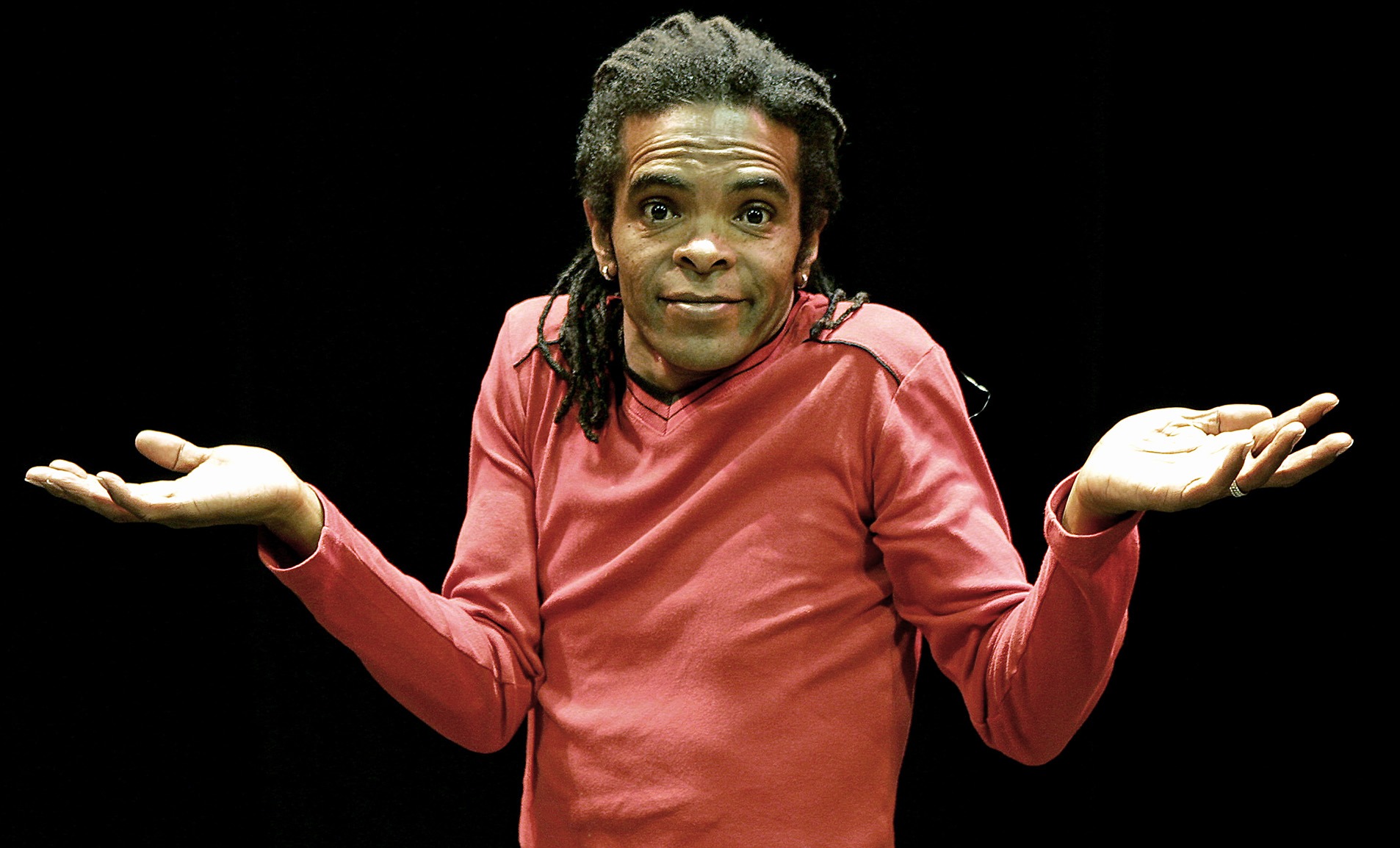
 South African actor, comedian and television personality, Soli Philander. (Photo: Sharief Jaffer / Media 24 Pty Ltd (newspapers / Gallo Images)
One of South Africa’s most versatile actors, comedians and activists, Soli Philander, died at the age of 65 in Cape Town from cancer on Wednesday evening, 4 March. Philander moved effortlessly between the Afrikaans, English and AfriKaaps worlds, where his authentic and warm style of acting endeared him to mixed audiences.
/file/attachments/orphans/ED_175072_328844.jpeg "Soli Philander during the Grilling of Soli Philander at Parker’s Comedy Club, Montecasino on 21 August 2019. (Photo: Oupa Bopape / Gallo Images)")
He was also often misunderstood and vilified for his honest views on diverse human rights topics, ranging from progressive politics and gender-based violence to affordable housing for disadvantaged communities, and much more.
Friends believe that when he publicly identified as non-binary, some of his work dried up. Philander, much like in the theatre of ancient Greece amid the uproarious laughter drawn forth by the comic’s jests, concealed a shadow of pathos.
Soli Philander, born Silamour Philander in January 1961 at Somerset Hospital in Cape Town, arrived in the world in the shadow of a great historical lie. The apartheid state had decreed that a man of his complexion, his language and his neighbourhood occupied a category between things: not white, not black, but coloured, a classification designed less to describe than to diminish. Philander spent his career proving it wrong.
/file/attachments/orphans/ED_179747_563232.jpeg "Soli Philander at the 9th Savanna Comics’ Choice Awards at Gold Reef City in Johannesburg on 7 September 2019. (Photo: Gallo Images / Oupa Bopape)")
He grew up in Elsiesrivier, a working-class township on the Cape Flats. His entry into performance was accidental: he went along to keep a friend company at an audition, and found what he wanted to do for the rest of his life. Everything that followed, four decades on stages, screens and airwaves, in Afrikaans, English and the fluid street register sometimes called AfriKaaps, grew from that unplanned afternoon.
South African History Online, which has documented his career extensively, records that Philander came of age as a performer in the politically charged alternative theatre scene of late-apartheid Cape Town, cutting his teeth at The Space Theatre, one of the few genuinely non-racial cultural venues of the 1970s and early 1980s.
/file/attachments/orphans/0000102982_718137.jpg "Soli Philander in 2004. (Photo: Gallo Images / Foto24 / Sharief Jaffer)")
A pivotal turn came when he starred in the Baxter Theatre’s 1980 production of Samuel Beckett’s Waiting for Godot, which toured nationally before transferring to London and the United States. It was an early signal of the range that would define him.
In 1984, he devised, wrote, directed and performed in a one-person cabaret built around a character named Rosie September, “the maid with the most”, for Pieter Toerien’s The Wrong Time of Year.
It was perhaps his one-man show Woeskroes, raw, funny and furious, that best distilled of what he was capable. In later years came Nice Coat, a solo stage show described by those who saw it as an act of prophecy, a searing, elegiac love letter to the Cape Town he had spent his life fighting for.
Megan Choritz, actor, writer and activist, says: “Soli Philander, I think of you almost every day. In my activism I often catch myself thinking: what would Soli do? Because you taught me how to stand up, speak out, by example. I will miss him passionately.”
On television, Philander was omnipresent in the best sense, recognisable across platforms and generations. He hosted Liriekeraai, the popular Afrikaans celebrity music game show on kykNET, for years, and the faces of children who grew up watching that programme often lit up when his name came up later. He also presented Vat ’n Kans, hosted Exploring Southern Africa for M-Net, and anchored two years of daily broadcasting on 567 CapeTalk Radio with his talk show Airborne.
/file/attachments/orphans/pic1_353024.jpg "Soli Philander formed the Soli Philander Foundation in March 2023, a formal structure through which he channelled his long-standing philanthropic and social development work. (Photo: Soli Philander / Facebook)")
Elzet Nel, an actor who collaborated with him, recalls the first time she encountered him: “I was a child the first time I saw a shooting star. His name was Soli; he was the host of Liriekeraai. My mother took me to a live recording.
“Years later, I found myself sitting next to him in a minibus on the way to a film shoot, the short film Mr. The Fastest, in 2018. He told us about his years as a young artist in a broken South Africa.
“The mountains he had to move simply because of the colour of his skin. He told it with longing, and with the freedom that only victory can bring. He embraced my parents. Can you believe it? A legend, sitting there, starting conversations about the price of eggs, interrupted by giggles from his ‘audience’ every now and then.
“And his South Africa let him down often. Regularly condemned, cross-examined, or abandoned. He really raged against the dying of the light.”
/file/attachments/orphans/pic3_311070.jpg "Soli Philander in District Six. (Photo: Soli Philander / Facebook)")
The Afrikaans-speaking world, in particular the community of Punt Radio’s old listenership, will remember an afternoon that became legend among those who heard it. Wouter de Vos recalls: “When I think of Soli Philander, my first thought is always of something that happened one afternoon on the old Punt Geselsradio, where Soli was a presenter.
“There was a regular caller, a Johan van Ruiterwacht, if I recall correctly, whose grandchild, a little girl, had been killed in a tragic road accident by an alleged drunk driver. What I will never forget is Soli’s rage and grief over this unnecessary, entirely avoidable tragedy.
“He became so emotionally and personally involved in that pain that he had to take himself off air for a while, he was too distressed to broadcast. Soli felt that grief alongside Johan van Ruiterwacht and his family.
“He didn’t merely feel sorry for them. He felt it with them. That is how I choose to remember Soli Philander: as the man with genuine, undiluted empathy for another person’s pain.”
Journalist and friend Marianne Thamm, who knew him well, speaks of a darker, more complex intelligence beneath the warmth. There was, she says, always a shadow to Soli, a humour that intended to unsettle as much as to delight, to make people think as well as laugh.
“His Woeskroes, she recalls, carried that quality: a rawness about who he was, about the brother who had been falsely arrested in Johannesburg, about the losses his mother had already borne. The Philander home in those years was always full, family gathered close, a draughts board, music, young men watching football on a big television. A house that held its people.”
That holding together would be tested beyond imagination in the days before Soli Philander’s death. His younger brother, Jamiel Ebrahim Philander, had died on 14 February 2026, also from cancer. Within two weeks, their mother, Shaheadah Philander, lost two of her sons.
/file/attachments/orphans/ED_175080_970888.jpeg "Soli Philander once gave a rare interview in YOU magazine, published under the headline, I’m Not a Man, I’m Not a Woman, in which he identified himself as non-binary. (Photo: Oupa Bopape / Gallo Images)")
Sebastian Sebbi Petersen, owner of AfriKaap Radio, who had known Soli since the early 2000s, says: “It was Soli who first opened the door for me into radio and acting. Soli, a mentor, a man who believed in people.”
Advocate Shameemah Dollie Salie, spokesperson for Al Jama-ah, who had worked alongside Philander on various issues, says: “From our Boeka under the bridge feeding the homeless, to our deep shared solidarity with the people of Palestine, I could not believe it when I received the message that you are no more. We are going to miss your poetry, your deep discussions on the plight of our world.”
Philander once gave a rare interview in YOU magazine, published under the headline, I’m Not a Man, I’m Not a Woman, in which he identified himself as non-binary, a public disclosure of considerable courage given the cultural and social world in which he had lived his life.
He described a breakthrough moment of understanding that had come in the years following his divorce in 2015 from Toni Philander, his wife of 30 years, with whom he had four children. His announcement, in his own words, placed honesty above comfort.
In March 2023, he launched the Soli Philander Foundation, a formal structure through which he channelled his long-standing philanthropic and social development work. He had been a motivational speaker in schools and community settings for years.
He died at his daughter Kyla’s home in Cape Town with his eldest daughter singing to him as he took his last breath. Philander is survived by his mother, Shaheadah; his brother, Anwah; his former wife, Toni; his children, Danya, Kyla, Caleb and Ethan; and his foster daughter, Lauren. DM
Herman Lategan is a journalist and writer based in Cape Town.