
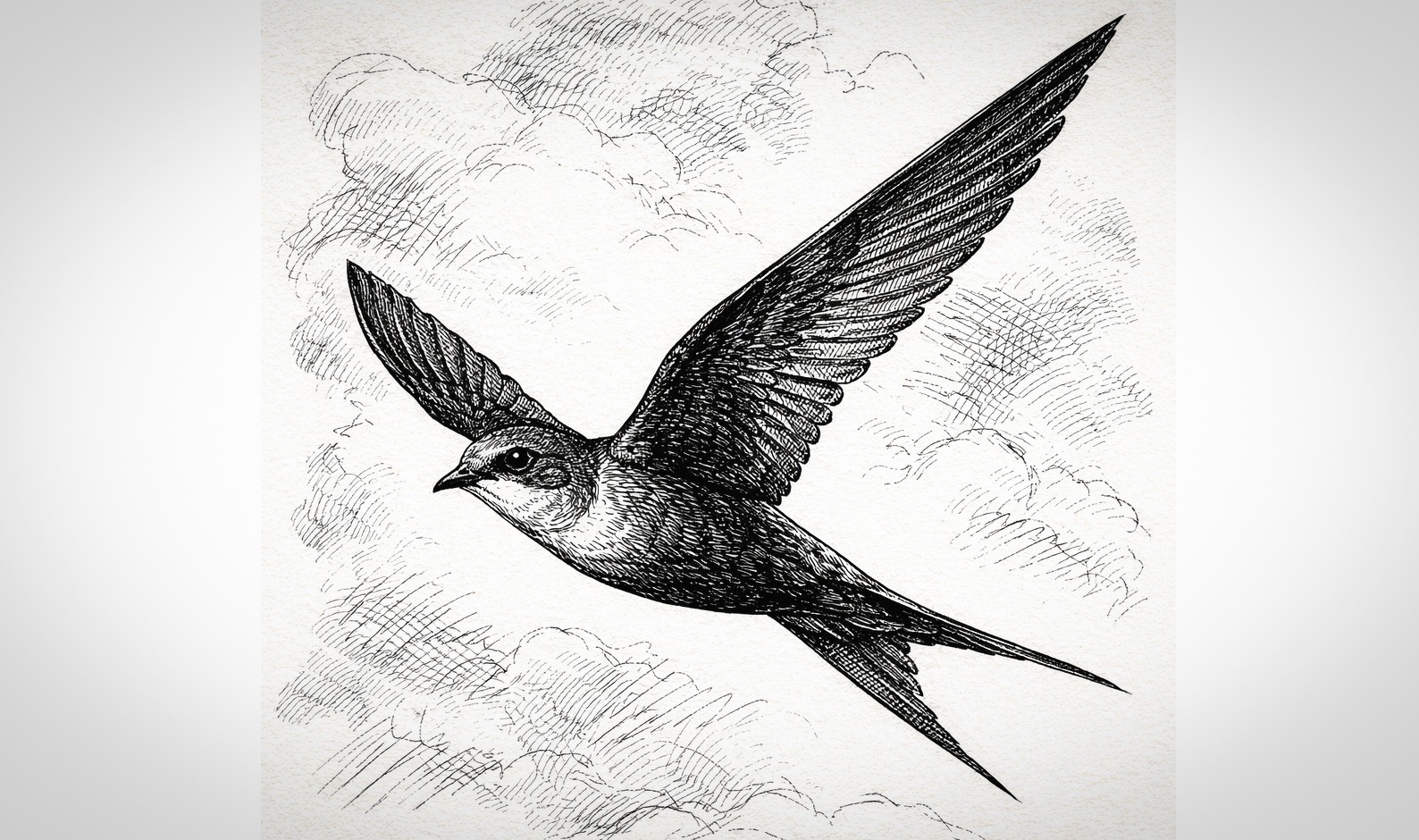
 African black swifts stay airborne for around 10 months of the year. (Image: Sketchy)
 /file/attachments/2987/NOtesfromasmallfinal_806626.jpg)
In these disquieting times in which men (yes, men) are at war with other men, dealing death to young conscripts, women and children, it’s good to be open to moments of grace. For me, grace is what happens when you tug on a random thread and discover it’s connected to the web of everything.
Cycling along a track high on the slopes of Devil’s Peak on Sunday, I came across a group of about 40 men, women and children in a clearing, conversing in isiXhosa.
Many were kneeling, trickling scooped sand and leaves through their fingers and chanting, others were chatting or eating breakfast from backpacks. It was a happy crowd.
I asked a young man if this was a religious group. He said: “No, this ceremony is much older than your religions. We are in celebration of the Old Ways.”
“What are you celebrating?” I asked. He pointed at the mountain, laughed, opened his arms wide and replied: “Everything.”
Pedalling back towards Table Mountain I was stopped in my tracks by a virtual blizzard of swifts. Thousands were hawking insects in a single valley and side-slopes, flying so fast and passing so close that the air rippled. They were celebrating a rhythm of insect hatching far older than our own history.
Swifts are among the most extraordinary aerial migrants on Earth. The birds zooming past my helmet could have hatched in Sweden, drifted over the Sahara Desert, hunted in the Congo Basin and were hawking on a Cape Town mountain – all without ever touching the ground.
When the chill sets in over Table Mountain they’ll head back, a round-trip distance of about 20,000km.
They’ll fly without ever landing for 10 months – eating, drinking, sleeping and mating in constant flight. They essentially live in the sky.
To rest they sleep one hemisphere of their brains at a time, climbing at dusk to about 3,000m and spending the night gliding slowly until dawn. Their nocturnal disappearance led early naturalists to believe they slept underwater.
Their food is “aerial plankton” – flies, aphids, beetles and spiders. They navigate using solar cues, polarised light and possibly geomagnetism. They can live for 20 years.
Researching and writing the Storied Mountain series has been a lesson in deep time. The rocks, the fynbos, the creatures and the cycles of life that swirl around Table Mountain predate us by, in many cases, millions of years. It’s made me think about how short our time on this planet has been, both as a species and as individuals.
I wonder if those powerful men who order out the tanks, the drones, the missiles and sea armadas intending to kill other people have ever stepped outside to listen to the dawn chorus of birds, stared in wonder at 1,000 swifts that never land or watched the languorous stride of sleepy eyed giraffe.
Do they have moments of grace? Probably not. But in these confusing times we should become collectors of those moments. They’re soul food.
Here are the links to the Storied Mountain series so far.
- The flat mountain that wouldn’t behave
- What is Table Mountain? A story of Deep Time
- Hotter, drier, wilder: reinventing conservation for a changing climate
- Table Mountain’s green cloak that took 60 million years to weave
- The fluid intelligence of Table Mountain’s rivers
- What it takes to keep Table Mountain wild