




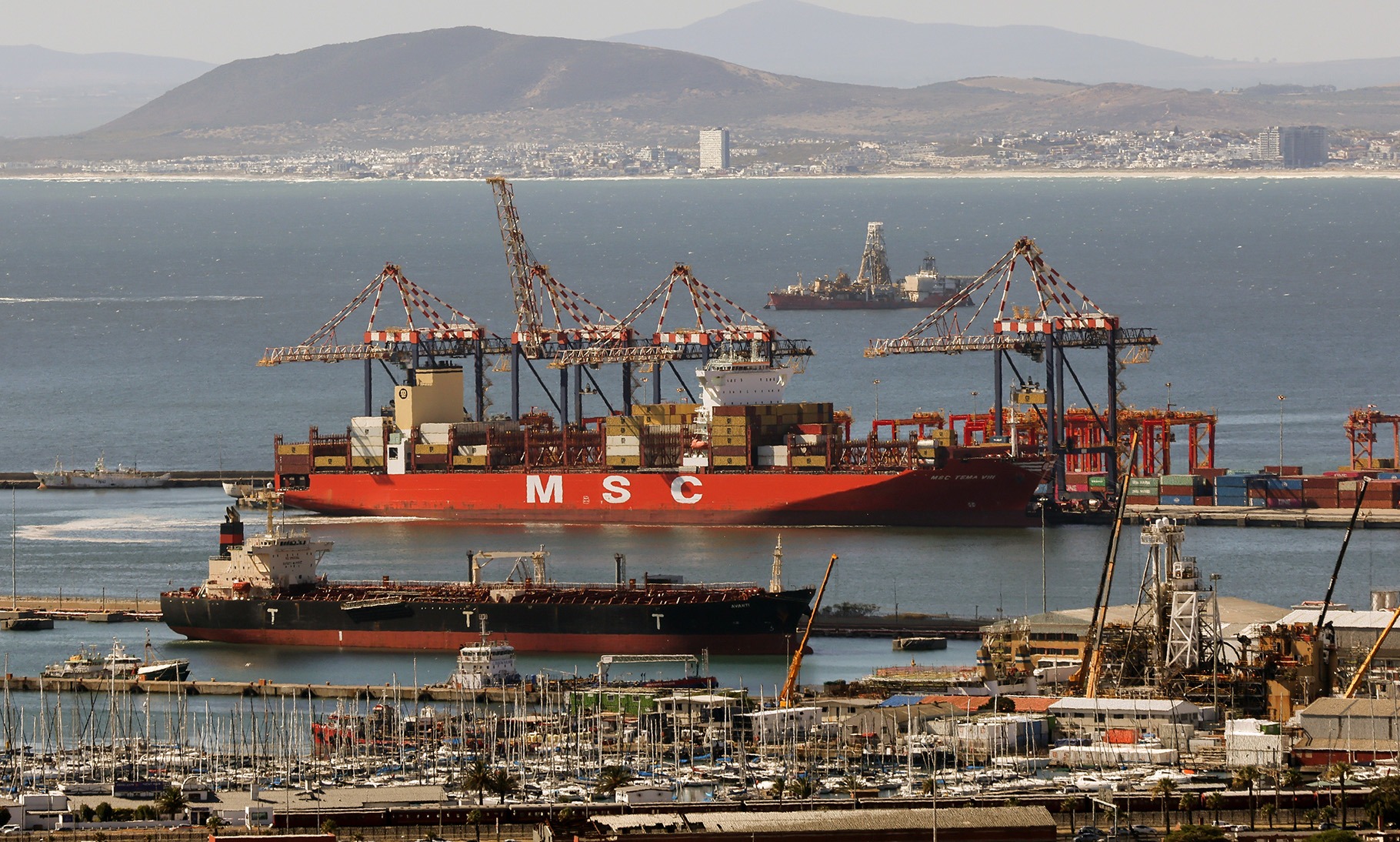
 Container ships are moored in the Port of Cape Town, South Africa, 02 March 2026. Shipping companies such as Denmark's Maersk and France's CMA CGM reported that their vessels will be rerouted to the Cape of Good Hope, near Cape Town, as the transit route through the Strait of Hormuz has been suspended due to the ongoing joint US-Israeli military operation, which began with strikes across Iran on 28 February. (Photo: EPA / HALDEN KROG)
 The Cape of Good Hope is once again the shipping world’s great hope as companies in the industry scramble to find new container routes in the wake of the escalating Middle East crisis, which has closed the Strait of Hormuz and created bottlenecks in the Suez canal.
South African retailer Shoprite this week flagged that 162 containers with goods to stock its shelves were stuck, according to Currency News, and the mounting crisis has already lit a fuse under the price of oil, a state of affairs that threatens to push domestic and global inflation higher.
“The US-Israeli strikes on Iran will have implications for energy markets, shipping costs, inflation risks and financial conditions – but everything hinges on how long the conflict lasts. While a prolonged war could bring back a 2022-style inflation shock, we continue to expect a relatively short-lived escalation,” Allianz Trade said in a report this week.
The Chartered Institute of Procurement & Supply (CIPS) warned that South African businesses “are facing an immediate supply chain shock”, noting that “war-risk insurance and freight surcharges can be imposed with little notice”.
“Rerouting around the Cape is adding 10-14 days to global shipping cycles, disrupting production schedules and seasonal demand planning, while war-risk premiums, fuel surcharges, and container rate hikes are being imposed rapidly, placing immediate pressure on cash flow,” said Paul Vos, regional managing director of CIPS Southern Africa.
/file/attachments/orphans/13797957_225027.jpg "Container ships are moored in the Port of Cape Town, South Africa, 02 March 2026. (Photo: EPA / HALDEN KROG")
What this means for local businesses
For firms exposed to suppliers in Europe or the Middle East, Vos recommends immediate mitigation steps. These include:
📋 Increase safety stock on critical Stock Keeping Units (even temporarily).
📋 Pull forward inbound orders where possible.
📋 Activate secondary suppliers in Africa or other stable regions.
📋 Renegotiate contract terms to allow for split or expedited shipments.
In addition, CIPS recommends a three-step resilience check:
✅️ No more than 30% exposure to a single high-risk corridor.
✅️ At least two viable trade lanes for critical categories.
✅️ Stress-testing the financial impact if freight doubles and lead times extend by two to three weeks.
War-risk insurance and freight surcharges can be imposed with little notice. CIPS therefore advises finance and procurement leaders to build surcharge pass-through mechanisms into contracts, shift to indexed pricing linked to freight benchmarks, pre-approve escalation bands at Exco level, review war-risk exclusions, and negotiate interim insurance riders.
Reuters reported this morning that MSC is slapping an emergency fuel surcharge on select routes from 16 March 2026. Companies with goods on the Europe-southern Africa route will pay R980 ($60) per TEU (one TEU represents the volume of a standard 20-foot-long, 8-foot-wide ISO container), for standard containers and R1,471 ($90) for reefers (refrigerated containers). The North West Continent-Canary Islands lane gets R475 (€25) per TEU standard and R666 (€35) for reefers.
This is a supply chain shock to the global economy, and as Allianz Trade noted the pain inflicted will depend on the duration of the conflict. But with the oil price at $78 a barrel – compared with about $64 a week ago – and $100 a barrel on the cards in the eyes of many market watchers, the pain is already being felt.
For SA, oil at $100 a barrel and a weakening rand will sink any hopes of another interest rate cut any time soon, and could even prompt the Reserve Bank to reverse course and start hiking again as it remains laser-focused on anchoring consumer inflation at 3.0%.
Meanwhile, potential shortages in the shops could be in the pipeline for a range of goods, as South African retailers import a lot of stuff.
The situation is hardly at a point yet where consumers need to stampede to stock up through panic buying. But then, the unfolding drama in the Middle East can evoke images of Armageddon. DM