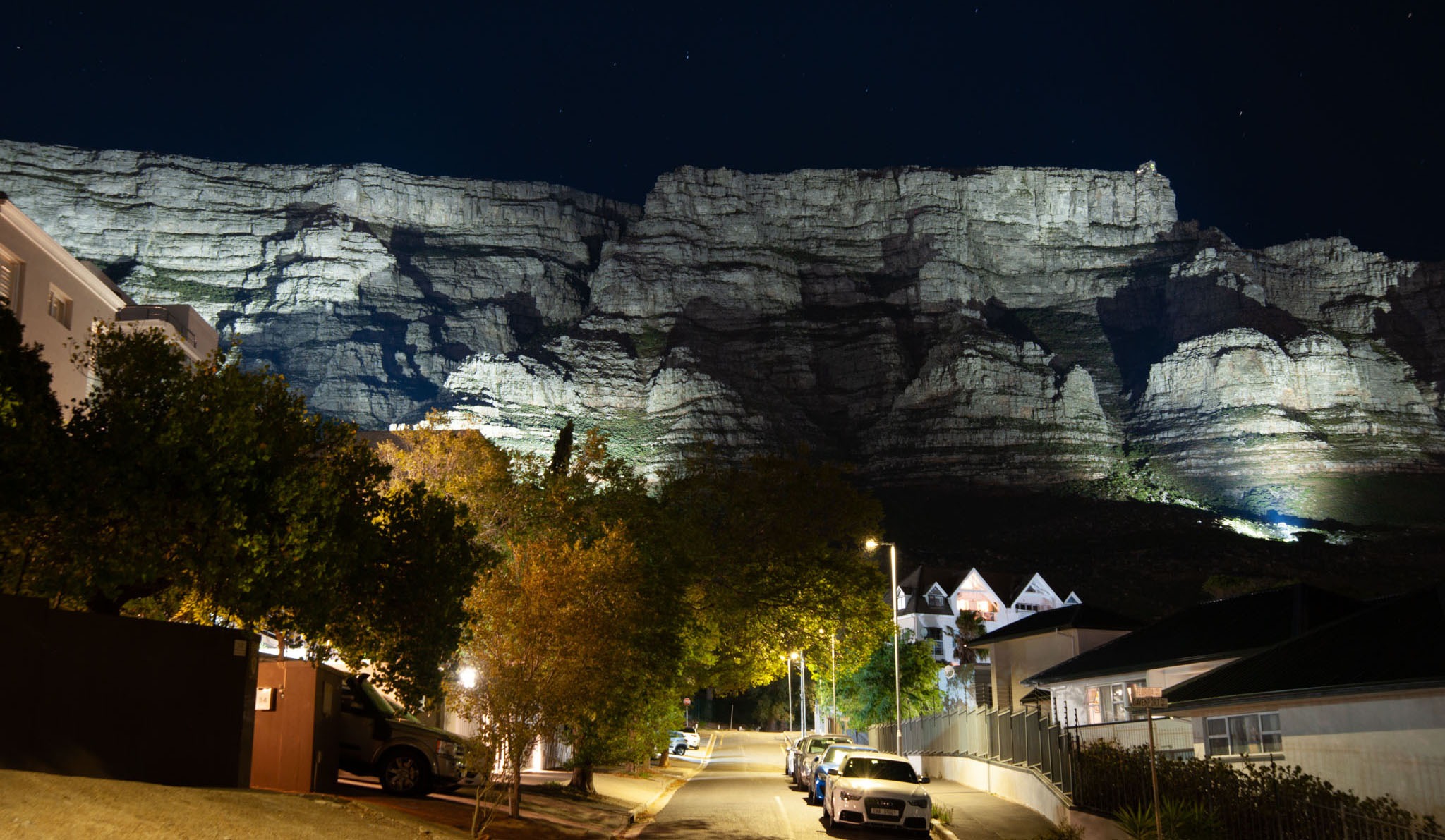
 Table Mountain has presence, especially at night. (Photo: Don Pinnock)
 Cullinan doesn’t speak about mountains in abstract legalese. He speaks about them as presences. To sit with him while he explains the idea of granting – or rather recognising – rights for a mountain is to feel the ground shift slightly beneath your assumptions.
The proposal is not sentimental, it’s not decorative environmentalism. It’s not even primarily about conservation. It is about correcting a mistake.
That mistake began when Western legal systems reduced the living world to property. Under modern law, mountains are objects. Rivers are resources. Forests are timber. They exist within a framework that assumes their main purpose is to serve human interests.
“To say that a mountain has rights immediately jars with people,” he explains. “An object is not supposed to have rights. The moment you say the mountain has rights, you’re implying something radical: the mountain is not an object. It’s a subject.”
/file/dailymaverick/wp-content/uploads/2025/06/CormacPolar-1.jpg "File photo of Cormac Cullinan with the 2025 Shackleton Medal for the Protection of the Polar Regions. (Photo: Martin Hartley)")
That shift – from object to subject – changes everything.
Cullinan is not naïve about law. He knows that legal systems have been central to legitimising environmental destruction. He’s spent decades studying and challenging the frameworks that allow extraction to masquerade as progress. But he’s also pragmatic. You have to know the right point of entry.
“Rights” language, he says, is a hook. It’s a concept deeply embedded in dominant legal systems. If you can extend rights beyond humans and corporations to include ecosystems, you create corresponding duties on humans. Duties to respect, duties not to infringe.
The real point of recognising rights of nature, he says, is not to give mountains power over humans. It’s to impose responsibilities on humans. It is about changing how humans govern other humans in relation to the Earth. It is a distinction that matters.
Cullinan is careful to explain that it’s not about humans “governing” nature differently. Nature governs itself. The mountain will continue being a mountain whether we recognise its rights or not. The shift is about how we behave.
/file/attachments/orphans/TMpersonhood_602070.jpg "Dead Man’s Tree on the slopes of Table Mountain is a memory tree for those who have loved the mountain but departed. (Photo: Don Pinnock)")
Once you begin to treat the mountain as a subject, a different question arises: How do you listen to it? Cullinan smiles slightly at that question. Nature does not speak as we do. There is no affidavit from the fynbos. No sworn testimony from sandstone cliffs. But there’s language.
“The mountain speaks in soil composition,” he says, “in water flow, in species health, in the flowering cycles of plants and the return – or absence – of insects and birds. If ecosystems deteriorate, that’s the mountain expressing distress. If water systems are polluted or slopes eroded, that is a form of communication.”
These are not mystical claims, they’re ecological realities. But Cullinan also refuses to stop there. He insists that our relationship with mountains cannot be purely intellectual.
“When you walk on a mountain, your breathing changes. Your muscles respond. Your mood shifts. You feel something that doesn’t show up on a measuring instrument. Modern culture has been trained to distrust that dimension of experience. If it cannot be quantified, it’s dismissed.”
Cullinan disagrees. He sees the current era – in which we insist on viewing mountains as inert objects – as an historical aberration and of very recent history. For most of the past – for by far the longest time of being human – we understood otherwise. Across wisdom traditions and indigenous cultures, mountains were never merely geology. They were beings. Presences. Participants in the community of life, worthy of respect in themselves.
If a mountain has rights, I ask, who represents those rights? Cullinan resists simplistic answers.
He doesn’t want the government to appoint a symbolic guardian and tick a bureaucratic box. Instead, he imagines a more careful process. Representatives who would need ecological understanding, emotional connection. They would need humility. Above all, they would need the capacity to listen.
He’s blunt about what that excludes: narcissism, ego, political grandstanding – these qualities would disqualify someone immediately. If the task is to interpret the interests of a mountain, self-absorption is a liability.
He envisions something closer to a council than a single figure – a group capable of integrating scientific knowledge, lived experience and perhaps even forms of understanding that modern systems have marginalised.
The key is not to speak for the mountain in a dominating sense, but to translate what careful attention reveals. And that requires a cultural shift as much as a legal one.
Rights of Nature movement
He describes the Rights of Nature movement as both a bridge and a Trojan horse. It uses the familiar language of rights to introduce unfamiliar ideas into mainstream law. Indigenous perspectives – in which rivers and mountains are understood as living beings – are translated into legal frameworks that Western systems can recognise.
He acknowledges the criticism. Rights language can oversimplify rich cosmologies. It can compress complex relationships into legal categories. But he’s practical. Perfect anthropological fidelity will not prevent ecological collapse. Legal evolution might.
Law, he says, is like the DNA of society. It determines how societies replicate themselves – who makes decisions, whose interests count, what is considered legitimate. If the DNA says only humans and corporations are rights-holders and everything else is property, we live that way. But if the DNA changes, society changes with it. Law is, essentially, the inscribed human story.
One of the obvious objections is whether the rights of a mountain could conflict with the rights of people. Cullinan’s answer is measured.
Human rights conflict with each other all the time. Courts adjudicate competing claims constantly. There’s nothing unmanageable about ecological rights entering that conversation. In the long term, he argues, human wellbeing and ecological wellbeing are aligned. A healthy mountain provides water, stability, resilience.
Short-term conflicts may arise. But many such tensions reflect injustices within human society rather than genuine opposition between people and ecosystems. It is easier to blame the mountain than to confront inequality.
Perhaps the most delicate question concerns awareness. Are mountains actually alive? Or is this all metaphor?
Cullinan pauses before answering. He has been influenced by indigenous perspectives over many years. He does see mountains and rivers as alive, he answers, but not in a simplistic biological sense.
“Life is not confined to organisms with metabolism and DNA. Life flows through systems. It organises temporarily into forms – a person, a tree, a river basin – then dissolves back into the whole. Soil and rock determine ecosystems. Without them, there is no life as we recognise it. Drawing a hard line between living and non-living misses the entangled nature of reality.”
And beyond theory, he says, there’s experience. Many people have stood before a mountain at dawn or dusk and felt the presence of something other than themselves. Not imaginary. Not sentimental. Real.
‘Possessed of a dimension of presence or spirit’
Cullinan does not insist that this can be proven. He simply insists that it cannot be dismissed. For him, a mountain is a being in the fullest sense physically present, ecologically alive and possessed of a dimension of presence or spirit.
When asked what keeps him hopeful, Cullinan doesn’t reach for statistics or policy wins. He returns to something simpler.
“This planet has life. That’s extraordinary. We have not found another like it. Life is rare, creative, beautiful. To contribute to its flourishing is perhaps the highest value available to us.
“Recognising the rights of a mountain is not about elevating rock over people. It is about remembering that we’re participants in a larger community of life. It’s about becoming more fully human.”
His vision is both radical and disarmingly straightforward: change the way we see, and the law will follow. Change the law and society can learn to see differently. Fifty years from now, he says, people will wonder why we needed law to understand that.
Meanwhile, the mountain will continue being a mountain. The real question is whether we’ll learn to be better neighbours. DM
The series so far:
- The flat mountain that wouldn’t behave
- What is Table Mountain? A story of Deep Time
- Hotter, drier, wilder: reinventing conservation for a changing climate
- Table Mountain’s green cloak that took 60 million years to weave
- The fluid intelligence of Table Mountain’s rivers
- What it takes to keep Table Mountain wild
- Rough sleepers: The mountain keeps us