




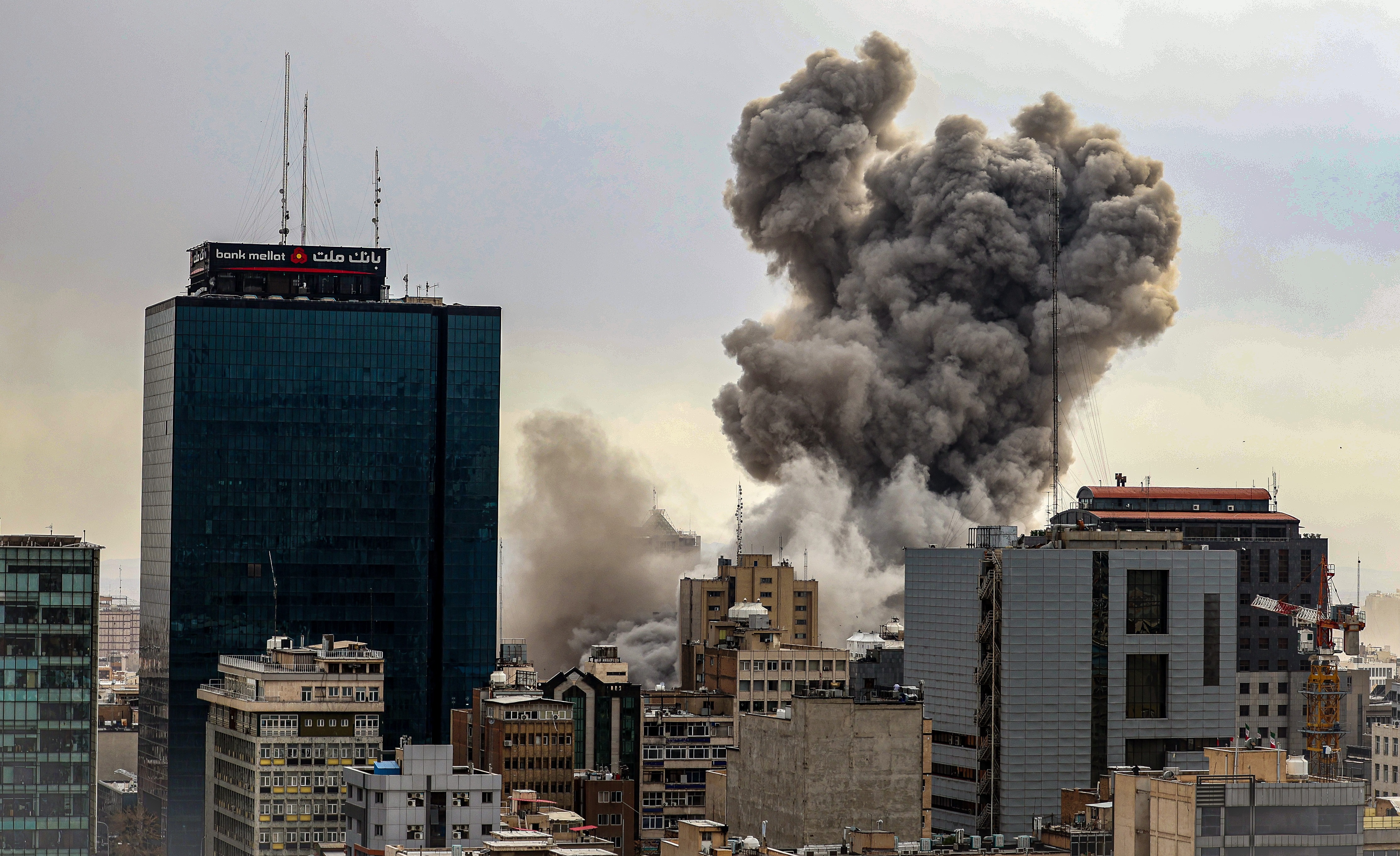
 A general view of Tehran with smoke visible in the distance after explosions were reported in the city, on March 02, 2026 in Tehran, Iran. (Photo: Contributor/Getty Images)
 South Africa has urged its citizens in the Middle East to “take immediate advantage” of the resumption of limited commercial flights out of the region amid the ongoing military action.
In a statement on Wednesday, 4 March, the Department of International Relations and Cooperation (Dirco) said it had noted a significant increase in registrations on its Travel Smart system, with more than 6,400 South African citizens in the Middle East registering their presence as of 4 March.

“South African citizens currently in the region for non-essential travel who wish to evacuate cities and countries affected by the ongoing interstate conflict in the Middle East are strongly advised to use the official channels listed below. This proactive measure is essential to prepare for an exit from the danger zones as soon as it is safe to secure passage.
“We urge all citizens to note that several airlines have resumed limited commercial flights out of the region. Citizens are strongly encouraged to take immediate advantage of this opportunity to leave, as heavy attacks are regrettably expected to continue in the coming days. Your safety is our paramount concern,” said Dirco.
Dirco director-general Zane Dangor told Daily Maverick on Tuesday that if the situation in the Middle East became any more perilous, the SA government would need to look at other means of evacuating people, suggesting road options may need to be explored.
Other countries, including the US, have also advised their citizens to leave the region now.
Official contact information for consular support:
South African emergency line (Dirco): +27 12 351 1000 (request consular services)
South African Embassy (Amman, Jordan): +962 6-461-5167
Jordan border inquiry: +962 5 393 3031
Email for coordination: ngwanyaa@dirco.gov.za or segevl@dirco.gov.za
Emergency consular support: Litha Ngwanya: +972 50-520-8100 | Email: ngwanyaa@dirco.gov.za / Lizelle Segev: +972 54-588-0698 | Email: segevl@dirco.gov.za
“South Africa takes this opportunity to reiterate its firm call on all parties to the conflict to exercise maximum restraint and to act in a manner consistent with international law, international humanitarian law and the principles of the United Nations Charter,” added the department.
US and Israeli airstrikes that killed Iran’s supreme leader, Ayatollah Ali Khamenei, on Saturday, 28 February, have heightened tensions in the Middle East after Iran retaliated, threatening regional stability and escalating military confrontations across the Gulf states.
According to the Associated Press, at least 1,045 people have been killed in the attacks on Iran. Iranian state media claim that as many as 180 girls were killed in the bombing of an elementary school, while 11 people have been killed in Iranian strikes in Israel. Lebanon’s health ministry said on Tuesday that Israeli airstrikes on Lebanon had killed at least 50 people and wounded 335 since the latest escalation began.
/file/attachments/orphans/13790438_440197.jpg "Smoke rises in central Tehran after an Israeli attack on 28 February. (Photo: Abedin Taherkenareh / EPA)")
Emirates, the region’s largest airline, had paused all flights to and from Dubai until Tuesday. Qatar Airways, based in Doha, and Etihad Airways, based in Abu Dhabi, had also suspended flights until the regional airspace is safely reopened.
More than 4,000 flights a day were cancelled across the region, according to the flight tracking platform FlightAware.
Emirates had since resumed limited flights from Dubai International Airport on Wednesday, according to a report from the BBC. Etihad Airways had also resumed limited operations. Most Emirates flights are to Europe, the US and India, and the airline has not yet resumed flights to South Africa.
Conflict to continue
Yasmine Farouk, Middle East specialist at the International Crisis Group (ICG), said at a seminar on Tuesday that Al Jazeera had calculated that up to then, Iran had launched 1,732 projectiles at neighbouring Gulf states, mostly the United Arab Emirates (UAE).
She said the Gulf states had been confident or even over-confident that Iran would not attack them because of their recent concerted diplomatic efforts to try to avoid that.
She noted that Iran had warned the states of possible reprisals if it were attacked by the US and Israel, but their scale and speed, and the targeting of civilian infrastructure, had still surprised them.
Farouk said she did not think the Gulf states would retaliate militarily to Iran’s attacks for fear of looking as though they were in a coalition with the US and Israel. “Although all options are on the table,” she added.
Read more: ANC’s long friendship with Iran has come at a cost
/file/attachments/orphans/RC2LVJAWE7DB_783146.jpg "Stranded passengers wait near the Emirates Airways customer service office at I Gusti Ngurah Rai International Airport in Bali, Indonesia, on 1 March after flights to Doha, Dubai and Abu Dhabi were cancelled following the US-Israeli strikes on Iran. (Photo: Johannes Christo / Reuters)")
The US Senate was set to vote on Wednesday on a Democratic-backed war powers resolution that would prevent US President Donald Trump from continuing the conflict against Iran, according to a report in The Guardian. This is after Trump said the war would continue for weeks, stating, “We projected four to five weeks, but we have capability to go far longer than that.”
ICG Iran specialist Naysan Rafati said he did not think the Iranian leadership was looking for an off-ramp from the war because it felt it had taken off-ramps from previous conflicts — like the US and Israeli attacks last June — without benefit.
He believed that Iran was focusing its retaliation on the Gulf states rather than Israel because they were closer and because Israel had the advantage of only having to defend itself on one front.
Rafati said Iran hoped to put pressure on Trump. He speculated that Tehran might be hoping to hit one big target with catastrophic results, to force the US to react. He cited the example of the massive bombings of US and French military barracks in Beirut on 23 October 1983, in which 241 US and 58 French military personnel, six civilians and two of the attackers died.
Rafati noted that the attack had persuaded former President Ronald Reagan to withdraw US forces from Beirut.
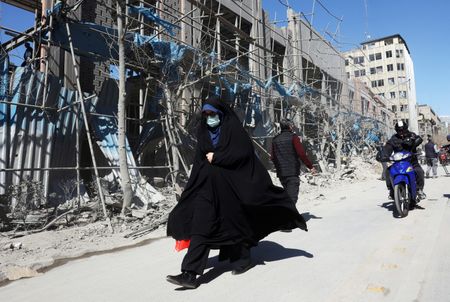
/file/attachments/2989/1213799348_395951.jpg "An Iranian woman walks past a damaged building after an airstrike in central Tehran on 3 March. (Photo: Abedin Taherkenareh / EPA)")
Meanwhile, ICG US expert Michael Hanna said Trump could face rising pressure from the Gulf states to end the war. The US president was also facing rising global pressure because of the negative impact of the war on equities and on the oil price.
He said Trump was also facing domestic political pressure, with polls showing 59% of Americans were immediately opposed to the war. He suggested that the non-interventionist faction in Trump’s Maga base could rally against the war if it dragged on. DM