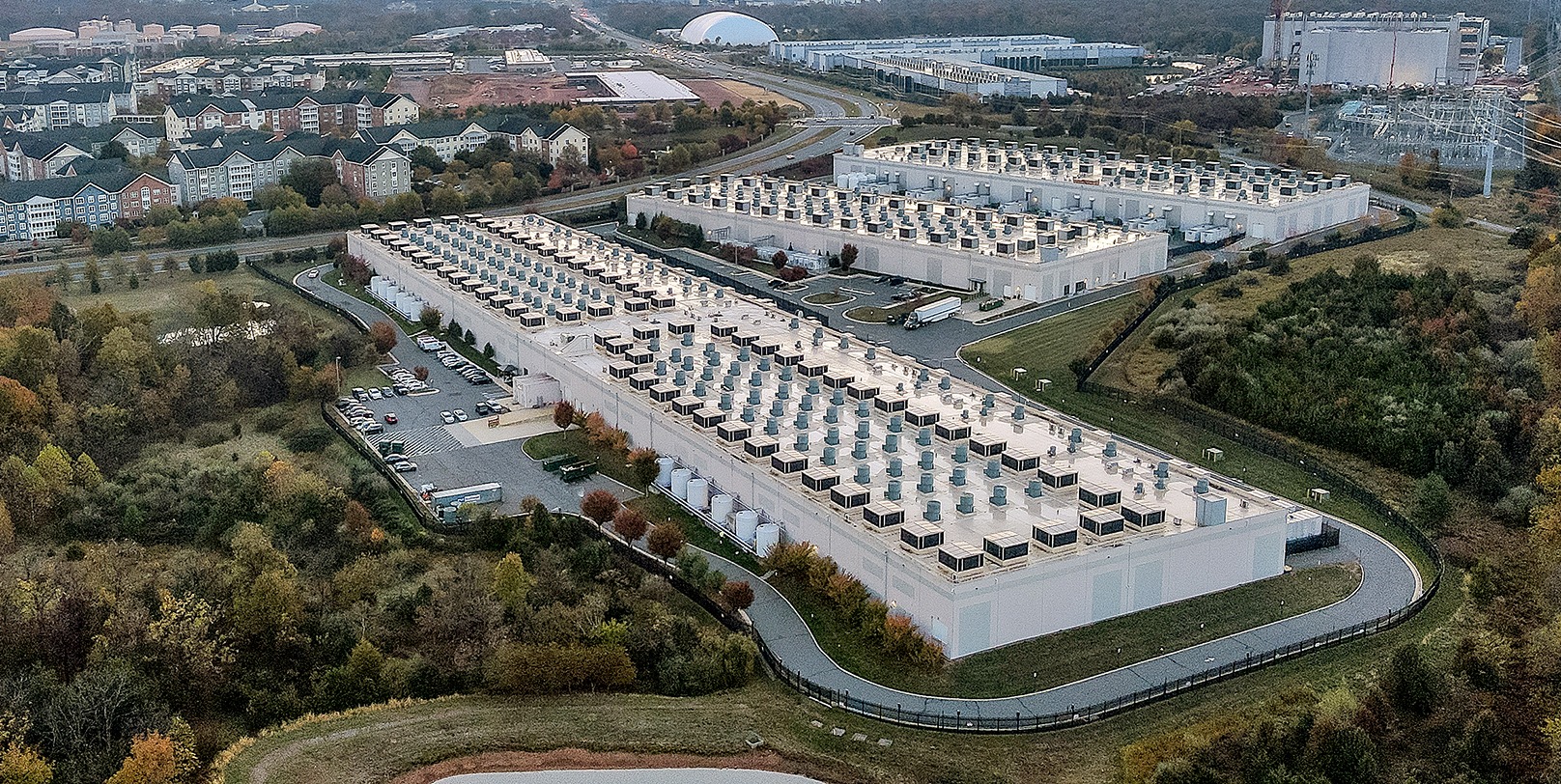
 An Amazon data centre in Virginia, US, one of the growing number of global centres consuming ever-larger amounts of electricity and water. (Photo: Lexi Critchett / Bloomberg via Getty Images)
 Brushing aside concerns by Democratic Alliance councillors, the eThekwini Municipality has voted to sign a legally binding memorandum of agreement with a South Korean power consortium to develop a new AI data centre south of the city.
According to an official report to the city’s economic development and planning committee, the new centre will cost anywhere between $3-billion and $10-billion in a public-private venture. The city would provide land and infrastructure, and the South Korean company would pay for the buildings and all other operational costs.
The proposed 5ha development site is at the mouth of the Lovu River, close to the Amanzimtoti Cable Landing Station. This station is linked to the 45,000km-long 2Africa submarine cable system, which encircles Africa and links the continent to Europe, the Middle East and India.
/file/attachments/orphans/tonydurbanmonster2LovuRiverdatacentrelocatormapSupplied_306366.jpg "eThekwini council documents indicate that the new data centre is earmarked for the mouth of the Lovu River near Amanzimtoti. (Source: Adapted from eThekwini Municipality briefing document)")
The city report acknowledges that AI data centres are “resource-intensive”, but does not explicitly state how much electricity and cooling water the new data centre would consume in relation to other customers, nor provide details on the exact source or price of the electricity and water needed.
But last year, during a Daily Maverick investigation, the city confirmed that current demand from all municipal customers in eThekwini is around 1,600MW.
Buried in the city’s seven-page report are two clear references to a data centre capacity of 400MW — suggesting that a new facility of this size would consume the equivalent of one-quarter of the city’s current electricity supplies.
eThekwini has pointedly refused to answer Daily Maverick’s written questions on the power requirements of the new centre and where the electricity would come from.
Instead, the City issued a general press release to all media houses stating: “Any figures currently circulating publicly, including specific megawatt estimates, should not be regarded as confirmed project specifications”. (See eThekwini’s response further below.)
/file/attachments/orphans/tonydurbanmonster6Ethekwini400MWdatacentresourceEthekwiniMunicipality_610225.jpg "Screenshot showing the 400MW figure in eThekwini briefing docs.")
At 400MW, this would make it the largest data centre in South Africa, dwarfing Teraco’s 70MW Isando data campus in Johannesburg (currently the largest in the country). Late last year, the Cavaleros Group said it was planning to build a 360MW data campus in Cape Town and a 200MW centre near Pretoria.
eThekwini’s briefing document makes a brief reference to supplying electricity to the new Durban data centre from “existing renewable energy resources in possession of the proposed development partner”.
However, neither eThekwini nor the Korean companies have provided details of where this renewable power is located. And, if this power were to come from wind or solar schemes, there is no explanation of how nighttime and low-wind supply fluctuations would affect data centre operations that depend on consistent 24/7 power supplies.
This raises questions about how much power would need to be supplied directly from the city’s existing power network.
Call for full transparency
Andre Beetge, a senior DA councillor, raised several questions about the Korean project when the issue came up for preliminary approval by the council last week. Beetge said his party would abstain from supporting it until there was “full transparency, detailed feasibility disclosure, environmental assessment, infrastructure impact analysis and proper public consultation”.
/file/attachments/orphans/tonydurbanmonster4mapof2africasubmarinecablesource2africacablenet_211630.jpg "A map of the 45,000km long 2Africa submarine cable, which has three cable landing points in South Africa. (Source: 2africacable.net)")
The DA did not oppose progress, investment or technology, he said, but it could not support signing a memorandum of agreement with the Koreans when the full energy and water impacts remained undefined; the environmental implications were unclear; local economic participation was not guaranteed, and public participation had not yet taken place.
“At first glance, the proposal sounds almost too good to be true,” said Beetge, noting that the project promised capital investment of between $3-billion and $10-billion, along with up to 5,000 temporary construction jobs, up to 500 permanent jobs and a new “global technology footprint for eThekwini”.
However, there were still too many unanswered questions at a time when Durban was already battling an unstable electricity supply and significant council water losses exceeding 50%.
Beetge also noted that countries in the European Union and elsewhere were adopting stricter energy-efficiency regulations to protect national resources in the light of the global AI infrastructure expansion.
/file/attachments/orphans/tonydurbanmonster5interiorofadatacentreSourceSwitch_764378.jpg "The interior of a typical data centre. (Source: Switch)")
“Why is there no similar regulatory framework referenced in this proposal? One is left to question whether Africa is again being viewed as a jurisdiction with comparatively less stringent regulatory oversight — a convenient destination for energy-intensive infrastructure that may face stricter scrutiny elsewhere.”
Bold claims
Nevertheless, the eThekwini briefing document suggests the new centre would be operational in the 2027/2028 financial year and was poised to “enhance municipal service analytics and planning capabilities”.
It also makes bold claims about reducing the municipality’s “reliance on foreign technology”, speeding up the detection of water leaks, sewerage pipe bursts and electricity theft, while “driving efficient municipal delivery”.
“This will enable the municipality to predict infrastructure failures before they occur and reduce service interruptions, which lowers emergency repair costs, resulting in faster response times leading to customer satisfaction.”
The only reference to cooling water supply is a single line stating, “The proximity of Umsimbazi River presents an opportunity for alternative water supply.”
However, eThekwini’s briefing map depicts the project site on the Lovu River, not the Umsimbazi River, which lies about 2km further south.
Apart from the municipality’s apparent confusion about the site location, the reference to “alternative” water supply suggests that eThekwini will be the primary supplier of large volumes of potable water to cool the data centre.
Data centres in several parts of the world use large volumes of water. The US-based Environmental and Energy Study Institute suggests that some of the larger data centres can consume up to 19 million litres per day, equivalent to the water use of a town of 10,000 to 50,000 people.
Water drawn from the estuary mouths of either the Lovu or Umsimbazi is also likely to have a high salinity content, which appears to make these sources unsuitable due to the high risk of corroding cooling systems.
We sent questions to eThekwini on Monday, requesting clarity on several issues.
eThekwini responds
In its response (also circulated to other media just as Daily Maverick was about to publish), the city confirmed that it had approved a resolution authorising eThekwini to enter into a memorandum of agreement (MOA) with a Korean power consortium to “explore the potential development of an AI Data Centre in the south of Durban.
“The MOA creates a structured framework for engagement between the Municipality and the prospective investor to assess the feasibility of the proposal. Such agreements are standard practice at the early stages of large-scale projects, enabling information exchange and preliminary assessments.”
It said the city’s initial reference to the “Korea South Power Consortium” referred to “a collective of Korean energy and technology entities that have expressed interest in exploring the proposed investment”.
/file/attachments/orphans/tonydurbanmonster3KospowebsitetitlepagesourceKOSPO_949563.jpg "The Korea Southern Power Company (Kospo) is believed to be part of the Korean-based consortium driving the proposal. The company did not respond to our requests for comment. (Source: Kospo)")
“The specific companies that may formally participate in future agreements have not yet been finalised.”
On how much power it would consume, eThekwini said: “No final decisions have been made regarding the electricity requirements of the proposed facility or how electricity may be supplied. Any figures currently circulating publicly, including specific megawatt estimates, should not be regarded as confirmed project specifications.”
On whether eThekwini would provide any special incentives, including cut-rate power tariffs or rate rebates, the city said: “Council’s approval to enter the MOA does not include approval for any Municipal infrastructure commitments, subsidies, incentives, or financial contributions.
“Should such matters arise at a later stage, they would undergo separate processes in line with Municipal governance requirements and applicable legislation.”
The City was likewise vague on water requirements, stating that water demand, sourcing, and associated infrastructure needs had not yet been determined.
“These matters fall within the scope of technical, environmental, and feasibility assessments that would take place should the engagement progress.”
Will there be a full environmental impact assessment process and public participation?
“Should the engagement progress beyond the exploratory phase, all proposed development activities would be subject to the full suite of legislative and regulatory requirements, including environmental authorisations and water use approvals where applicable.”
Is there a BEE component to the proposed development?
“Considerations relating to empowerment, local participation, and wider socio-economic benefits have not yet been defined. These elements typically form part of detailed project structuring during later stages, should the project advance.”
eThekwini further stated: “It is important to emphasise and clarify that Council’s approval is strictly limited to entering into an MOA for exploratory and feasibility purposes.
“This approval does not constitute: approval of the project itself; approval of infrastructure commitments; approval of financial contributions; confirmation of technical specifications or approval of regulatory or statutory authorisations. Any future steps will be informed by feasibility outcomes and will follow all required statutory processes.” DM