




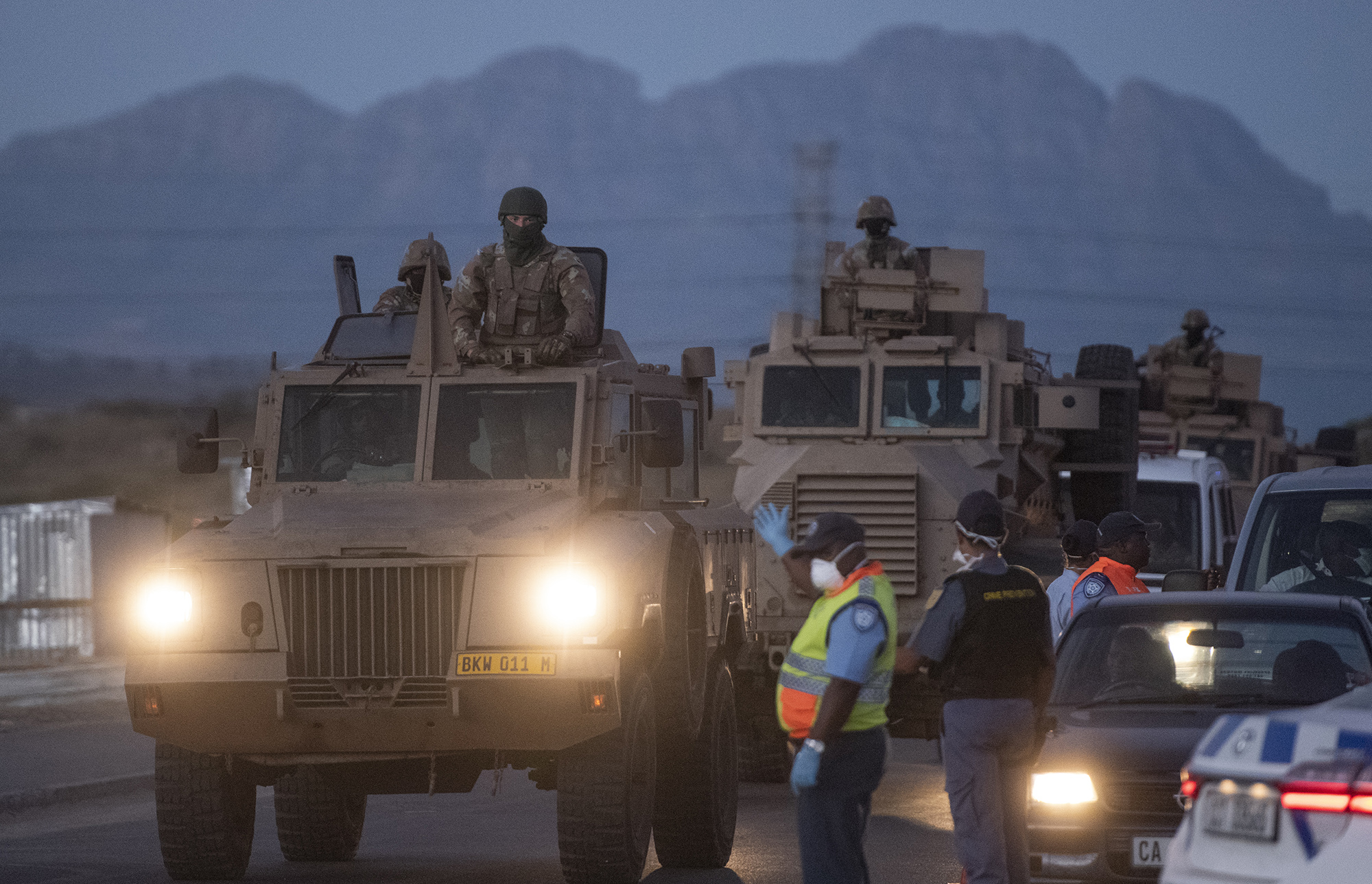
 The South African Army during a police ministry and SAPS visit to determine adherence to Covid-19 restrictions during the lockdown in March 2020 in Cape Town. (Photo: Gallo Images/Brenton Geach)
 “It’s personally shameful” that the police have admitted that they have failed so badly that they need the help of the country’s military to help fight crime within South Africa’s borders.
Those were the words of Democratic Alliance MP Dianne Kohler Barnard on Wednesday, 4 March 2026, in Parliament, as the police oversight committee was briefed on the deployment of the South African National Defence Force (SANDF).
During his State of the Nation Address in February, President Cyril Ramaphosa announced the deployment of the SANDF to help the police fight crime: gang violence in the Western Cape and illegal mining in Gauteng.
After an outcry from residents of Gqeberha’s northern areas, Acting Police Minister Firoz Cachalia announced that the deployment had been extended to the Eastern Cape.
According to a presentation on Wednesday, hotspot areas where the SANDF will be deployed include gang-affected communities on the Cape Flats (Western Cape) and Gqeberha’s northern areas (Eastern Cape).
The other focus is illegal mining, where troops will also be deployed in Gauteng (Johannesburg, Ekurhuleni, West Rand districts), North West (Klerksdorp, Orkney, Stilfontein, Hartbeesfontein and Dr Ruth Mompati District) and Free State (Goldfields area).
As Daily Maverick’s John Stupart has written, military intervention to fight crime has not worked in the past and is likely only to hasten the decline of SA’s armed services. The last deployment took place in 2018 in the Western Cape to assist with gang violence.
SAPS failures laid bare
Now, as preparations are under way for the deployment, MPs have said outright that the deployment of the country’s army to help fight crime is an indictment of the South African Police Service (SAPS)’s failure to do so.
Leigh-Anne Mathys from the Economic Freedom Fighters said: “It’s a sad moment for us that we have succumbed to the fact that the SAPS has failed and the fact that we have to bring in the SANDF. It’s not a day that we should be celebrating, but nonetheless, we are positive that there has been some action taken in curbing the out-of-control crime in our country.”
She continued: “We should be ashamed and we should be heartbroken that we have to send the SANDF to assist with something that the SAPS is more than capable of doing.”
Kenneth Meshoe, from the African Christian Democratic Party, questioned if the SAPS had briefed the SANDF on the challenges and expectations “so that where the police were failing, they will not fail again. I think we need to be open and the police need to be open [and say], ‘This is where we are failing.’”
Kohler Barnard said: “My opinion has never changed. For a democracy such as ours to reveal to the world, many of whom overseas are watching us most carefully in terms of investing or not in our country, for us to seemingly admit that our SAPS, despite their massive budget, are outmanned, outgunned and often outsmarted by the criminals running rampant here, is to me personally shameful.”
The veteran politician, who sits on the intelligence oversight committee and the ad hoc committee meant to unpack the allegations of capture within the policing system, said: “Now the world is watching once again as we see the SANDF deployed within our borders because our SAPS virtually lost the war – the optics are horrific.”
/file/dailymaverick/wp-content/uploads/Sune-CapeFlats-armyTW-option-2.jpg "South African National Defence Force soldiers secure a perimeter during a crime operation in Ottery, Cape Town, South Africa, on 22 May 2015. (Photo: EPA / Nic Bothma)")
One-year deployment
In response, National Police Commissioner Fannie Masemola said: “We are not failing. We are going to work with the SANDF. We’re going to work together; if we were failing, we would have been saying we will sit back as if they have to go and do the job alone.”
He added: “They are complementing us [on our work].”
The SANDF, he said, had certain limited powers. They would be able to perform arrests and then hand individuals over to the police; they would also “immediately” hand over any confiscated exhibits to the police.
/file/dailymaverick/wp-content/uploads/2025/11/ED_579179.jpg "National Police Commissioner Fannie Masemola. (Photo: Gallo Images / Brenton Geach)")
According to Major-General Mark Hankel, the project coordinator for the deployment and acting inspectorate divisional commissioner, the deployment started on 1 March 2026 and would conclude on 31 March 2027. Effectively, the operation would run to the “end of the next financial year”, he said.
The SANDF has not yet been sent into affected areas and troops were undergoing training as part of the deployment process, said Hankel.
Writing in Daily Maverick, Marianne Merten explained the process for army deployment: The president writes to the leaders of the legislative sphere, Parliament’s presiding officers.
Then the Speaker of the National Assembly and the chairperson of the National Council of Provinces then formally refer such communication to the defence committee, and the presidential letters are published in the Announcements, Tablings and Committee Reports (ATC), or the record of Parliament’s work.
Then the Joint Standing Committee on Defence meets to discuss and deliberate on the deployment authorisation to consider whether or not to support it. The committee’s decision goes to the Houses for approval.
This has not yet happened.
‘SANDF not a magic bullet’
In response to some of the MPs, Cachalia told the committee: “There are challenges that the SAPS needs to address and there are capacity issues that have long plagued policing in the country, concerning, for instance, detective services, crime intelligence, and so forth.
“The questions we now face are what we are gonna do about them and the reform agenda, the reset agenda, and that is recognised by the leadership of the SAPS,” he said. “So the deployment of the SANDF is not being presented as a panacea, as a magic bullet.”
/file/attachments/orphans/WhatsAppImage2026-02-17at210540_104221.jpeg "Acting Minister of Police Firoz Cachalia at the State of the Nation Address debate on 17 February 2026. (Photo: Phando Jikelo / RSA Parliament)")
The deployment as a stabilisation strategy, he argued, was “to create space for the implementation of an organised crime strategy”. This, according to the acting minister, “was adopted by the Cabinet about a month ago – it’s in the process of being implemented”.
In February, national third-quarter crime statistics, covering October to December 2025, showed a decrease in major crimes like murder and sexual offences. Year-on-year murder figures for October to December 2025 decreased by 8.7%, while sexual offences dropped by 2.8%. On the other hand, attempted murders and commercial crimes were up by 2.5% and 2%, respectively.
Cachalia said it was still too high.
On Friday, there will be another parliamentary meeting to discuss the deployment: this time by the defence committee, which will unpack the SANDF’s readiness for the deployment. DM